



Key Takeaways
- Trending products need more than demand. A strong BFCM product also needs reliable sourcing, manageable shipping costs, and sufficient fulfillment capacity.
- Beauty, home, accessories, and consumer electronics remain key categories. Product margins, shipping characteristics, and return risk should be evaluated together.
- Inventory planning matters before BFCM. Fast-moving SKUs need earlier purchasing and clearer replenishment thresholds.
- QC becomes more important at peak volume. A small defect rate can create a large number of returns when order volume spikes.
- Fulfillment strategy should follow the SKU lifecycle. Testing, validation, scaling, and mature products require different inventory and fulfillment models.
Quick Answer: What Products Are Worth Selling During BFCM 2026?
The strongest BFCM products typically combine consumer demand, healthy margins, reliable supply, and manageable fulfillment requirements.
Instead of choosing products based only on trend data, sellers should evaluate four factors:
- Demand: Is the product likely to attract seasonal or promotional demand?
- Supply: Can suppliers maintain quality and production capacity during peak season?
- Economics: Can the product absorb shipping, fulfillment, advertising, and return costs?
- Fulfillment: Can inventory be positioned and shipped fast enough to meet customer expectations?
For new products, flexible China fulfillment can reduce inventory risk. Proven winners may benefit from regional inventory and dedicated fulfillment workflows before order volume peaks.
What Makes a Product BFCM-Ready?
BFCM demand can increase quickly, but not every trending product is operationally suitable for a peak-season campaign.
From our experience working across sourcing, QC, warehousing, and cross-border fulfillment, the products that look strongest on a trend report are not always the easiest to scale operationally.
A product becomes more attractive when it combines demand with predictable supply and fulfillment requirements.
| Product Factor |
What to Look For | BFCM Advantage |
|---|---|---|
| Demand | Strong search, social, or repeat-purchase interest | Higher promotional potential |
| Margin | Enough room for discounts and fulfillment costs | More pricing flexibility |
| Supply | Stable factory capacity or multiple suppliers | Lower stockout risk |
| Shipping | Compact, lightweight, non-fragile | Lower logistics cost |
| Returns | Low defect and return complexity | Easier peak-season operations |
| Fulfillment | Easy to pick, pack, and ship | Higher processing efficiency |
What We See in Practice
A recurring issue during peak season is that brands evaluate product demand first and operational feasibility second.
A product may generate strong sales but become difficult to scale because of:
- unstable supplier quality;
- long production lead times;
- complicated packaging;
- high volumetric weight;
- frequent functional defects;
- or limited warehouse processing capacity.
That is why BFCM product selection should involve sourcing and fulfillment teams early—not only the marketing team.
BFCM 2026 Trending Product Categories
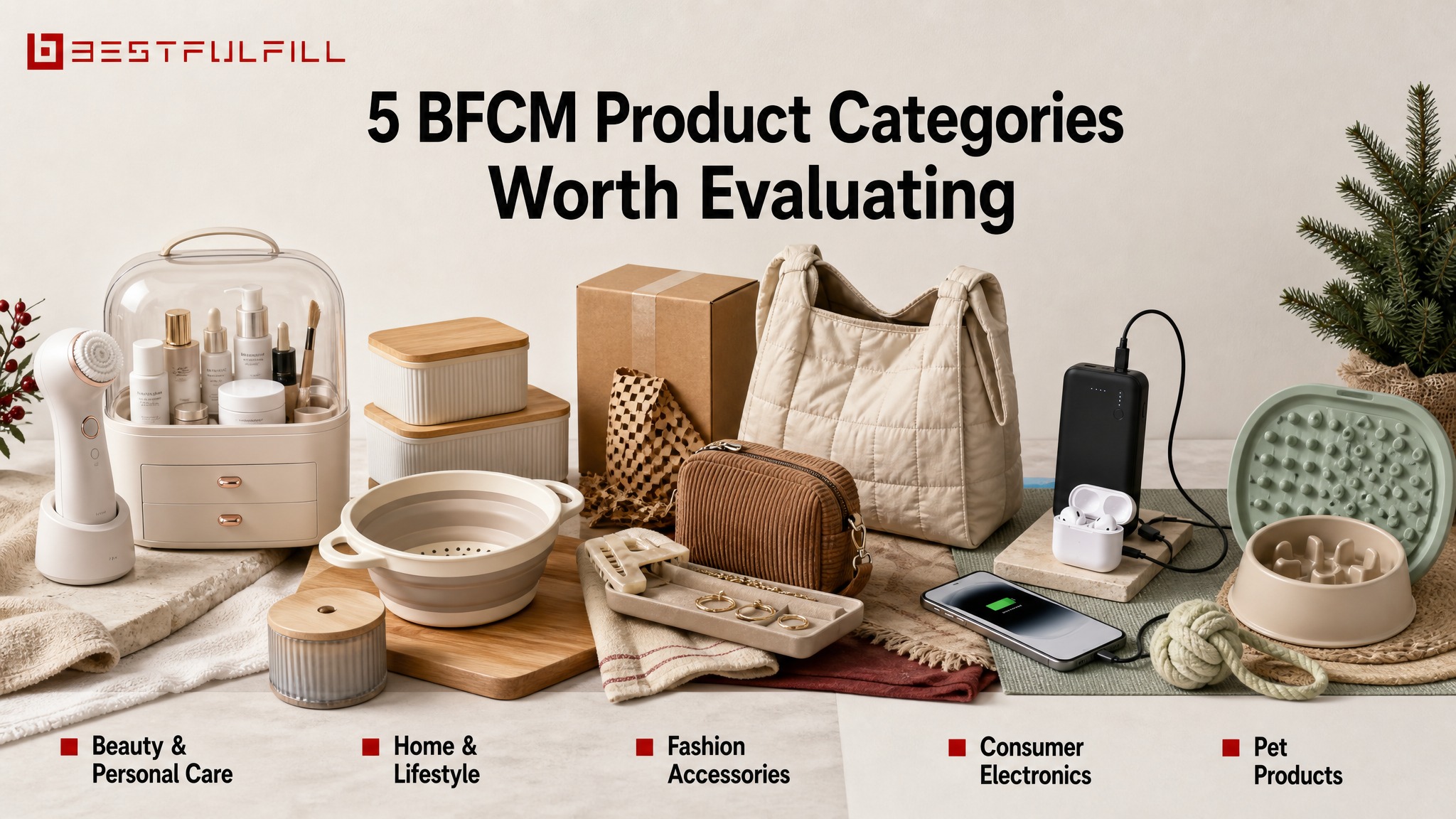
The following categories are worth evaluating for BFCM campaigns based on their combination of consumer appeal, gifting potential, shipping characteristics, and sourcing flexibility.
| Category | Product Examples | Opportunity | Main Risk |
|---|---|---|---|
| Beauty & Personal Care |
Beauty tools, organizers, accessories |
Giftable and visually marketable | Compliance and product claims |
| Home & Lifestyle |
Storage products, kitchen tools, decor |
Broad consumer demand | Bulky SKUs can increase freight costs |
| Fashion Accessories |
Bags, jewelry, seasonal accessories |
Lightweight and easy to bundle | Trend volatility and quality variation |
| Consumer Electronics |
Small gadgets, accessories, smart devices |
Strong promotional appeal | QC, batteries, compliance |
| Pet Products | Pet accessories, grooming tools, toys |
High engagement and repeat demand | Product safety and material quality |
Beauty & Personal Care
Beauty products can perform well during BFCM because many items are naturally suited to gifting and promotional bundles.
Examples include:
- Beauty tools
- Cosmetic organizers
- Hair accessories
- Skincare accessories
- Personal-care devices
The main consideration is compliance. Products involving cosmetics, electrical components, or specific consumer claims may require additional documentation and regulatory review.
For fulfillment, lightweight products with standardized packaging are generally easier to scale.
Home & Lifestyle
Home products benefit from broad consumer demand and strong gifting potential.
Examples include:
- Kitchen accessories
- Storage solutions
- Home organization products
- Small décor
- Lifestyle accessories
The challenge is product size. A product that looks inexpensive at the factory can become less attractive after volumetric shipping costs are included.
Fashion Accessories
Accessories can be attractive BFCM products because they are generally lightweight and easy to bundle.
Potential products include:
- Bags
- Jewelry
- Hair accessories
- Seasonal accessories
- Small fashion items
The main operational challenge is consistency. Color, material, sizing, and finish need to remain stable as order volume increases.
Consumer Electronics
Small electronics and accessories can generate strong promotional interest, but they require greater operational control.
Key considerations include:
- Functional testing
- Battery requirements
- Product certification
- Packaging
- Defect rates
For higher-value electronics, pre-shipment inspection becomes particularly valuable before large quantities are dispatched.
Pet Products
Pet products continue to attract strong ecommerce engagement and can work well for both gifting and impulse purchases.
Potential products include:
- Grooming tools
- Pet accessories
- Interactive toys
- Travel products
- Feeding accessories
Product safety and material quality should be checked carefully before scaling.
Product Trend vs. Supply-Chain Readiness
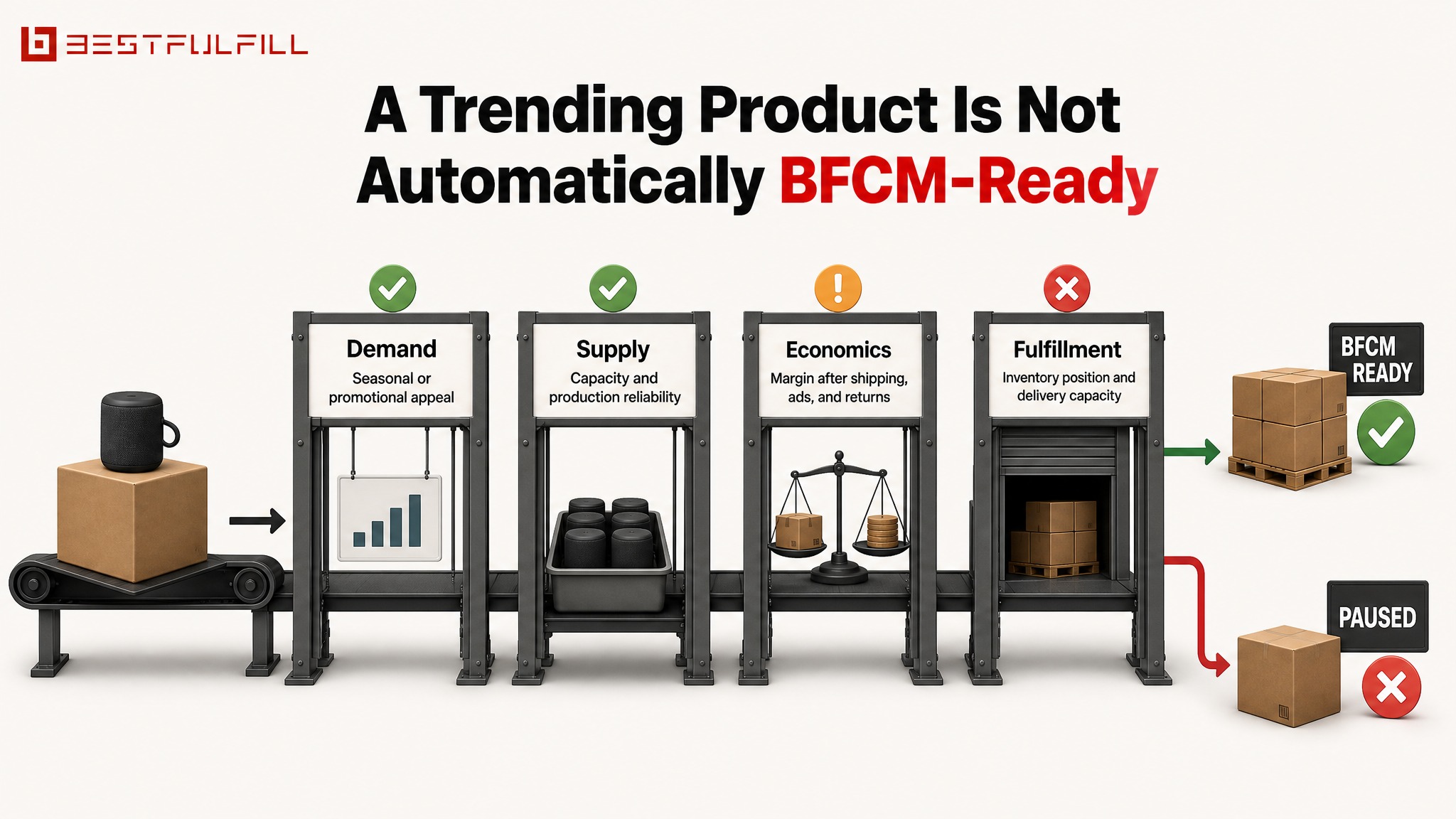
A product can be trending and still be a poor BFCM choice.
For example, a bulky product with a low selling price may generate strong social engagement but produce weak margins after shipping. Similarly, an electronic product with a high return rate can create significant customer-service costs during peak season.
| Product Type | Demand Potential | Sourcing Difficulty | Fulfillment Difficulty | BFCM Potential |
|---|---|---|---|---|
| Small accessories |
High | Low | Low | High |
| Beauty tools | High | Medium | Low | High |
| Home products | Medium-High | Medium | Medium-High | Medium-High |
| Small electronics |
High | High | High | High |
| Pet accessories | Medium-High | Medium | Low-Medium | High |
A Fulfillment Perspective
In our experience, shipping characteristics can change the economics of a winning product very quickly.
Before scaling a BFCM SKU, we typically recommend reviewing:
- Product dimensions and actual shipping weight
- Packaging size
- Defect and return patterns
- Supplier production capacity
- Destination-market demand
- Available warehouse capacity
This helps brands avoid a common peak-season problem: a product sells faster than the supply chain can support it.
How to Prepare Inventory for BFCM
The biggest operational mistake is waiting until demand becomes obvious before preparing inventory.
Peak-season planning should start with historical sales, current product performance, supplier lead times, and expected promotional uplift.
A basic planning framework includes:
Forecast demand → Confirm supplier capacity → Set safety stock → Position inventory → Monitor sell-through
For proven products, brands can increase inventory before the campaign. For untested products, a smaller initial stock position can reduce the risk of excess inventory after the promotion.
Four Inventory Questions to Ask
- How quickly can the supplier replenish?
Long production lead times require earlier purchasing decisions.
- How much safety stock is needed?
Fast-moving SKUs generally require more buffer than long-tail products.
- Where should inventory be stored?
China fulfillment provides flexibility, while regional inventory can improve delivery speed.
- What happens if demand exceeds the forecast?
A backup supplier, alternative shipping route, or secondary fulfillment location can reduce disruption.
BFCM Fulfillment Strategy by SKU Lifecycle
Not every SKU should use the same fulfillment model.
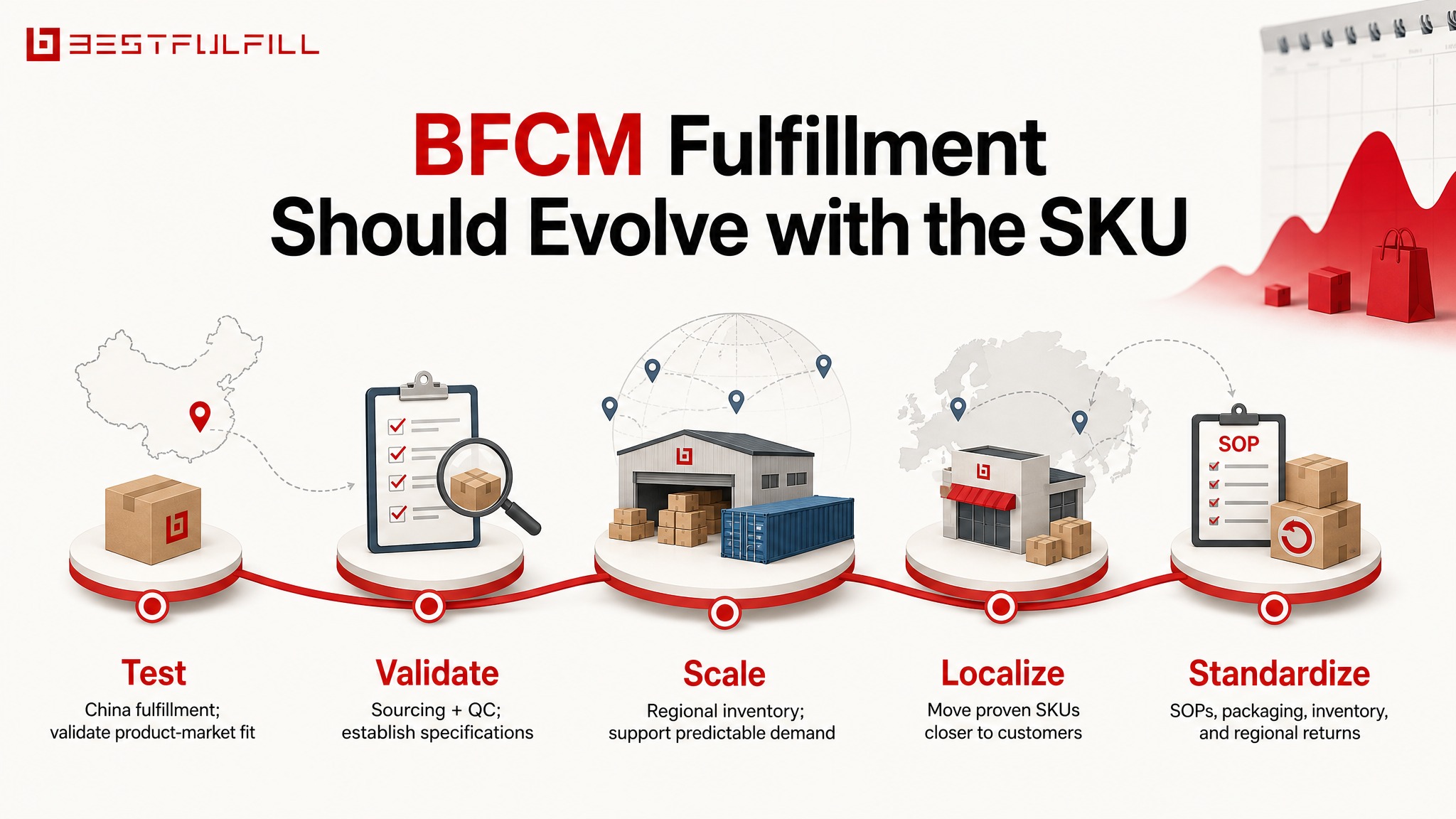
The appropriate strategy changes as a product moves from testing to validation, scaling, and maturity.
| SKU Stage | Main Goal | Recommended Fulfillment |
|---|---|---|
| Testing | Validate demand | Flexible China fulfillment |
| Validation | Improve reliability | QC + sourcing optimization |
| Scaling | Balance speed and cost | Regional inventory |
| Mature | Standardize operations | Multi-market fulfillment + SOPs |
Testing Stage
At this stage, the priority is flexibility rather than maximum delivery speed.
China-based fulfillment can help brands test:
- Product-market fit
- Pricing
- Creative performance
- Geographic demand
Holding large amounts of inventory before demand is validated creates unnecessary risk.
Validation Stage
Once a product starts generating consistent orders, quality and supplier reliability become more important.
This is the right time to establish:
- Product specifications
- QC standards
- Packaging requirements
- Supplier communication procedures
- Replenishment rules
Scaling Stage
When order volume becomes predictable, regional inventory can improve delivery speed and reduce pressure on cross-border parcel networks.
For example, proven US demand may justify US inventory, while stable European demand can support EU stock.
Mature Stage
Mature products require repeatable processes rather than ad hoc fulfillment.
Brands may need:
- Standardized SOPs
- Multi-market inventory
- Regional returns
- Automated order processing
- Replenishment management
At this stage, fulfillment becomes part of the brand's operating infrastructure.
How to Reduce BFCM Fulfillment Risks
Peak season amplifies small operational problems.
A 2% defect rate may appear manageable during normal sales. At 10,000 orders, however, the same rate can translate into hundreds of customer issues.
| Risk | Potential Impact | Recommended Action |
|---|---|---|
| Supplier delays | Stockouts | Confirm production capacity early |
| Product defects | Returns and refunds | Pre-shipment QC |
| Inventory shortage | Lost sales | Maintain safety stock |
| Carrier congestion | Delivery delays | Reserve capacity early |
| Packaging issues | Damage and complaints | Test packaging before peak |
| Returns | Higher operating cost | Establish regional return process |
What We See in Practice
At higher volumes, small operational errors compound quickly.
A packaging problem affecting 1% of orders may seem insignificant during normal operations. During BFCM, however, that same percentage can translate into hundreds of damaged parcels or customer-service cases.
This is why peak preparation should focus not only on inventory quantity, but also on process stability.
What Should Brands Do Before BFCM?
| 8–12 Weeks Before BFCM & Planning Phase |
4–8 Weeks Before BFCM Stocking & Execution Phase |
1–4 Weeks Before BFCM Readiness & Validation Phase |
|---|---|---|
| • Identify priority SKUs • Review historical sales • Confirm supplier capacity • Review product margins • Estimate inventory requirements |
• Complete product QC • Confirm packaging design • Position inventory across nodes • Secure shipping capacity • Establish replenishment plans |
• Monitor real-time inventory levels • Confirm warehouse capacity • Test fulfillment workflows • Prepare customer-service procedures • Review carrier performance |
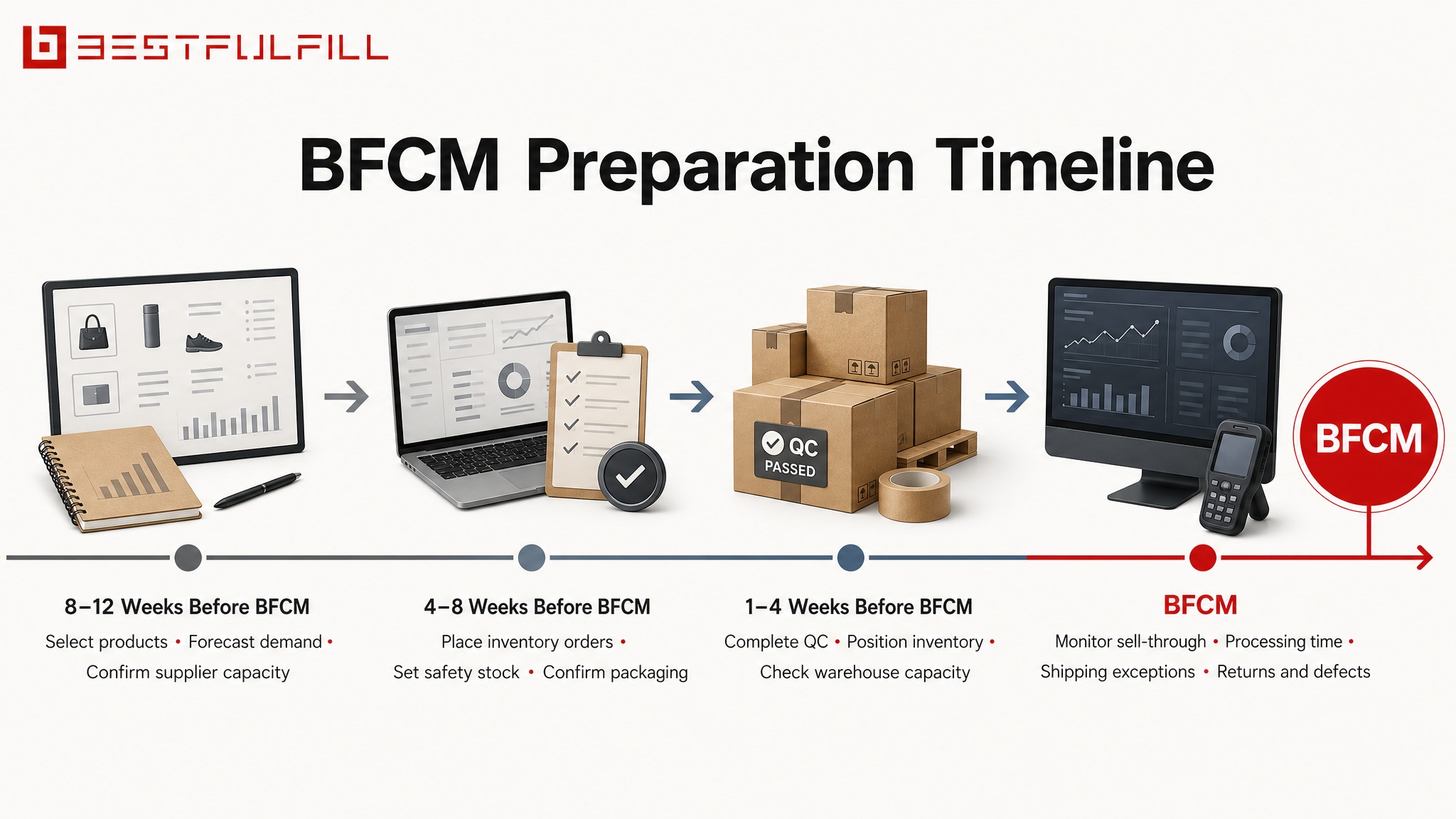
During BFCM
Track:
- Daily order volume
- Inventory sell-through
- Fulfillment processing time
- Shipping exceptions
- Return and defect rates
Real-time monitoring allows brands to react before a small operational issue becomes a large customer-service problem.
How Bestfulfill Supports BFCM Fulfillment
For BFCM, the value of a fulfillment partner is not simply faster shipping.
The more important question is whether the fulfillment model can change as the SKU changes.
Based on our experience across sourcing, QC, warehousing, and cross-border fulfillment, we see fulfillment as a lifecycle rather than a one-size-fits-all service.
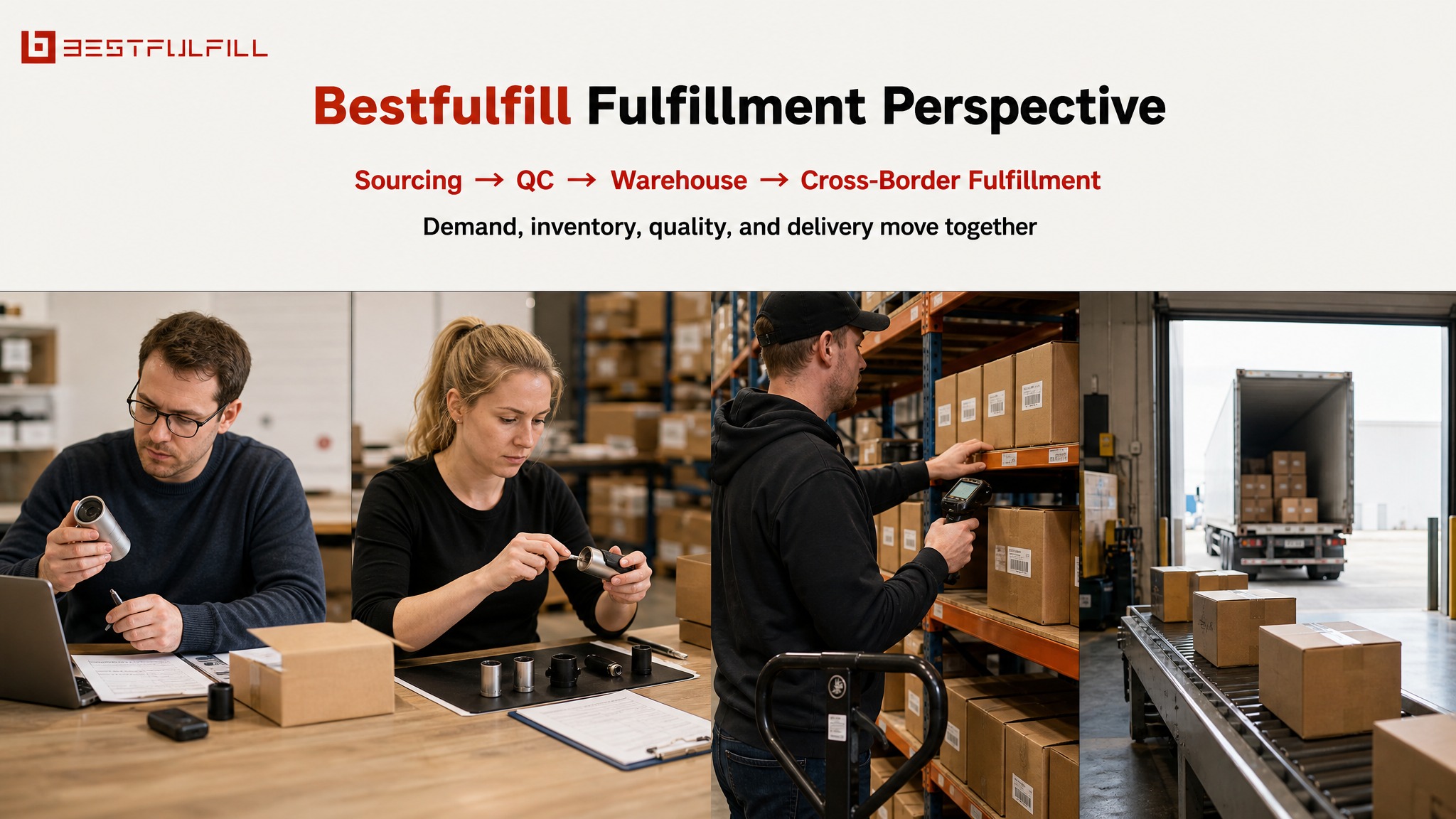
Bestfulfill's SKU Lifecycle Approach
Test → Validate → Scale → Localize → Standardize
Testing: China fulfillment provides flexibility while demand is being validated.
Validation: Sourcing and QC processes become more structured as sales become consistent.
Scaling: Regional inventory can be introduced when order volume and destination demand become predictable.
Localization: Proven SKUs can move closer to customers to improve delivery performance.
Standardization: Mature products can use customized SOPs, packaging workflows, inventory management, and regional return processes.
This approach helps brands avoid applying the same fulfillment model to every SKU.
Instead, fulfillment evolves with the product.
Final Takeaway
BFCM product selection is no longer only about finding products that are trending.
A stronger product strategy connects demand, sourcing, margins, inventory, and fulfillment from the beginning.
The most promising BFCM products are those that can:
- Generate clear consumer demand
- Maintain healthy margins after landed costs
- Be sourced consistently
- Pass appropriate quality checks
- Scale without major fulfillment bottlenecks
For new products, flexibility is usually the priority.
For proven winners, inventory positioning and fulfillment capacity become more important.
And for mature products, standardized supply-chain operations can become a competitive advantage.
The goal is not simply to sell more during BFCM. It is to make sure the supply chain can support the growth that follows.
Frequently Asked Questions (FAQ)
What products are trending for BFCM 2026?
Beauty and personal-care accessories, home and lifestyle products, fashion accessories, consumer electronics, and pet products are categories worth evaluating. Actual demand varies by market and product.
How early should brands prepare for BFCM?
Brands should ideally begin planning 8–12 weeks before the peak period, particularly when products have long production lead times or require custom packaging.
Should new products be stocked before BFCM?
Not necessarily. New products can initially use flexible fulfillment models to validate demand before committing to larger inventory positions.
When should a brand move inventory closer to customers?
Regional inventory becomes more attractive when a SKU has stable demand and sufficient sales volume to justify the additional inventory commitment.
Why is QC important during BFCM?
Higher order volume magnifies existing defect rates. Pre-shipment inspection can help identify product or packaging problems before they affect a larger number of customers.
What is the best fulfillment strategy for BFCM?
There is no single model for every SKU. A practical approach is to use flexible fulfillment during testing, stronger QC during validation, regional inventory during scaling, and standardized multi-market fulfillment for mature products.