Key Takeaways
- Compare total fulfillment cost, not just pick-and-pack pricing.
- Minimum monthly spend, storage commitments, and contract terms can materially affect smaller brands.
- Very early-stage sellers often need flexibility more than a large fulfillment network.
- More complex sourcing, branding, and international shipping needs usually require a deeper service model.
- Scalability matters because changing 3PLs later can be expensive and disruptive.
Quick Answer: What Are the Best 3PLs for Small and Growing Ecommerce Brands?
The best 3PL depends on the brand’s stage, product type, and operating complexity.
- Bestfulfill — growing brands sourcing from China that need sourcing, QC, branded fulfillment, and global shipping connected.
- ShipBob — established DTC brands with predictable regional demand.
- ShipMonk — brands with bundles, subscriptions, kitting, or customized workflows.
- Red Stag Fulfillment — heavy, oversized, fragile, or high-value products.
- Stord / Flexport — larger brands with broader logistics or freight complexity.
Very early-stage sellers with low or inconsistent volume may still be better served by self-fulfillment or a low-commitment 3PL.
For a broader market comparison, see Best 3PL Fulfillment Companies for Ecommerce in 2026.
3PL Comparison for Small and Growing Ecommerce Brands
| Provider | Best Fit | Commitment Style | Main Strength | Main Watchout |
| Bestfulfill | Growing brands sourcing from China | Flexible / custom quote | Sourcing, QC, branded fulfillment, global shipping | Less relevant for simple domestic-only operations |
| ShipBob | Established DTC brands with predictable demand | Custom quote | Distributed regional fulfillment | Economics improve with steadier volume |
| ShipMonk | Brands with bundles, subscriptions, or kitting | Volume-based monthly minimum | Flexible ecommerce workflows | Minimum commitment varies with projected volume |
| Red Stag Fulfillment | Heavy, oversized, fragile, or high-value products | Custom quote | Specialized product handling | Less suited to standard lightweight parcels |
| Stord | Larger omnichannel brands | Custom solution | Warehousing and logistics orchestration | More complex than most early-stage brands require |
| Flexport | Brands with freight and cross-border complexity | Service-dependent | Freight, customs, and fulfillment coordination | Often unnecessary for simple domestic fulfillment |
Exact minimums and fees vary by provider and contract, so current commercial terms should always be confirmed directly.
When Should a Small Ecommerce Brand Start Using a 3PL?
There is no universal monthly order threshold.
A brand is usually ready for a 3PL when fulfillment starts consuming too much time or becoming difficult to manage.
Common signs include:
- Packing and shipping are taking too much founder or team time
- Late dispatches or fulfillment errors are increasing
- Inventory is becoming harder to track
- Branded packaging, bundles, or kitting are difficult to manage in-house
- Returns require too much manual work
- The business is entering new markets
A relatively low-volume brand may still benefit from outsourcing if its products are complex, internationally sourced, high-value, or operationally demanding.
Simple products and straightforward domestic shipping may stay in-house for longer.
A 3PL becomes useful when fulfillment starts getting in the way of growth, not at one fixed order number.
For more on provider evaluation, see How to Compare Ecommerce Fulfillment Companies in 2026.
The 5 Factors That Matter Most
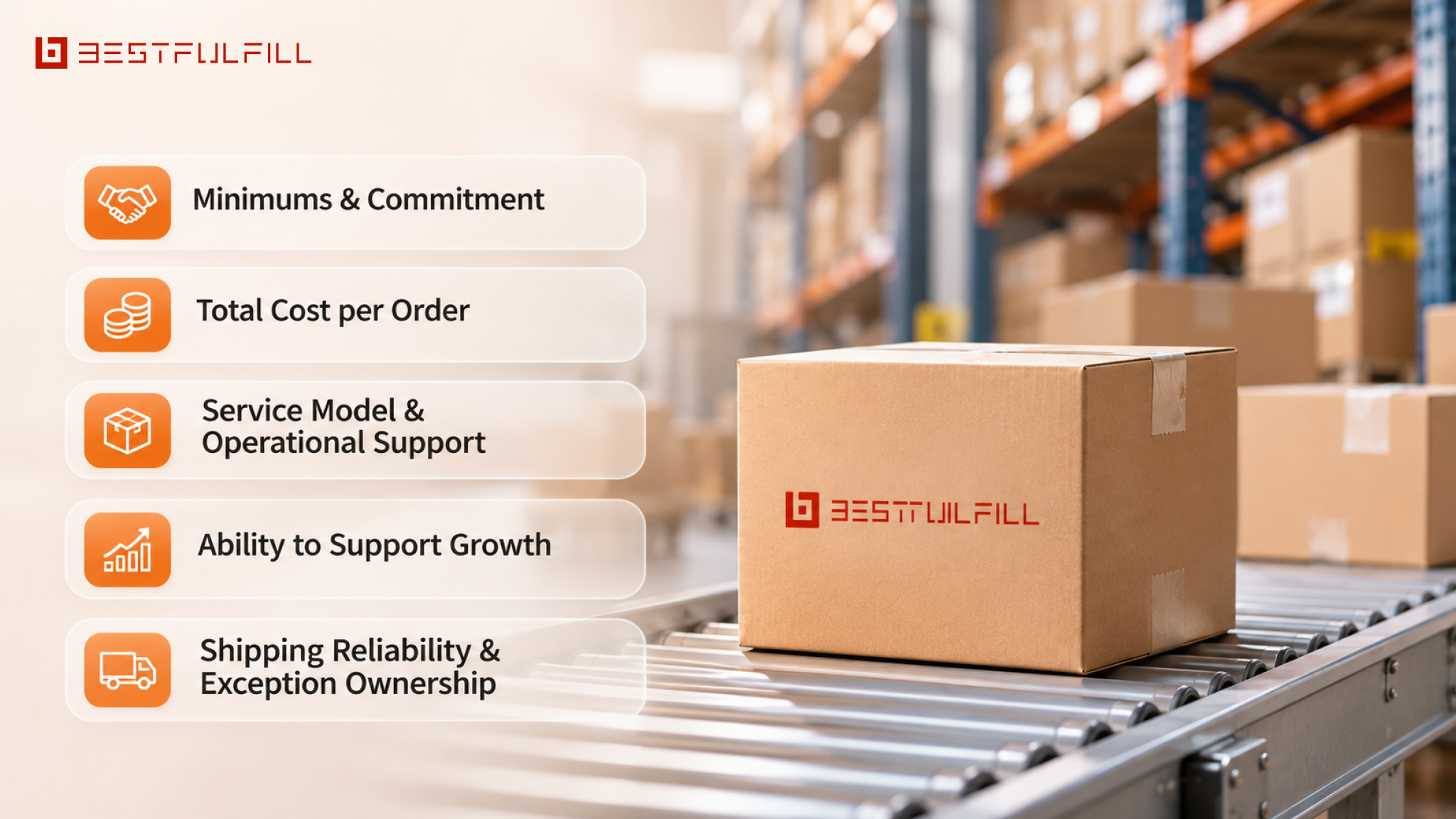
Minimums and Commitment
Minimum commitments matter more when order volume is still uneven.
A 3PL may require:
- Monthly order or spend minimums
- Storage minimums
- Setup or onboarding fees
- Contract commitments
- Exit or termination fees
A provider may offer an attractive per-order rate but still become expensive during slower months if the fixed commitment is too high.
ShipMonk, for example, calculates its monthly minimum using projected monthly order volume and first-item pick fees rather than applying one universal order threshold. ShipMonk Pricing
Before signing, brands should understand what happens if monthly volume falls below forecast, whether pricing changes during peak periods, and how flexible the contract is if the business model changes.
Total Cost per Order
Pick-and-pack pricing is only one part of fulfillment cost.
The final cost can also include receiving, storage, packaging, additional item handling, kitting, returns, account fees, and shipping.
ShipBob’s official pricing structure, for example, includes implementation, receiving, warehousing, and picking, packing, and shipping rather than presenting fulfillment as one standalone rate. ShipBob Pricing
A useful comparison should model a realistic month using the brand’s actual:
- SKU mix
- Parcel size
- Destination mix
- Storage profile
- Return rate
This gives a clearer view of true cost per shipped order than comparing one advertised rate.
Service Model and Operational Support
Not every ecommerce brand needs the same level of support.
A simple operation may only need warehousing, pick-and-pack, and shipping.
A more complex brand may also need supplier coordination, QC, branded packaging, labeling, international fulfillment, and exception management.
This becomes particularly relevant for brands sourcing internationally.
Bestfulfill is one example of a fuller-service model, combining sourcing, QC, branded fulfillment, and global shipping for brands sourcing from China.
Other businesses may be better served by a more specialized or lower-touch 3PL if their fulfillment needs are simpler.
For China-specific provider options, see Best China-Based 3PL Companies for Ecommerce Brands in 2026.
Ability to Support Growth
A provider should still make sense when the business becomes more demanding.
Growth may bring:
- Higher daily order volume
- More SKUs and variants
- Branded packaging
- Bundles and kitting
- New sales channels
- International markets
- Overseas inventory
Changing 3PLs later is not a simple software switch. Inventory may need to move, systems need to reconnect, and workflows often need to be rebuilt.
The goal is not to buy enterprise infrastructure too early. It is to avoid choosing a provider that becomes restrictive after the next stage of growth.
Shipping Reliability and Exception Ownership
Reliability matters because smaller brands can feel the impact of failed orders quickly.
Average transit time only tells part of the story. Brands also need to understand what happens when an address is wrong, a parcel stops moving, customs holds a shipment, or a delivery fails.
Useful areas to evaluate include:
- Dispatch consistency
- Carrier flexibility
- Tracking visibility
- Lost or delayed shipment handling
- Customs exceptions
- Returns
- Escalation support
A strong 3PL should have a defined process for identifying exceptions, notifying the merchant, and taking operational action before a small shipping issue becomes a customer-service problem.
Which 3PL Model Fits Each Stage of Growth?
| Brand Stage | Typical Situation | Best Fulfillment Model |
| Very early stage | Low or inconsistent volume; simple products | Self-fulfillment or low-commitment 3PL |
| Early growth | Stable orders; fulfillment consuming founder time | Flexible ecommerce 3PL |
| Growing DTC | More SKUs, branding, bundles, multiple channels | Full-service ecommerce 3PL |
| International sourcing growth | Supplier coordination, QC, branding, cross-border shipping | Origin-connected full-service 3PL |
| Multi-market scale | Inventory and demand across several regions | Regional or hybrid fulfillment network |
Most brands move through several of these stages.
The practical goal is to avoid changing fulfillment models every time the business adds another layer of complexity.
For brands planning multi-country expansion, see Which Fulfillment Providers Are Best for Multi-Country Ecommerce in 2026?.
Red Flags When Choosing a 3PL
Watch for:
- Pricing that is difficult to understand
- Minimum commitments far above realistic volume
- Long contracts with unclear exit terms
- Weak inventory visibility
- Poor returns handling
- Limited carrier flexibility
- No clear exception process
- No ability to support new markets
Problems often appear when the sales proposal looks simple but the operating model is not.
The provider should be able to explain how non-standard situations are handled, not just how normal orders move through the warehouse.
Final Takeaway
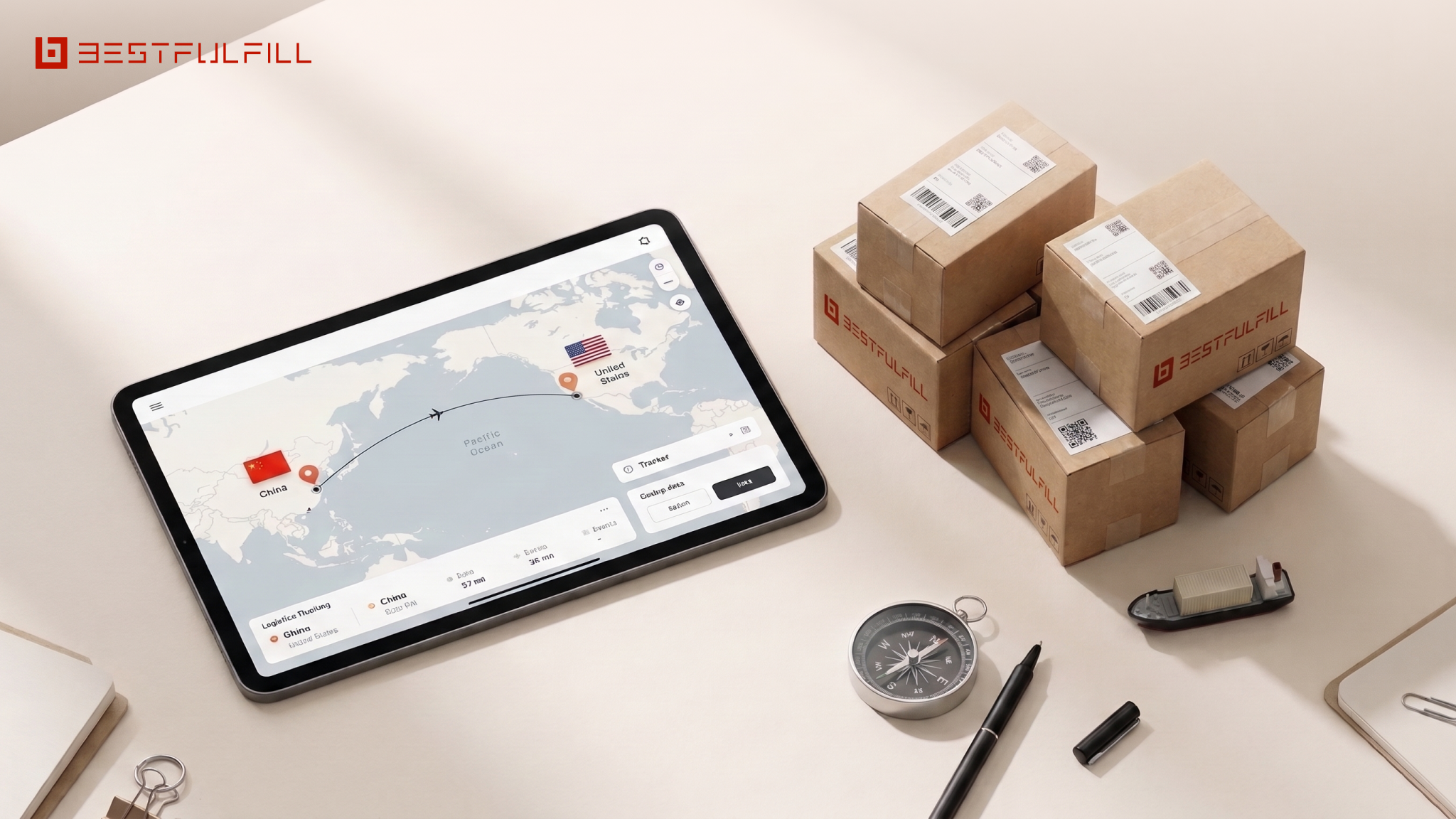
For small and growing ecommerce brands, 3PL selection usually comes down to five areas:
Minimums → Total Cost → Service Model → Reliability → Growth Fit
A simple operation may only need a flexible provider with low commitments.
As the business adds more products, markets, sourcing requirements, or operational complexity, a deeper service model may become more useful.
The strongest fit is a provider that works for the business now and still makes operational sense as it grows.
Frequently Asked Questions (FAQ)
What 3PL companies are recommended for new ecommerce sellers?
Very early-stage sellers with low and inconsistent volume may be better served by self-fulfillment or a low-commitment 3PL.
Once demand becomes more stable, ecommerce-focused providers such as ShipBob or ShipMonk may become more practical. Brands sourcing from China may also consider Bestfulfill when sourcing, QC, branding, and international fulfillment need to be coordinated together.
Which 3PL offers the best value for small DTC brands?
Value depends on the operating model.
A regional 3PL may offer better economics for straightforward domestic fulfillment. For DTC brands managing China sourcing, product QC, custom packaging, and cross-border shipping, a fuller-service provider such as Bestfulfill may create more value by reducing the number of separate vendors involved.
Are there 3PLs with no minimum order requirements?
Yes. Some providers accept very small accounts or do not publish formal order minimums.
However, minimum orders are only one part of the economics. Storage, receiving, account, and shipping costs can still make outsourcing inefficient at very low volume.
Which 3PL is best for a Shopify brand that is starting to scale?
For brands with predictable regional demand, providers such as ShipBob or ShipMonk may be suitable.
If the Shopify brand sources inventory from China and also needs QC, branded packaging, and cross-border fulfillment, a China-connected provider such as Bestfulfill may be more relevant.
What is the best 3PL for brands sourcing from China?
China-sourcing brands typically need stronger origin coordination than brands buying inventory domestically.
Providers that can connect supplier coordination, QC, warehousing, branded fulfillment, and international shipping are particularly relevant. Bestfulfill is one example of this China-connected fulfillment model.
Is a full-service 3PL worth it for a small ecommerce brand?
It can be when the brand already manages complexity beyond basic pick-and-pack.
International sourcing, QC, custom packaging, multiple shipping markets, or more complex exception management can make a full-service model worthwhile earlier than order volume alone might suggest.
Should a small brand choose a global 3PL or a regional provider?
A regional provider often makes more sense when demand is concentrated in one market.
A global or hybrid fulfillment model becomes more useful when meaningful demand exists across several regions or when international sourcing and regional inventory need to be coordinated together.
Should warehouse network size influence which 3PL I choose?
Yes, but only when the network matches actual demand.
A larger warehouse network can reduce delivery distance and support expansion, but distributing inventory across too many locations can also increase inventory requirements and operational complexity.
Small brands should prioritize network relevance over network size.