


The Old Math Simply Doesn't Add Up Anymore
The biggest shift boils down to cold, hard numbers. Two massive cost shocks have completely gutted the profit margins of old-school dropshipping.
The Death of Free Passes at Customs
Remember the $800 de minimis exemption? The loophole that allowed over a billion packages to enter the U.S. duty-free is gone. Thanks to recent tariff and customs changes, you're now looking at an extra $4 to $11 in landed costs per order for direct shipments from China. If you’re selling a $15 to $30 impulse-buy product, that extra fee completely wipes out your profit.
The Ad Spend Bloodbath
At the same time, Meta and TikTok ad costs (CPMs) are through the roof. Today, your Customer Acquisition Cost (CAC) will easily eat up 30% to 40% of your revenue per order.
Let’s look at how the math plays out on a standard $30 product:
| Metric | Old-School Generic Dropshipping (30% Gross Margin) | Branded Private Label Dropshipping (60% Gross Margin) |
|---|---|---|
| Gross Profit | $9 per order | $18 per order |
| Average Paid CAC | $12 per order | $12 per order |
| The Bottom Line | -$3 Loss per order (Scaling just makes you lose money faster) | +$6 Profit per order (Perfect for profitable scaling) |
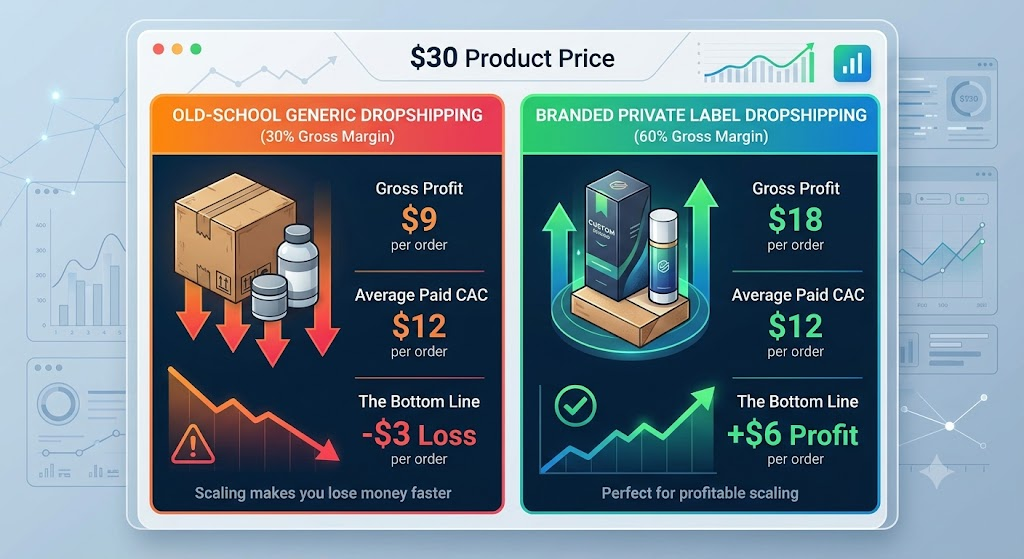
The Takeaway: You can no longer survive on razor-thin margins. To cover rising ad costs, you must upgrade to a differentiated, branded model that commands higher prices and better margins.
Customer Expectations Have Permanently Shifted
Beyond regulations, consumer behavior has changed for good. We live in an Amazon Prime world now. Shoppers expect their orders in 3 to 7 days, period.
But it’s not just about speed. Buyers want a real brand experience. They want consistent quality and a polished unboxing experience—and data shows they’re willing to pay 10% to 20% more for a brand they trust.

The Churn-and-Burn Cycle
Traditional dropshipping stores simply can't meet this bar. Slow cross-border shipping kills conversions. Plain, unbranded plastic mailers leave zero brand impression. And inconsistent quality leads to a nightmare of returns and chargebacks. Without repeat customers to offset ad costs, your business becomes a sinking ship.
That’s why the industry is moving toward branded dropshipping. You keep the capital efficiency of global sourcing, but you actually build lasting value.
How to Upgrade Your Customer Experience:
-
Regional Warehousing: Staging bulk inventory in local US/EU warehouses cuts delivery times down to 3–7 days.
-
Standardized Quality Control (QC): Pre-shipment inspections catch defects before they reach your customer, slashing your return rates.
-
Branded Unboxing: Custom packaging and thoughtful inserts turn a one-time buyer into a loyal, repeat customer.
-
Private Labeling: Making minor product customizations lets you escape price wars and hit that golden 60%+ gross margin.
Platform & Regulatory Risks are at an All-Time High
The original appeal of traditional dropshipping was low risk and low barrier to entry. But today? Running the old playbook is one of the riskiest things you can do online. Platforms and payment processors are cracking down hard.
Platform Enforcement is Real
Shopify and TikTok Shop aren't playing around. They are actively shadowbanning or outright suspending stores with high return rates, duplicate generic listings, and shipping delays. Their algorithms now heavily favor branded, high-satisfaction merchants.
The Dreaded Payment Hold
Stripe, PayPal, and Shopify Payments will flag your account the second your chargeback rate creeps near 0.65% to 1%. Traditional dropshipping stores routinely see chargeback rates of 2% to 3% due to long shipping times. If your funds get frozen overnight, your cash flow dies—and so does your business.
🇪🇺 Europe is Closing the Loophole, Too
Think the US changes were tough? Starting July 2026, the EU is eliminating its €150 customs duty exemption. They are introducing a flat €3 duty per product category on direct-import low-value parcels, alongside strict new safety certifications (like GPSR and CE). If you don't have the resources to navigate these rules, your packages will get seized at the border.
The Verdict: Evolve or Get Left Behind
Does this mean dropshipping is dead? Absolutely not. It just means the old way of doing it is.
The future belongs to the hybrids—sellers who leverage the flexibility of dropshipping but back it up with private label customization, branded packaging, local fulfillment, and strict quality control. It’s an exciting evolution, not an ending.
Ready to stop gambling with generic products and build a scalable, bulletproof brand?
Let’s get your supply chain ready for the modern market. Reach out to the Bestfulfill team today for a free, custom assessment and let's map out your transition to a high-margin, branded fulfillment strategy!