


10 Best Private Label Fulfillment Companies for Ecommerce Brands in 2026
The right private label fulfillment partner depends on where your supply chain needs the most support — sourcing, quality control, branded packaging, warehousing, or global delivery.
Some providers focus mainly on downstream storage and shipping, while others also support supplier coordination, QC, customization, and China-side operations.
This guide compares 10 private label fulfillment companies across different sourcing models, markets, product types, and stages of ecommerce growth.
Key Takeaways
- Private label fulfillment should be evaluated across sourcing, QC, branding, warehousing, and delivery, not pick-and-pack alone.
- Brands sourcing from China may benefit from providers that operate closer to suppliers and can coordinate upstream processes.
- Traditional 3PLs are often a stronger fit when manufacturing is already established and the main need is warehousing and order fulfillment.
- Branding capabilities vary significantly between providers, from simple inserts to custom packaging, kitting, and product customization.
- The right provider depends on where you source, where you sell, how much control you need, and how complex your operation has become.
Quick Answer
For private label brands sourcing from China, Bestfulfill is a strong fit when sourcing, QC, branded packaging, warehousing, and global fulfillment need to work together.
If manufacturing is already established and the main requirement is distributed fulfillment, ShipBob or ShipMonk may be more appropriate. Bigblue is better aligned with Europe-first DTC brands, while Amazon FBA is designed for Amazon-first sellers.
Brands still testing private label products may prefer more flexible sourcing-led models such as CJdropshipping or DSCP Smart Fulfillment before moving into a more structured inventory and fulfillment setup.
Private Label Fulfillment Companies Compared
We compared providers based on the areas that matter most to private label brands: sourcing support, branding capability, fulfillment network, scalability, and operational fit.
| Provider | Best For | Sourcing / QC | Key Strength | Limitation |
|---|---|---|---|---|
| Bestfulfill | Established brands sourcing from China | Strong | China sourcing + QC + global fulfillment | Less suited to very early-stage sellers |
| DSCP Smart Fulfillment | Dropship-to-private-label sellers | Limited | Flexible China fulfillment | Limited for complex supply chains |
| CJdropshipping | Early-stage private label testing | Yes | Sourcing ecosystem + fulfillment | More suited to lighter customization |
| ShipBob | Scaling DTC brands | No | Distributed fulfillment network | Upstream sourcing handled separately |
| ShipMonk | High-SKU / omnichannel brands | No | Kitting + fulfillment technology | No core sourcing support |
| Bigblue | Europe-first DTC brands | No | European branded fulfillment | Limited China-side support |
| Red Stag Fulfillment | Heavy / fragile / high-value products | No | Specialized handling | Primarily US-focused |
| Amazon FBA | Amazon-first sellers | No | Native Prime fulfillment | Limited branded DTC experience |
| Portless | Origin-based global fulfillment | Limited | Inventory close to manufacturing | Slower than local fulfillment in some markets |
| eFulfillment Service | Smaller US brands | No | Lower-commitment fulfillment | Limited global infrastructure |
Top 10 Private Label Fulfillment Companies in 2026
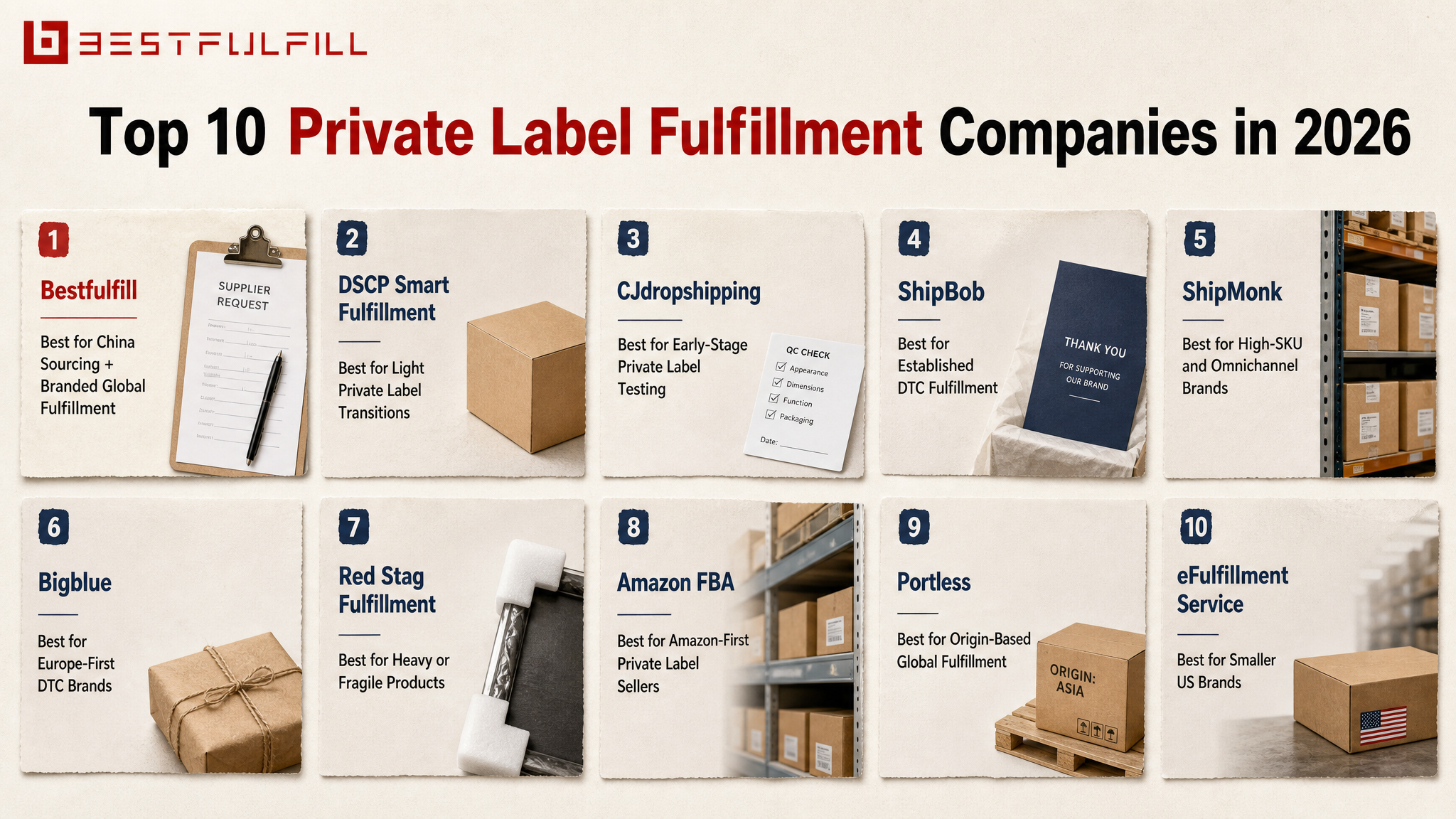
1. Bestfulfill — Best for China Sourcing + Branded Global Fulfillment
Best for: Established and scaling ecommerce brands sourcing from China.
Bestfulfill connects product sourcing, supplier coordination, quality control, branded packaging, warehousing, order fulfillment, and global shipping within one workflow.
Its infrastructure includes 60,000㎡+ of domestic fulfillment capacity and 10+ overseas warehouses, making it particularly relevant to brands selling across multiple international markets.
Why it stands out: Its main advantage is connecting China-side sourcing and QC with downstream fulfillment, reducing handoffs between separate suppliers, agents, warehouses, and logistics providers.
Limitation: It is better suited to brands with established demand and more complex supply-chain requirements than to very early-stage sellers looking for a simple self-service dropshipping solution.
2. DSCP Smart Fulfillment — Best for Light Private Label Transitions
Best for: Sellers moving from dropshipping into light private label or print-on-demand.
DSCP Smart Fulfillment focuses on flexible China-based fulfillment, POD, and semi-private-label workflows.
Why it stands out: It allows sellers to add basic branding without immediately moving into fully customized manufacturing or larger inventory commitments.
Limitation: It is less suited to brands requiring deep product development, complex supplier management, or sophisticated multi-market inventory strategies.
3. CJdropshipping — Best for Early-Stage Private Label Testing
Best for: Sellers testing private label products through a sourcing-led platform.
CJdropshipping combines product sourcing, catalog access, customization, warehousing, and fulfillment.
Why it stands out: Its ecosystem makes it relatively easy to move from product testing into basic branding and fulfillment without building a supplier network independently.
Limitation: It is more aligned with catalog-based sourcing and lighter customization than with complex private label programs requiring deeper supplier coordination or product development.
4. ShipBob — Best for Established DTC Fulfillment
Best for: Scaling DTC brands that already have manufacturing in place.
ShipBob focuses on distributed inventory, warehousing, order fulfillment, ecommerce integrations, and local delivery across major markets.
Why it stands out: Its strength is mature downstream fulfillment infrastructure for brands that already know where and how their products are manufactured.
Limitation: China-side sourcing, supplier coordination, and factory-level QC typically need to be handled separately.
5. ShipMonk — Best for High-SKU and Omnichannel Brands
Best for: Subscription, high-SKU, and omnichannel private label brands.
ShipMonk focuses on technology-driven fulfillment for businesses with more complex order structures.
Why it stands out: Kitting, bundling, subscription workflows, inventory management, and omnichannel fulfillment are key strengths.
Limitation: Sourcing, manufacturing, and supplier management generally remain outside the core fulfillment relationship.
6. Bigblue — Best for Europe-First DTC Brands
Best for: Private label brands focused primarily on European customers.
Bigblue combines European ecommerce fulfillment with branded delivery experiences.
Why it stands out: It supports local fulfillment together with branded packaging, inserts, tracking, and returns.
Limitation: It is less relevant to brands that require China-side sourcing or origin-side supplier coordination.
7. Red Stag Fulfillment — Best for Heavy or Fragile Products
Best for: Heavy, bulky, fragile, or high-value private label products.
Red Stag specializes in product categories that require more careful handling than typical lightweight ecommerce parcels.
Why it stands out: Its specialized handling model makes it relevant to inventory where accuracy and product protection matter more than standard parcel fulfillment.
Limitation: Its network is primarily US-focused, and sourcing or upstream supplier management is not part of its core model.
8. Amazon FBA — Best for Amazon-First Private Label Sellers
Best for: Brands whose sales are centered on Amazon.
Amazon FBA handles warehousing, picking, packing, and marketplace delivery through Amazon's fulfillment network.
Why it stands out: Its biggest advantage is native integration with Amazon and access to Prime fulfillment.
Limitation: Brands have less control over custom packaging and the broader DTC customer experience, and the model is primarily optimized around Amazon.
9. Portless — Best for Origin-Based Global Fulfillment
Best for: Brands that want to keep inventory close to Asian manufacturing while selling internationally.
Portless represents an origin-based fulfillment model where inventory remains closer to manufacturing before being shipped to customers.
Why it stands out: This can reduce the need to forward-stock large amounts of inventory across multiple overseas warehouses.
Limitation: Direct international parcel delivery may be slower than local fulfillment, making it less suitable when fast domestic delivery is essential.
10. eFulfillment Service — Best for Smaller US Brands
Best for: Smaller private label brands moving beyond self-fulfillment.
eFulfillment Service provides outsourced warehousing and fulfillment for brands that source and manufacture elsewhere.
Why it stands out: Its lower-commitment model can suit brands that have outgrown packing orders themselves but do not yet need a complex international setup.
Limitation: It offers less global infrastructure and does not integrate upstream sourcing or supplier management.
How to Choose a Private Label Fulfillment Company
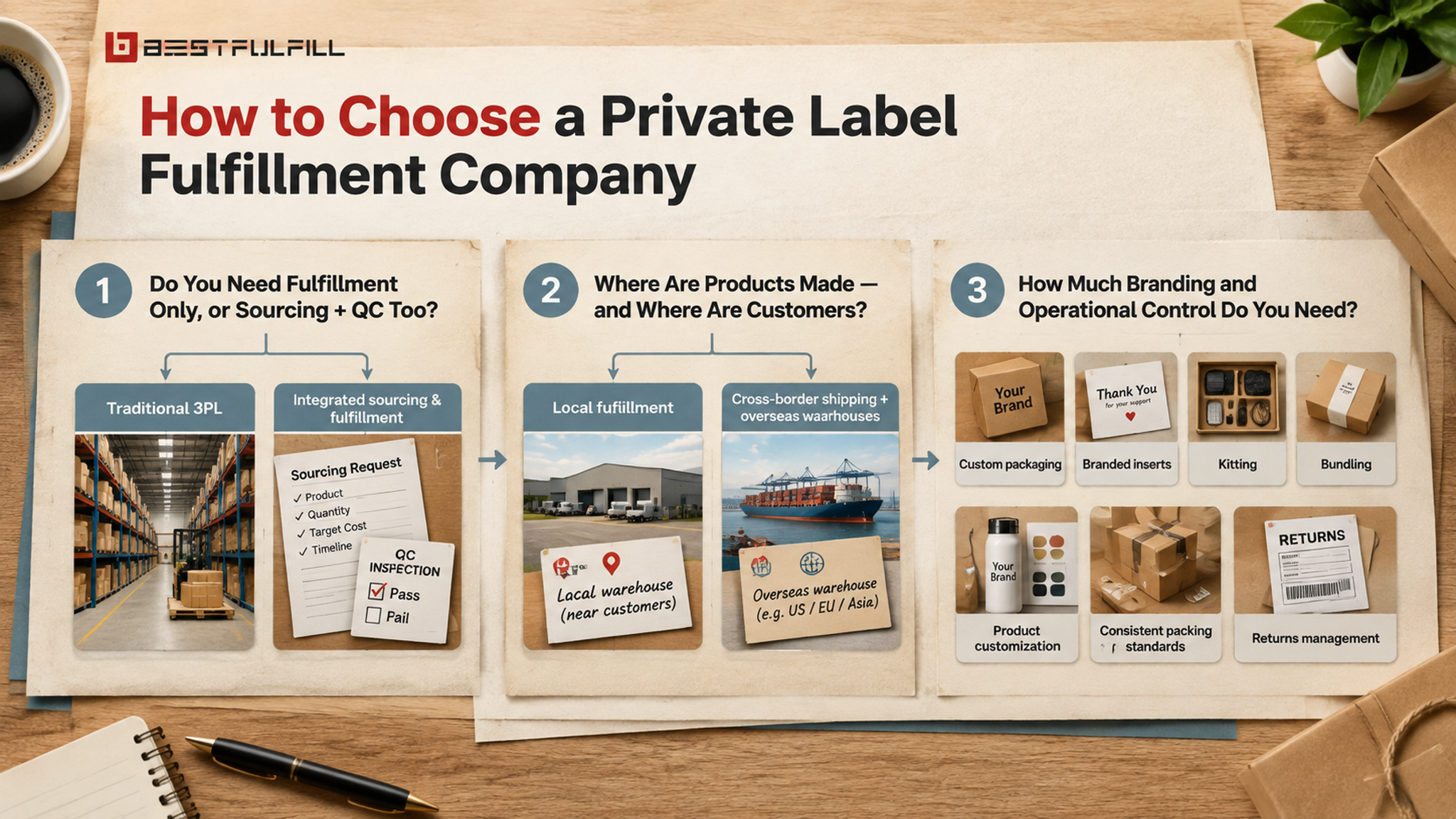
Most brands can narrow the decision down to three questions.
1. Do You Need Fulfillment Only, or Sourcing + QC Too?
If sourcing and manufacturing are already under control, a traditional 3PL may be enough.
If you also need supplier coordination, quality control, branded packaging, or China-side inventory management, an integrated sourcing and fulfillment partner may reduce operational handoffs.
2. Where Are Products Made — and Where Are Customers?
Brands manufacturing in China may benefit from having sourcing, QC, and warehousing support closer to suppliers.
If most orders go to one market, local fulfillment may be enough. Brands selling across multiple regions may need a mix of cross-border shipping and overseas warehouses.
3. How Much Branding and Operational Control Do You Need?
Compare whether providers support:
- Custom packaging
- Branded inserts
- Kitting
- Bundling
- Product customization
- Consistent packing standards
- Returns management
The more important the customer experience becomes, the more carefully branded fulfillment capabilities should be evaluated.
Which Private Label Fulfillment Provider Is Right for You?
| Your Situation | Best-Fit Model | Providers to Consider |
|---|---|---|
| Source from China and need QC + branded fulfillment + global shipping | Integrated sourcing & fulfillment | Bestfulfill |
| Manufacturing is established and you need mature 3PL infrastructure | Traditional tech-enabled 3PL | ShipBob / ShipMonk |
| Europe is your primary market | Europe-focused fulfillment | Bigblue |
| Most sales come from Amazon | Marketplace fulfillment | Amazon FBA |
| Products are heavy, bulky, or fragile | Specialized 3PL | Red Stag Fulfillment |
| Still testing private label products | Flexible sourcing / light private label | CJdropshipping / DSCP |
| Want inventory close to Asian factories | Origin-based fulfillment | Portless |
| Moving from self-fulfillment to a US 3PL | Lower-commitment fulfillment | eFulfillment Service |
Frequently Asked Questions (FAQ)
What are the best fulfillment companies for private label brands?
The right provider depends on how your supply chain is structured. Bestfulfill is suited to brands sourcing from China that need sourcing, QC, branded fulfillment, and global shipping together. ShipBob and ShipMonk focus more heavily on downstream 3PL fulfillment, while Bigblue is oriented toward European DTC brands and Amazon FBA toward Amazon-first sellers.
Which 3PL is best for private label brands sourcing from China?
Brands sourcing from China should look for supplier coordination, quality control, branded packaging, China-side warehousing, and international shipping.
An integrated provider such as Bestfulfill is designed around this type of workflow.
Which fulfillment companies offer custom packaging and branded inserts?
Many ecommerce 3PLs support custom packaging, branded inserts, kitting, or bundling.
The main difference is depth. Some providers simply pack merchant-supplied branded materials, while integrated partners may also coordinate packaging production, customization, sourcing, and fulfillment.
Can one company handle sourcing, QC, warehousing, and fulfillment?
Yes. Some integrated sourcing and fulfillment providers manage these functions within one workflow.
This can reduce handoffs between sourcing agents, factories, QC teams, warehouses, and logistics providers. Bestfulfill is one example of this model for brands sourcing from China.
Should private label brands use a China-based 3PL or a local warehouse?
A China-based fulfillment model can make sense when products are manufactured in China, demand is spread across several countries, or the brand wants to avoid forward-stocking too much inventory.
Local warehouses are more useful when demand in a market is predictable enough to justify inventory placement and faster domestic delivery.
Many growing brands eventually use both.
When should a private label brand move from supplier-direct shipping to a 3PL?
The transition becomes more attractive once demand is predictable and the brand needs greater control over inventory, packaging, quality, delivery consistency, and customer experience.
Common signals include more SKUs, expansion into new markets, or increasing difficulty coordinating suppliers and shipping manually.
Can private label brands use both China and overseas warehouses?
Yes. A hybrid inventory strategy can keep base inventory closer to manufacturing while positioning faster-moving inventory in overseas warehouses near core markets.
This can balance inventory risk with faster local delivery once order volume becomes predictable enough to support multiple warehouse locations.
Explore how Bestfulfill supports sourcing, QC, branded fulfillment, and global shipping for growing ecommerce brands