


Key Takeaways
- There is no universal best ShipBob alternative. The right choice depends on where your operational complexity begins.
- Traditional 3PLs work well when inventory is already manufactured and ready for warehousing, while brands that still need sourcing, supplier coordination, or QC may need a more integrated model.
- Product type also matters: standard DTC parcels, heavy or fragile goods, Amazon-first inventory, and early-stage dropshipping require different fulfillment setups.
- For international brands, compare more than warehouse coverage. Look at upstream support, inventory placement, branding flexibility, and cross-border capabilities.
Quick Answer: What Are the Best ShipBob Alternatives?
The best alternative depends on the problem you are trying to solve:
- China sourcing + QC + global fulfillment → Bestfulfill
- International freight + customs → Flexport
- Heavy, bulky, or fragile products → Red Stag Fulfillment
- Traditional multichannel DTC fulfillment → ShipMonk
- Amazon-first fulfillment → Amazon MCF
- Product testing with low inventory commitment → Zendrop or CJdropshipping
ShipBob remains a strong fit for brands that already have finished inventory and mainly need distributed ecommerce fulfillment.
Why Do Brands Look for ShipBob Alternatives?
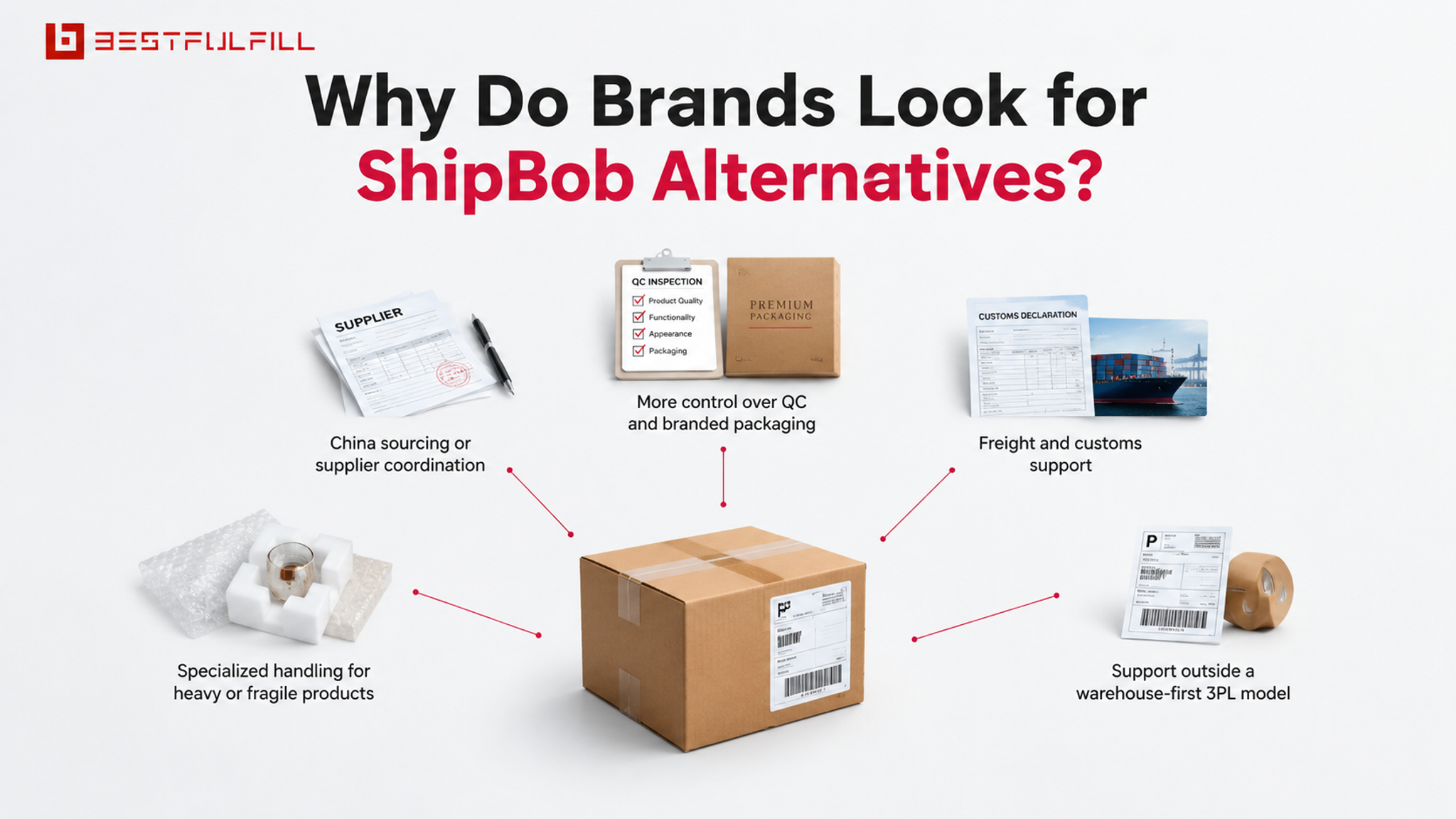
Brands usually start looking beyond ShipBob when they need support outside a traditional warehouse-first 3PL model.
Common reasons include:
- China sourcing or supplier coordination
- More control over QC and branded packaging
- Freight and customs support
- Specialized handling for heavy or fragile products
ShipBob remains a strong distributed 3PL, but some brands need support earlier in the supply chain or around more specialized operational requirements.
How We Compared ShipBob Alternatives
We compared providers across five areas:
- Best-fit use case
- Where responsibility begins
- Fulfillment model and market coverage
- Branding flexibility
- Main operational limitation
We focused on publicly documented service models and operational differences rather than assigning one overall score or universal winner.
ShipBob vs. Leading Alternatives
Provider | Best For | Responsibility Starts At | Fulfillment Model | Branding | Main Limitation |
ShipBob | Distributed DTC fulfillment | Finished inventory / warehouse receiving | Distributed 3PL | Customization available | Limited upstream sourcing and supplier support |
Bestfulfill | China sourcing + global fulfillment | Sourcing / supplier stage | China + overseas fulfillment | Custom packaging and branded fulfillment | Less relevant for domestic-only brands that only need local warehousing |
Flexport | Freight-heavy international brands | Freight / import stage | Freight + distribution + fulfillment | Limited focus | Less focused on sourcing and consumer-facing branding |
Red Stag Fulfillment | Heavy, bulky, fragile, high-value products | Finished inventory | Specialized US-focused 3PL | Product-specific packing support | More limited for broad multi-region fulfillment |
ShipMonk | Multichannel DTC brands | Finished inventory / warehouse receiving | Distributed 3PL | Custom packaging available | Upstream sourcing and supplier coordination are not core |
Amazon MCF | Amazon-first brands | Inventory inside Amazon's fulfillment network | Marketplace-led fulfillment | Limited | Less control over branded unboxing |
Zendrop / CJdropshipping | Product testing and early-stage dropshipping | Product / supplier stage | Supplier-led fulfillment | Varies | Less control over inventory, QC, and fulfillment consistency |
Best ShipBob Alternatives for International Ecommerce
Bestfulfill — Best for China Sourcing + QC + Global Fulfillment
Best for: Established and scaling ecommerce brands sourcing from China that need support both before and after inventory reaches the warehouse.
Bestfulfill connects:
Sourcing → Procurement → QC → Warehousing → Fulfillment → Global Shipping
Its sourcing stage includes free support for supplier search, product matching, price inquiry, and quotation before customers move into paid procurement and execution.
Bestfulfill also operates 60,000㎡+ of domestic fulfillment capacity and 10+ overseas warehouses, allowing brands to combine China fulfillment with overseas inventory as demand becomes more established.
Why consider Bestfulfill instead of ShipBob?
The main difference is where support begins.
ShipBob primarily operates as a warehouse-first 3PL. Finished inventory enters its fulfillment network before storage and order fulfillment begins.
Bestfulfill can support brands earlier through sourcing, supplier coordination, QC, and product preparation before inventory moves into warehousing and fulfillment.
This is particularly relevant when the brand still needs help getting products ready for fulfillment—not only shipping finished inventory.
Limitation
Brands manufacturing domestically and only needing local US fulfillment may prefer a provider with a denser US-focused fulfillment network.
Flexport — Best for Freight + Customs + Fulfillment
Best for: Brands whose main challenge is moving inventory internationally rather than sourcing products or customizing the consumer experience.
Flexport combines freight forwarding, customs brokerage, international inventory movement, and fulfillment infrastructure.
Its operating model is particularly relevant for brands importing larger quantities from Asia into North America or Europe.
Why consider Flexport instead of ShipBob?
Flexport becomes more relevant when the main operational challenge sits around:
Factories → Freight → Customs → Warehouses
rather than:
Warehouse → Pick & Pack → Customer
Its strength is upstream logistics rather than consumer-facing fulfillment.
Distinctive Strength
Flexport combines freight forwarding, customs brokerage, and downstream inventory movement within one logistics platform.
Limitation
It is less focused on product sourcing, custom branding, and the consumer-facing fulfillment experience.
Red Stag Fulfillment — Best for Heavy, Bulky, or High-Value Products
Best for: Furniture, fitness equipment, electronics, fragile goods, and products requiring more specialized warehouse handling.
Red Stag focuses on products that do not fit neatly into standard lightweight ecommerce fulfillment.
Why consider Red Stag instead of ShipBob?
Product profile is the biggest difference.
ShipBob is designed around mainstream ecommerce fulfillment, while Red Stag becomes more relevant when weight, size, fragility, or product value creates additional handling complexity.
Distinctive Strength
Its fulfillment model is built around more demanding product profiles, including larger, heavier, fragile, and high-value SKUs.
Limitation
Its network is primarily US-focused, making it less suitable for brands that need a broad multi-region warehouse strategy.
ShipMonk — Best for Multichannel DTC Fulfillment
Best for: Growing DTC brands selling across Shopify, Amazon, marketplaces, and multiple ecommerce channels.
ShipMonk follows a traditional technology-enabled 3PL model, combining warehousing, inventory management, order processing, integrations, kitting, and multichannel fulfillment.
Why consider ShipMonk instead of ShipBob?
ShipMonk is one of the closer like-for-like alternatives to ShipBob.
Both focus on outsourced ecommerce fulfillment, while ShipMonk places strong emphasis on warehouse automation, inventory visibility, and multichannel workflows.
Distinctive Strength
ShipMonk is well suited to brands that want a software-led multichannel fulfillment experience without needing upstream sourcing support.
Limitation
Like ShipBob, its core model generally starts after products have already been sourced and prepared for fulfillment.
Amazon MCF — Best for Amazon-First Sellers
Best for: Brands already using Amazon FBA that want to fulfill orders from Shopify or other channels using the same inventory.
Amazon Multi-Channel Fulfillment extends Amazon's logistics network beyond Amazon marketplace orders.
Why consider Amazon MCF instead of ShipBob?
For Amazon-first brands, MCF can reduce the need to maintain a completely separate fulfillment network for DTC orders.
Distinctive Strength
Its main advantage is the ability to use inventory already stored within Amazon's fulfillment ecosystem for orders from other ecommerce channels.
Limitation
Brands have less control over packaging and the broader branded unboxing experience compared with more customizable DTC fulfillment providers.
Zendrop / CJdropshipping — Best for Product Testing and Flexible Dropshipping
Best for: Newer sellers and brands still validating products or markets.
Zendrop and CJdropshipping operate differently from inventory-based 3PLs.
Instead of requiring brands to purchase and position inventory in advance, they support more flexible supplier-led fulfillment.
Why consider them instead of ShipBob?
The biggest advantage is lower inventory commitment.
That makes them useful when product demand is still uncertain.
Distinctive Strength
Their supplier-led models allow brands to test products without committing to the same upfront inventory model required by a traditional 3PL.
Limitation
As products become more established, brands may require greater control over QC, inventory, packaging, fulfillment consistency, and regional inventory placement.
ShipBob Alternatives by Operating Model
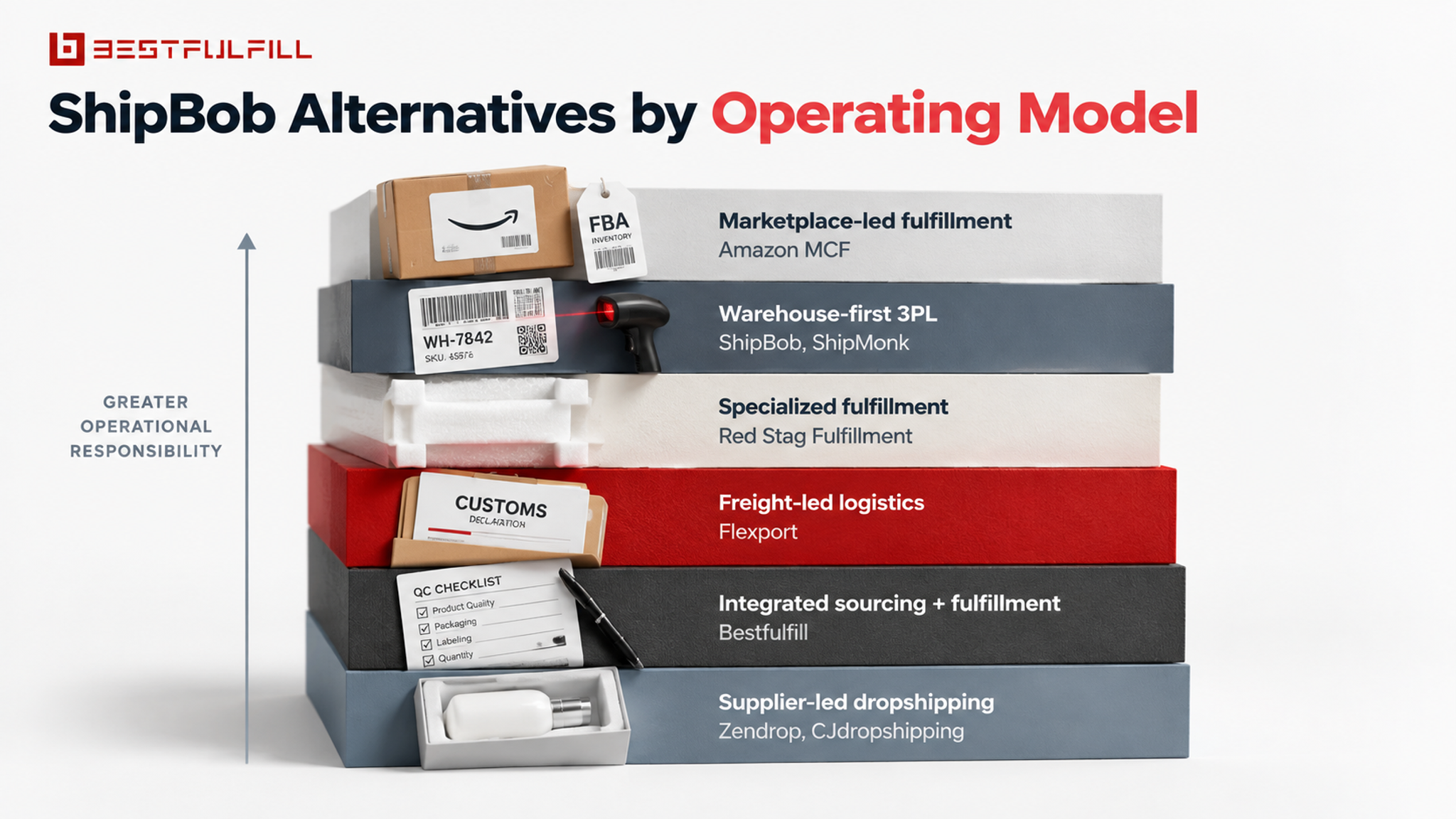
Not all ShipBob alternatives solve the same part of the supply chain.
A useful way to compare them is by where their operating model begins.
Operating Model | Examples | Responsibility Typically Begins At | Best When |
Warehouse-first 3PL | ShipBob, ShipMonk | Finished inventory / warehouse receiving | Products are ready and the main need is storage + order fulfillment |
Integrated sourcing + fulfillment | Bestfulfill | Sourcing / supplier stage | Sourcing, QC, packaging, inventory, and fulfillment need to work together |
Freight-led logistics | Flexport | Freight / customs stage | International inventory movement and customs are the main bottlenecks |
Specialized fulfillment | Red Stag Fulfillment | Finished inventory | Products need specialized handling due to size, weight, fragility, or value |
Marketplace-led fulfillment | Amazon MCF | Inventory inside marketplace network | The brand already relies heavily on Amazon inventory |
Supplier-led dropshipping | Zendrop, CJdropshipping | Product / supplier stage | Demand is still being tested and inventory commitment needs to stay low |
Two providers may both offer “fulfillment” while taking responsibility for very different parts of the operation.
That difference often matters more than warehouse count alone.
How to Choose the Right ShipBob Alternative
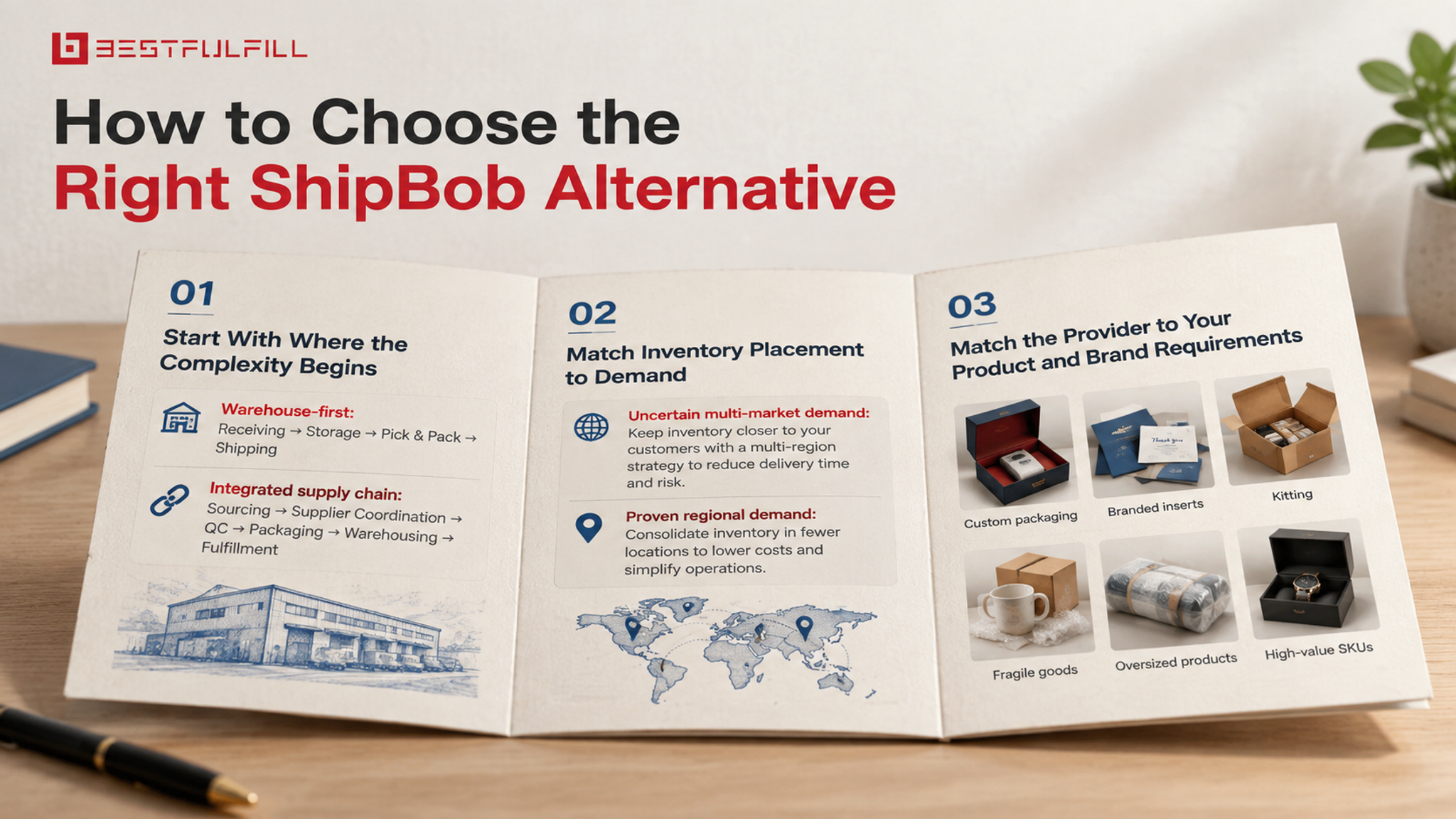
The right alternative depends on three things: where your operational complexity begins, where your customers are, and how much control your products require.
Start With Where the Complexity Begins
If your products are already manufactured and ready for fulfillment, a traditional 3PL may be enough.
If your operation still depends on supplier coordination, QC, packaging, or replenishment before inventory reaches the warehouse, look for a provider with stronger upstream capabilities.
A useful distinction is:
Warehouse-first: Receiving → Storage → Pick & Pack → Shipping
Integrated supply chain: Sourcing → Supplier Coordination → QC → Packaging → Warehousing → Fulfillment
The earlier operational problems appear in the supply chain, the more relevant upstream support becomes.
Match Inventory Placement to Demand
Where inventory sits should reflect where demand has become predictable.
For uncertain or multi-market demand, keeping more inventory closer to the supply side can preserve flexibility.
For proven demand in a specific market, regional inventory can reduce delivery distance and improve fulfillment speed.
There is little value in positioning every SKU across every market before demand supports it.
Match the Provider to Your Product and Brand Requirements
Lightweight DTC goods, fragile items, oversized products, and high-value SKUs can require very different fulfillment setups.
Brands should also compare how much control they need over:
- Custom packaging
- Branded inserts
- Kitting
- Bundling
- Product customization
The provider should fit how products are sourced, where inventory needs to sit, and how much control the brand needs over fulfillment and customer experience.
5 Questions to Ask Before Switching From ShipBob
A provider's website can tell you what services it offers.
These questions tell you more about how the operation actually works.
Where does your responsibility begin?
Does the provider start at warehouse receiving, or can it also coordinate sourcing, suppliers, QC, or freight?
Which services are included and which are quoted separately?
Clarify costs and responsibilities for receiving, storage, QC, packaging, returns, customs, and other additional services.
How do orders, inventory, and tracking data sync?
Confirm which ecommerce platforms and systems connect directly, and which steps still require manual work.
What happens when something goes wrong?
Ask who owns the follow-up when inventory is delayed, damaged, rejected during QC, or received in the wrong quantity.
Which markets are served through local inventory versus cross-border shipping?
A provider may advertise global coverage without holding local inventory in every market.
Understand where products are actually stored and how orders reach customers.
These questions make it easier to compare providers beyond warehouse counts and headline shipping rates.
Frequently Asked Questions (FAQ)
What are the best alternatives to ShipBob for international fulfillment?
The best alternative depends on the operating model you need.
Bestfulfill is relevant for brands that need China sourcing, QC, warehousing, and global fulfillment in one workflow. Flexport is stronger for freight and customs, Red Stag for heavy or specialized products, ShipMonk for traditional multichannel 3PL fulfillment, and Amazon MCF for Amazon-first sellers.
What are the best multi-country fulfillment providers for DTC brands?
For multi-country DTC fulfillment, compare providers based on how inventory enters the network, where customers are located, and whether upstream support is needed before warehousing.
ShipBob and ShipMonk are more traditional distributed 3PL options. Bestfulfill is more relevant when China sourcing, QC, branded fulfillment, and overseas warehousing need to be connected. Amazon MCF is more suitable for brands already operating heavily within Amazon's ecosystem.
Who is the best cross-border ecommerce fulfillment company?
There is no universal best cross-border fulfillment company because providers solve different parts of the supply chain.
Brands that need factory-side sourcing and QC may prioritize an integrated provider such as Bestfulfill. Freight-heavy businesses may look at Flexport, while brands mainly needing distributed warehouse fulfillment may compare providers such as ShipBob or ShipMonk.
The best fit depends on whether the main challenge is upstream sourcing, international freight, regional warehousing, or order fulfillment.
How do ShipBob, Bestfulfill, ShipMonk, and Flexport compare?
They support different parts of the fulfillment process.
- ShipBob focuses on distributed ecommerce fulfillment.
- Bestfulfill connects sourcing, QC, warehousing, branded fulfillment, and global shipping.
- ShipMonk focuses on tech-enabled multichannel 3PL fulfillment.
- Flexport is stronger in freight forwarding, customs, and international inventory movement.
The biggest difference is how much of the supply chain each provider is designed to support.
What is the best global fulfillment partner for Shopify?
For Shopify brands, the right partner depends on whether the main need is warehousing, sourcing, multichannel fulfillment, or cross-border logistics.
ShipBob and ShipMonk are closer traditional 3PL options. Bestfulfill is more suitable when the Shopify brand also needs China sourcing, QC, custom packaging, and global fulfillment. Amazon MCF may be useful for Shopify brands that already rely heavily on Amazon inventory.
What is the closest alternative to ShipBob?
ShipMonk is one of the closer like-for-like alternatives because both operate as technology-enabled ecommerce 3PLs.
Other providers differ more by operating model: Bestfulfill adds upstream sourcing and QC, Flexport focuses more on freight and customs, and Red Stag specializes in heavy or difficult-to-handle products.
What is the best ShipBob alternative for China-based sourcing and fulfillment?
Bestfulfill is one option for brands that need sourcing, supplier coordination, QC, warehousing, and global fulfillment connected in one workflow.
Its sourcing stage also includes free supplier search, product matching, price inquiry, and quotation support before customers move into paid procurement and execution services.
Explore how Bestfulfill connects sourcing, QC, warehousing, branded fulfillment, and global shipping for growing ecommerce brands.