



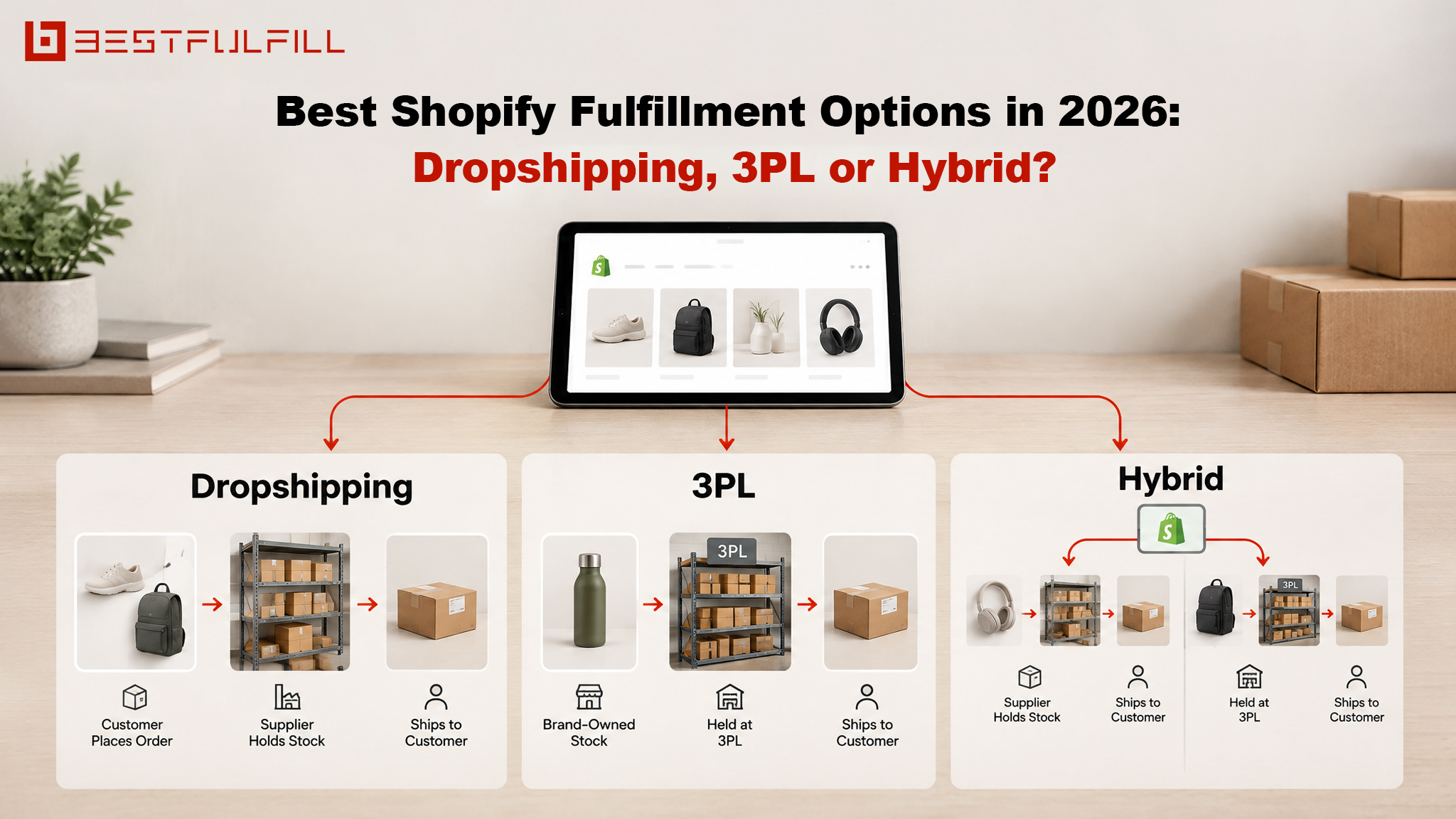
Best Shopify Fulfillment Options in 2026: Dropshipping, 3PL or Hybrid?
Choosing a fulfillment model for your Shopify store is no longer just about how to ship an order.
As a store grows, fulfillment starts affecting inventory risk, delivery speed, product quality, customer experience, cash flow, and how easily the business can scale.
A new product and a proven bestseller should not necessarily use the same fulfillment model.
For most Shopify brands, the right setup changes as products move from testing to validation and scale.
Key Takeaways
- Dropshipping is best for testing products with minimal inventory risk.
- 3PL fulfillment becomes more useful when demand is predictable and brands need greater control over inventory, shipping, and customer experience.
- Hybrid fulfillment combines flexibility with control and can work well for brands managing SKUs at different lifecycle stages.
- Fulfillment decisions should be made by SKU and business stage, rather than applying one model to the entire catalog.
- For brands sourcing from China, supplier coordination, QC, packaging, and inventory planning can matter as much as warehouse performance.
- The strongest fulfillment setup is usually the one that evolves as product demand becomes more predictable.
Quick Answer: What Is the Best Fulfillment Option for Shopify?
There is no single best model for every Shopify store.
| Business Stage | Best Fulfillment Model | Main Goal |
|---|---|---|
| Product Testing | Dropshipping | Validate demand with low inventory risk |
| Early Validation | Improved dropshipping | Stabilize supplier and shipping performance |
| Growing SKU | Hybrid fulfillment | Add inventory without losing flexibility |
| Scaling Brand | 3PL fulfillment | Improve control, speed, and consistency |
| Branded / Private Label | Sourcing + inventory + 3PL | Control product, packaging, and fulfillment |
The simplest rule is:
Use flexibility when demand is uncertain. Add inventory and fulfillment infrastructure as demand becomes more predictable.
Dropshipping — Best for Product Testing
Best for: New products, uncertain demand, and brands that want to minimize upfront inventory investment.
With dropshipping, the supplier holds inventory and ships orders directly to customers.
Its biggest advantage is flexibility. Brands can test new products without committing large amounts of capital to stock before demand is proven.
Main Advantages
- Low upfront inventory risk
- Fast product testing
- Simple market entry
- Easy catalog expansion
- Less warehouse management
Main Limitations
The trade-off is control.
When fulfillment is handled entirely by a supplier, the brand may have less control over:
Product quality · Packaging · Inventory availability · Processing time · Tracking · Shipping experience
That makes dropshipping highly useful for testing, but not necessarily the best long-term model for every successful SKU.
Once a product begins generating predictable demand, the question changes from:
“Can this product sell?”
to:
“Can the current supply chain support its growth?”
3PL Fulfillment — Best for Validated and Scaling Products
Best for: Products with predictable demand where the brand needs stronger inventory and fulfillment control.
With 3PL fulfillment, the brand purchases inventory and sends it to a third-party logistics provider, which can handle storage, picking, packing, shipping, and sometimes returns or other value-added services.
Why Brands Move to 3PL
Holding inventory can give growing brands greater control over:
- Fulfillment consistency
- Inventory visibility
- Packaging
- Shipping options
- Order processing
- Multi-market distribution
It can also reduce the amount of internal time spent coordinating daily fulfillment tasks.
The Trade-Off
Greater control comes with greater inventory commitment.
Brands need to manage:
Demand forecasting · Inventory investment · Storage · Replenishment · Unsold stock
That is why 3PL fulfillment generally makes more sense for validated and scaling SKUs than products that are still being tested.
Hybrid Fulfillment — Best for Brands Managing Different SKU Stages
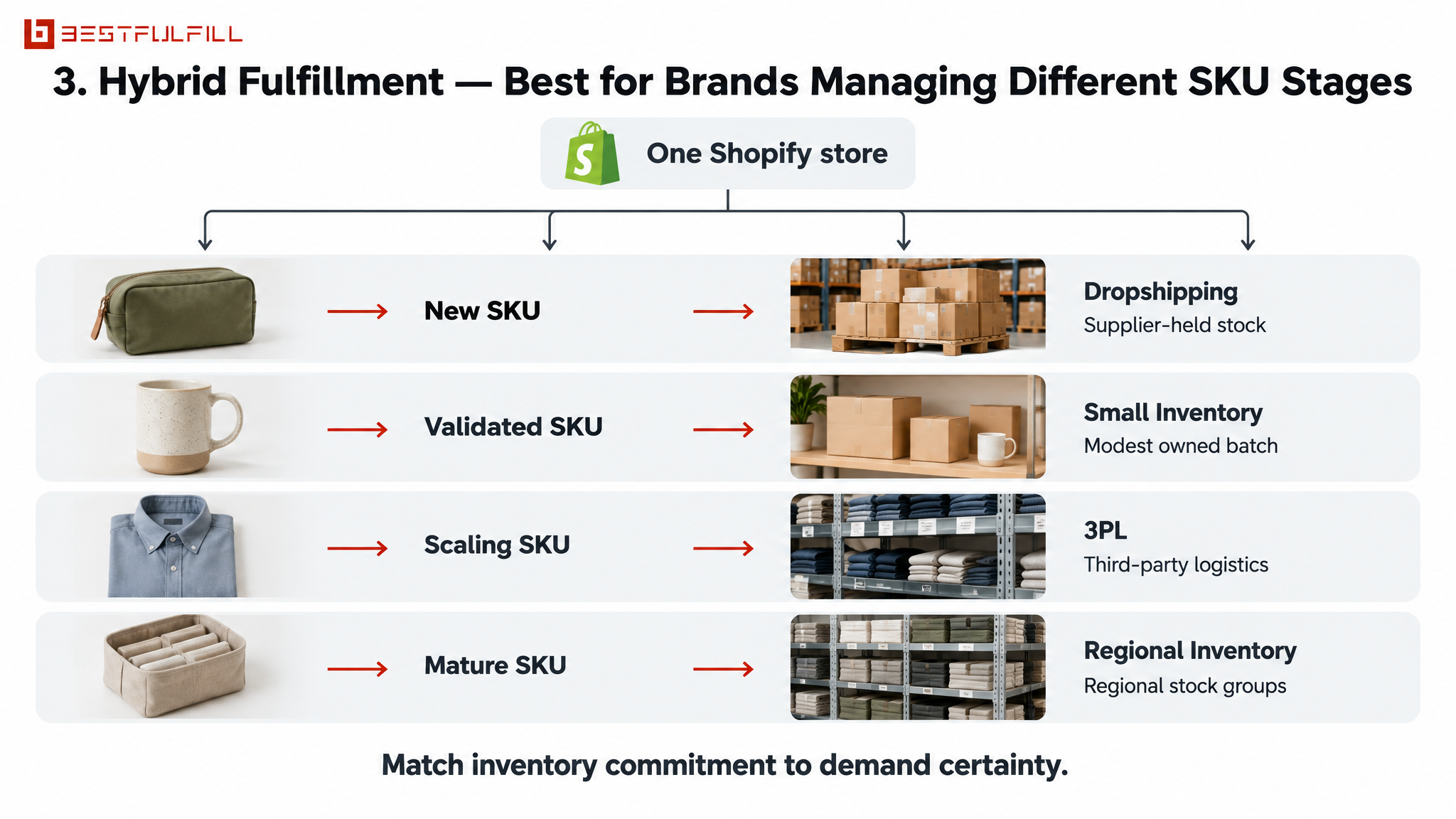
Best for: Growing Shopify brands that want to continue testing new products while adding more control to proven winners.
Hybrid fulfillment combines more than one fulfillment model within the same business.
For example:
New SKU → Dropshipping
Validated SKU → Small Inventory
Scaling SKU → 3PL
Mature SKU → Regional Inventory
This can be more practical than moving the entire product catalog to inventory at the same time.
Not every SKU carries the same level of demand certainty.
A new product should not necessarily receive the same inventory commitment as a product with stable repeat sales.
That is why hybrid fulfillment works especially well when fulfillment decisions follow the SKU lifecycle.
Do not over-invest in inventory before demand is proven—but do not keep a proven product in a low-control fulfillment model forever.
Dropshipping vs 3PL vs Hybrid: Which Should You Choose?
| If Your Priority Is... | Best Fit |
|---|---|
| Testing products with low risk | Dropshipping |
| Avoiding upfront inventory | Dropshipping |
| Better fulfillment control | 3PL |
| Custom packaging | 3PL |
| More predictable shipping | 3PL |
| Testing new SKUs while stocking winners | Hybrid |
| Managing different SKU lifecycle stages | Hybrid |
| China sourcing + QC + fulfillment | Integrated sourcing + fulfillment |
| Expanding across multiple markets | Hybrid / 3PL |
The strongest choice depends on where the uncertainty sits.
If the biggest uncertainty is product demand, stay flexible.
If demand is already proven but supplier, inventory, or fulfillment issues are limiting growth, adding more structure may create greater value.
What Changes When a Shopify Brand Starts Scaling?
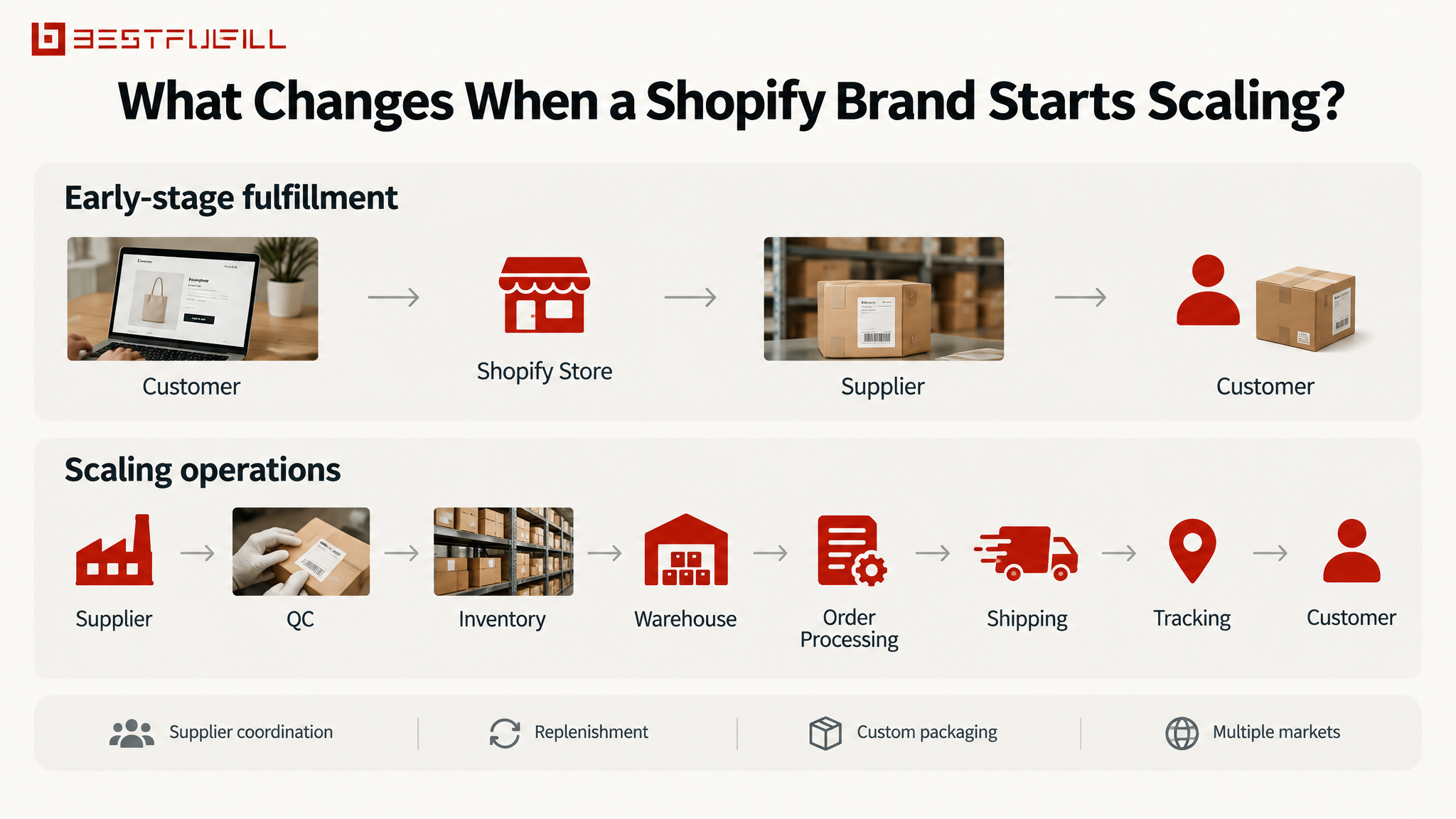
Early-stage fulfillment can be very simple:
Customer → Shopify Store → Supplier → Customer
But as the business grows, more operational steps appear:
Supplier → QC → Inventory → Warehouse → Order Processing → Shipping → Tracking → Customer
At that stage, fulfillment becomes less about simply sending parcels and more about coordinating the supply chain.
Common challenges start to include:
- Multiple suppliers
- Inconsistent product quality
- Replenishment timing
- Inventory allocation
- Custom packaging
- Peak-season capacity
- Different destination markets
- Multiple fulfillment locations
A Shopify store may continue operating smoothly while the supply chain behind it becomes increasingly complex.
That is why growing brands need to evaluate whether their operations can scale as reliably as their storefront.
What We See From Growing Shopify Brands
From our work with cross-border ecommerce brands, one pattern appears repeatedly:
Brands often upgrade fulfillment too late—or move too much inventory too early.
Products that are still being tested benefit from flexibility.
But once demand becomes more predictable, operational bottlenecks often move upstream.
We commonly see challenges around:
Supplier delays · Inconsistent QC · Packaging preparation · Replenishment timing · Inventory coordination · Shipping consistency
At that stage, simply changing the carrier may not solve the real problem.
A more useful approach is to map the complete workflow:
Sourcing → QC → Inventory → Warehousing → Fulfillment → Shipping
Then identify where greater control creates the most value.
This is also why we see fulfillment as a SKU lifecycle decision, rather than a one-time switch from dropshipping to inventory.
For Bestfulfill, that lifecycle approach is reflected in how different growth stages are supported: early-stage Shopify sellers can start with lighter fulfillment and small-batch product testing, while expanding DTC brands can move toward flexible capacity, customization, and more structured fulfillment.
Where Bestfulfill Fits
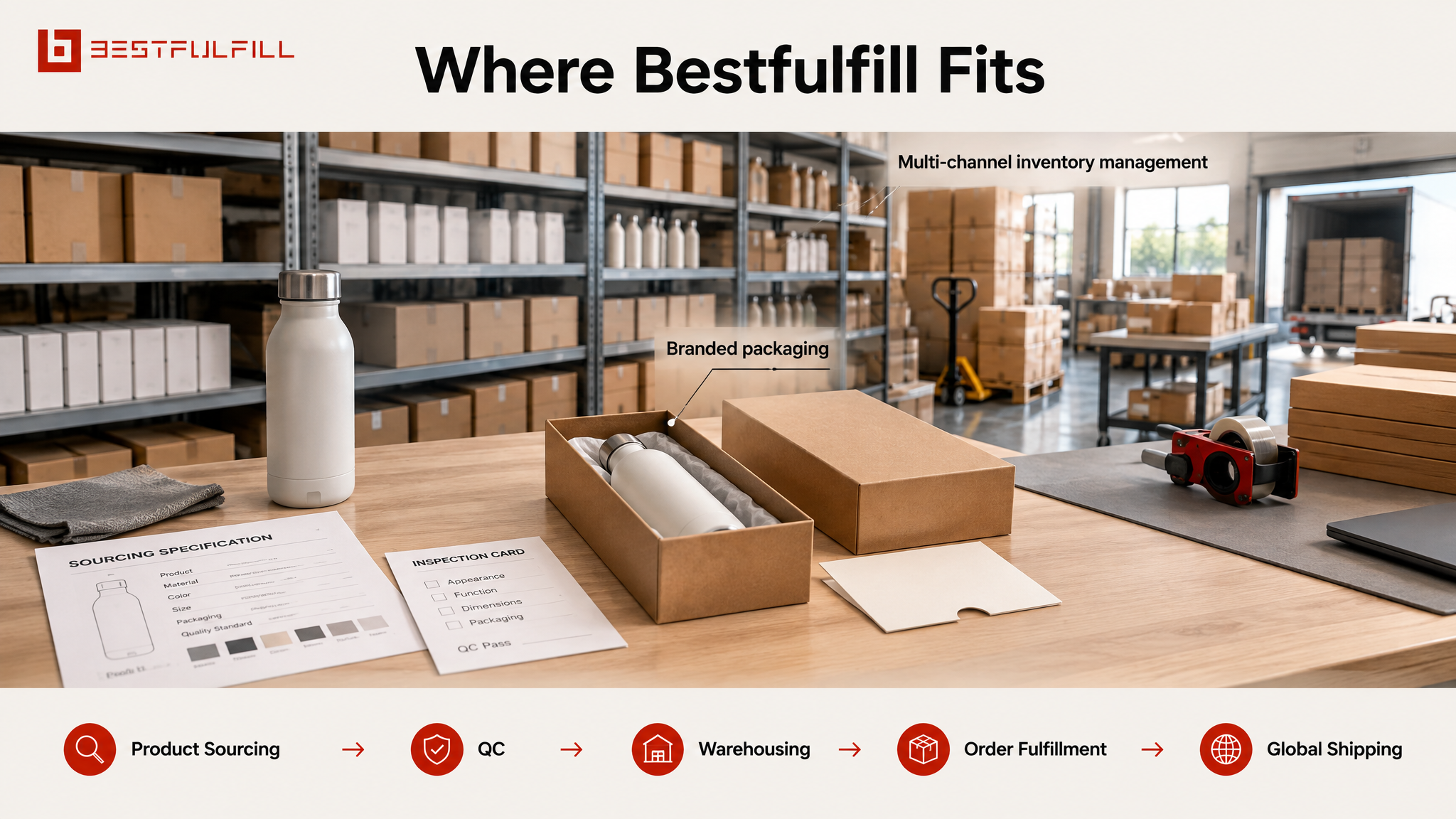
Bestfulfill is a sourcing and fulfillment partner for ecommerce brands that need to connect China sourcing, QC, warehousing, and global order fulfillment.
Its fulfillment infrastructure includes 60,000㎡ of domestic fulfillment capacity and 10+ overseas warehouses, with core business coverage across North America, Europe, Australia, and Southeast Asia.
The service workflow can connect:
Product Sourcing → QC → Warehousing → Order Fulfillment → Global Shipping
Bestfulfill also supports branded packaging and multi-channel inventory management as part of its fulfillment capabilities.
For stocked products, orders can be dispatched within 24 hours on business days, while selected local warehouse routes can provide 3–7 business day local delivery.
Bestfulfill May Be a Good Fit If You:
- Source products from China
- Need supplier coordination or QC
- Have validated products ready for inventory
- Want custom packaging or product branding
- Sell across multiple international markets
- Want fewer handoffs between sourcing, warehousing, and fulfillment
This becomes particularly relevant when the operational challenge starts before inventory enters the warehouse.
The goal is not to choose the provider with the widest service list.
It is to choose the partner that removes the largest bottleneck from your supply chain.
How to Choose a Shopify Fulfillment Model
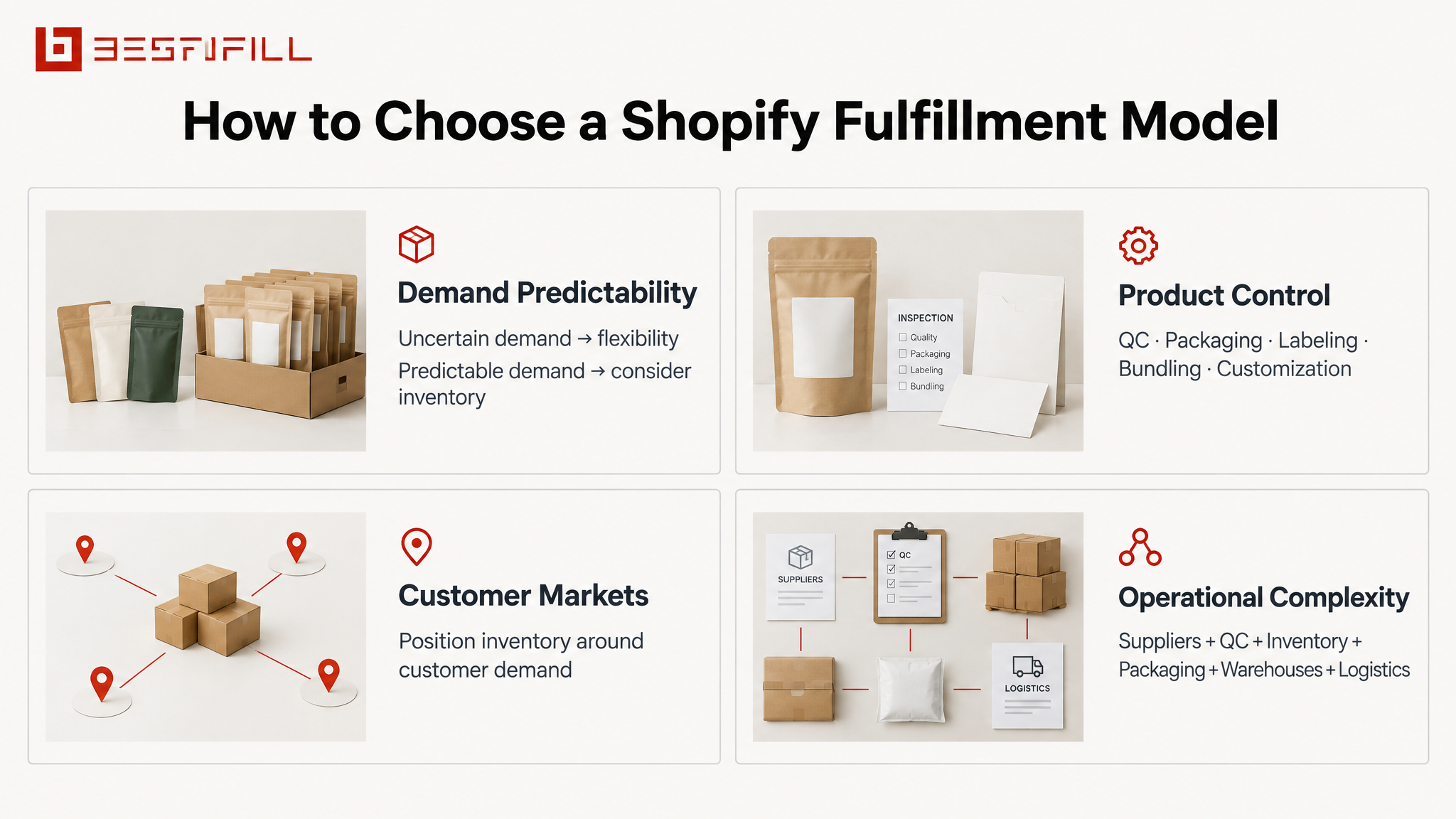
Instead of comparing fulfillment models through long feature lists, evaluate four factors.
1. Demand Predictability
Uncertain demand → prioritize flexibility
Predictable demand → consider inventory
The more stable demand becomes, the easier it is to justify holding stock.
2. Product Control
If your brand needs stronger:
QC · Packaging · Labeling · Bundling · Product customization
supplier-direct fulfillment may eventually become limiting.
3. Customer Markets
Where customers are located should influence where inventory is positioned.
A primarily domestic business may only need one regional fulfillment location.
A global DTC brand may require:
Cross-border fulfillment + overseas inventory
rather than one universal warehouse strategy.
Bestfulfill's current network, for example, combines domestic fulfillment infrastructure with 10+ overseas warehouse locations, allowing brands to move toward regional inventory as demand becomes more established.
4. Operational Complexity
The strongest signal that a business needs a more structured fulfillment model is often not order volume.
It is the amount of coordination required to fulfill those orders.
If your team is increasingly managing:
Suppliers + QC + Inventory + Packaging + Warehouses + Logistics
the current model may be becoming an operational bottleneck.
Final Verdict
The best Shopify fulfillment model in 2026 depends on the stage of the product and the business.
Dropshipping remains valuable for testing products and minimizing inventory risk.
3PL fulfillment becomes more useful for validated products that require greater control over inventory, packaging, and shipping.
Hybrid fulfillment can be particularly effective for growing brands because different products can use different fulfillment models based on demand and maturity.
The most useful principle is:
Fulfillment should evolve with the SKU lifecycle.
Test with flexibility.
Add control when demand becomes predictable.
Build fulfillment infrastructure when the product is ready to scale.
Frequently Asked Questions (FAQ)
What is the best fulfillment option for Shopify?
There is no single best option. Dropshipping works well for product testing, 3PL fulfillment is better suited to validated products, and hybrid fulfillment can work well for stores managing products at different lifecycle stages.
Does Shopify handle fulfillment?
Shopify provides the ecommerce platform and order-management tools, while physical fulfillment is typically handled by the merchant, supplier, warehouse, or third-party logistics provider.
What is Shopify 3PL fulfillment?
Shopify 3PL fulfillment means connecting a Shopify store to a third-party logistics provider that stores inventory and fulfills customer orders on behalf of the brand.
Is dropshipping or 3PL better for Shopify?
Dropshipping provides more flexibility and lower inventory risk. A 3PL provides more inventory, packaging, and fulfillment control. The right model depends largely on how predictable product demand has become.
When should a Shopify store use a 3PL?
Consider a 3PL when validated products require more consistent inventory availability, packaging, shipping performance, or operational control.
Can I use dropshipping and a 3PL at the same time?
Yes. A hybrid model allows a brand to dropship newer products while holding inventory for proven sellers.
What is hybrid fulfillment?
Hybrid fulfillment means using multiple fulfillment models within one business. For example, a store may dropship test products while using a 3PL for its highest-volume SKUs.
What is the best fulfillment model for a growing Shopify brand?
For many growing brands, a hybrid approach can balance inventory risk with greater control. New SKUs can remain flexible while validated products move toward inventory and structured fulfillment.
Can a 3PL handle custom packaging for Shopify orders?
Many 3PLs provide value-added services such as labeling, kitting, inserts, and branded packaging. Bestfulfill, for example, supports branded packaging alongside warehousing, order processing, logistics, and multi-channel inventory management.
How do Shopify stores fulfill international orders?
International Shopify brands can use supplier-direct shipping, cross-border 3PL fulfillment, regional overseas warehouses, or a combination of these methods. The best setup depends on demand concentration, inventory strategy, delivery expectations, and target markets.