



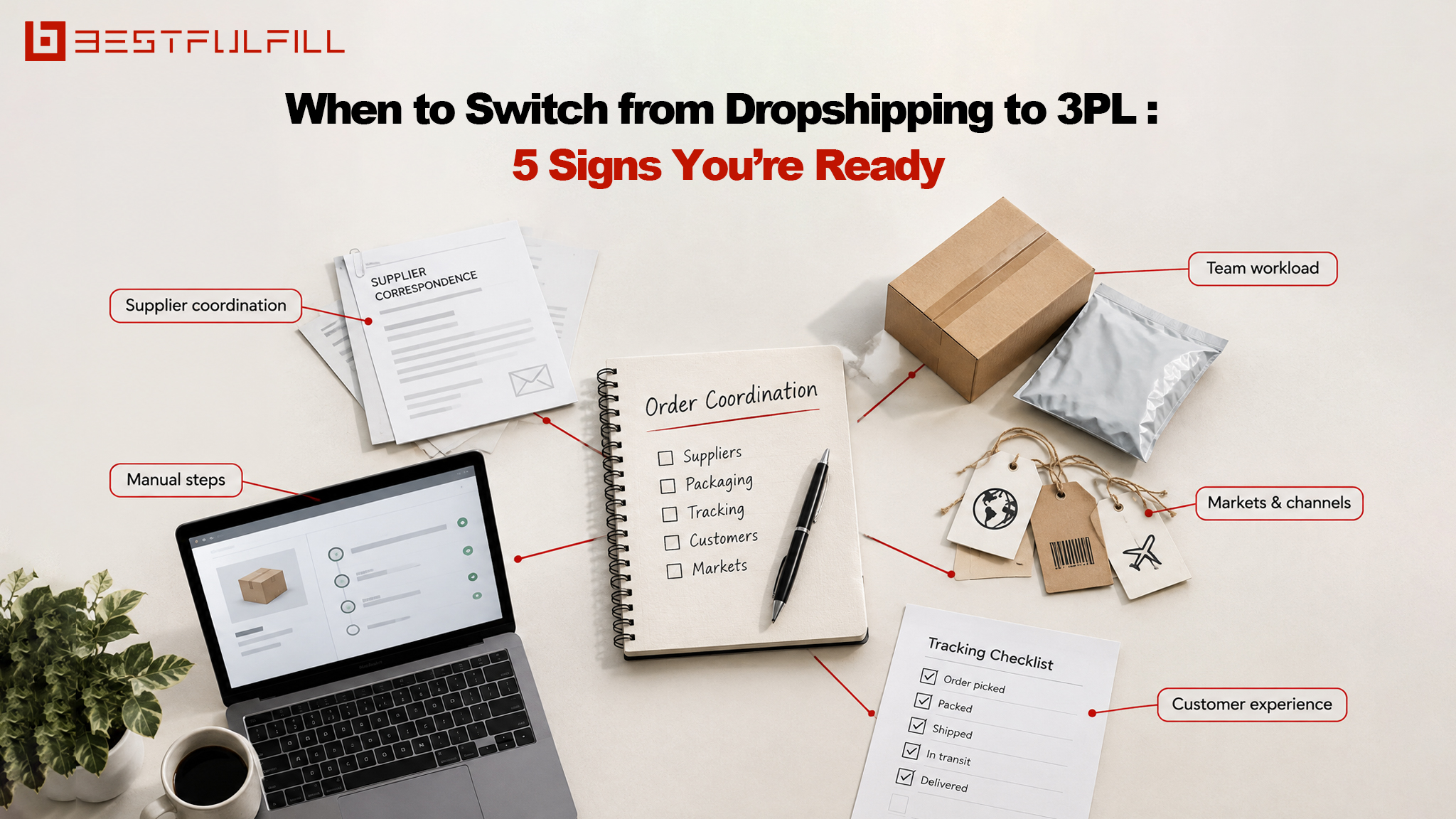
When to Switch from Dropshipping to 3PL: 5 Signs You’re Ready
Dropshipping can be a practical way to launch products, test demand, and grow without holding large amounts of inventory.
But as a business expands, fulfillment often becomes more complex. More suppliers, SKUs, sales channels, shipping routes, and customer expectations create more coordination work.
That does not mean every growing dropshipping business needs a 3PL.
The real question is whether your current fulfillment model can still support the way your business operates today.
Key Takeaways
- Growth alone does not mean you need a 3PL. Increasing fulfillment complexity is usually the stronger signal.
- Common warning signs include rising internal workload, fragmented supplier coordination, manual processes, inconsistent customer experience, and multi-market expansion.
- There is no universal order-volume threshold for switching from dropshipping to 3PL fulfillment.
- A 3PL can help centralize and standardize fulfillment, but it is not always the right choice for every business.
- Some brands use a hybrid fulfillment model, combining dropshipping and 3PL based on product demand or market needs.
Quick Answer: When Should You Switch from Dropshipping to a 3PL?
You should consider switching from dropshipping to a 3PL when fulfillment becomes harder to manage than the growth it supports.
This usually happens when your team spends more time coordinating suppliers, checking orders, handling shipping issues, or managing different fulfillment processes across products and markets.
There is no magic order number.
A higher-volume business may still use dropshipping efficiently if the workflow remains simple. A smaller brand with several suppliers, sales channels, and shipping routes may already need a more structured fulfillment setup.
The better question is:
Has your fulfillment operation become too complex to manage efficiently with your current setup?
If the answer is yes, it may be time to evaluate a 3PL.
Dropshipping vs 3PL: What Actually Changes?
The difference between dropshipping and 3PL fulfillment is not simply where products are stored. It is also about who coordinates the fulfillment process.
| Dropshipping | 3PL Fulfillment | |
|---|---|---|
| Inventory | Usually held by the supplier | Usually stored with the 3PL |
| Fulfillment | Supplier processes and ships orders | 3PL picks, packs, and ships |
| Coordination | Often managed supplier by supplier | More activities can be centralized |
| Packaging | Often supplier-dependent | More standardized or customizable |
| Operational Control | Lower | Higher |
| Best For | Product testing and simpler operations | Growing, more complex operations |
A simple dropshipping workflow may look like:
Customer Order → Supplier → Shipment → Customer
As the business grows, it can become:
Order → Supplier → QC → Warehouse → Carrier → Tracking → Customer Service → Returns
At that point, the problem is not dropshipping itself. The problem is whether the business can still manage all the moving parts efficiently.
5 Signs It May Be Time to Switch to a 3PL
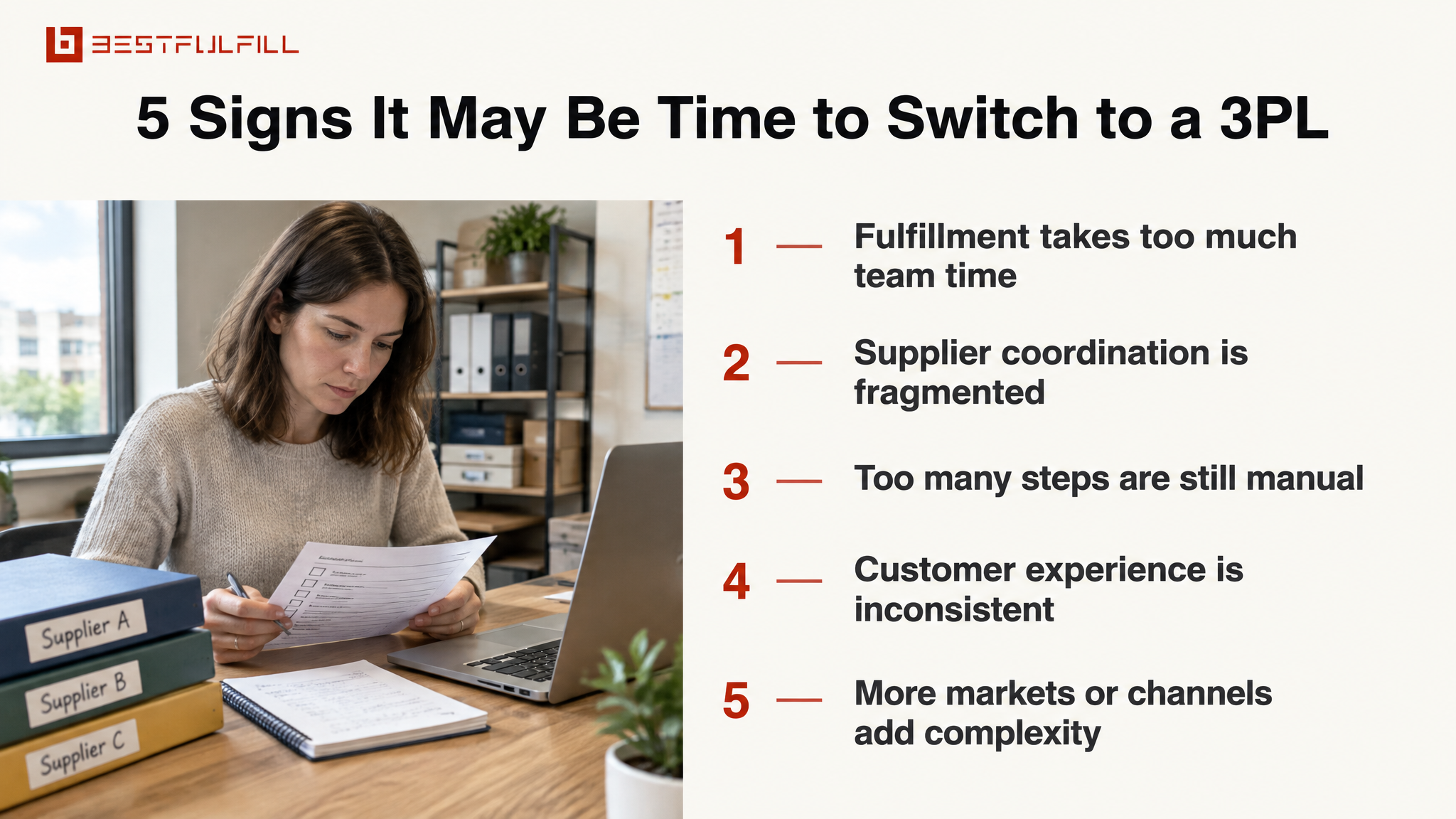
1. Fulfillment Is Taking Too Much of Your Team’s Time
Manual fulfillment may work well at first. But as orders grow, the workload grows too. Your team may spend more time checking orders, following up with suppliers, tracking shipments, and fixing fulfillment issues.
The cost is not just labor. It is also the time taken away from marketing, product development, and growth.
If fulfillment keeps demanding more internal resources, your current model may be reaching its limit.
2. Supplier Coordination Is Becoming Fragmented
More suppliers usually mean more processes to manage.
Different suppliers may follow different lead times, packaging standards, shipping methods, and communication routines.
What looks like three suppliers can quickly become three separate fulfillment workflows.
If your team is constantly coordinating between suppliers, QC, packaging, and shipping, the operation may need more centralization.
3. Too Many Fulfillment Steps Are Still Manual
Manual work is manageable when operations are simple. It becomes harder to scale as the business grows.
Your team may still be copying order information, confirming changes by hand, checking tracking one shipment at a time, or repeating the same instructions across different partners.
The more manual steps involved, the harder the workflow becomes to scale.
A 3PL can help reduce routine coordination and make fulfillment more structured.
4. Customer Experience Is Becoming Inconsistent
Fulfillment directly affects customer experience.
Packaging, order accuracy, processing speed, tracking, delivery, and returns all shape how customers see your brand.
If the experience changes depending on the supplier, product, or market, consistency becomes difficult to maintain.
A 3PL can help standardize key fulfillment processes and create a more predictable customer experience.
5. Multiple Markets or Channels Are Increasing Complexity
One store and one market are relatively simple to manage.
Add TikTok Shop, Amazon, new countries, and more suppliers, and the workflow becomes much more complex.
Each new channel adds another order flow. Each new market can add different shipping and fulfillment requirements.
If expansion creates far more coordination work, your fulfillment setup may no longer be built for the way the business operates today.
When Is a 3PL Worth It?
A 3PL is worth considering when the operational benefits of a more structured fulfillment model outweigh the cost and complexity of the current setup.
That means looking beyond shipping rates alone.
| Cost to Consider | What to Evaluate |
|---|---|
| Labor | How much internal time is spent managing fulfillment? |
| Coordination | How much supplier and logistics follow-up is required? |
| Errors | What do incorrect, delayed, or missed orders cost? |
| Customer Service | How much workload comes from tracking and delivery issues? |
| Opportunity Cost | What higher-value work could your team focus on instead? |
A 3PL does not automatically reduce every cost. Warehousing, receiving, pick-and-pack, and inventory management also come with expenses.
Its value often comes from reducing fragmented workflows, creating more repeatable processes, and freeing internal teams from routine coordination.
The right comparison is therefore total operational cost and complexity, not shipping price alone.
How to Transition from Dropshipping to a 3PL
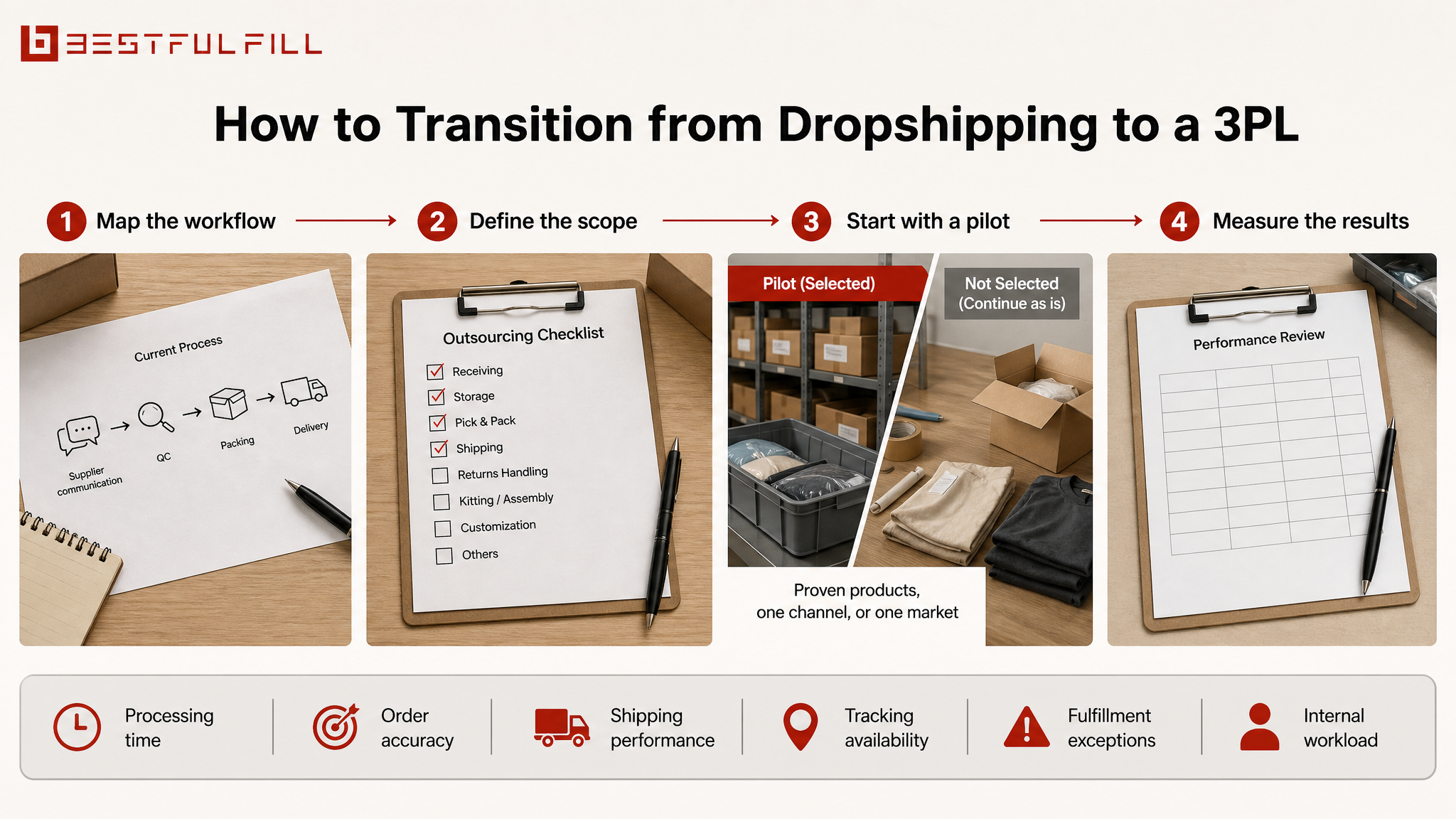
Moving to a 3PL does not mean everything has to change at once.
Start by mapping your current workflow from order placement to final delivery. Identify who handles supplier communication, product preparation, QC, packaging, shipping, tracking, returns, and fulfillment issues.
Next, define what you actually need from a 3PL. Some businesses only need warehousing and fulfillment. Others may also need supplier coordination, quality control, branded packaging, international shipping, or returns management.
You can also start with a smaller scope. Move proven products, one sales channel, or one destination market first.
Then measure the results. Useful metrics include fulfillment processing time, order accuracy, shipping performance, tracking availability, fulfillment exceptions, and internal workload.
The goal is not to outsource everything.
It is to transfer the right operational responsibilities to the right partner.
Can You Use Dropshipping and a 3PL at the Same Time?
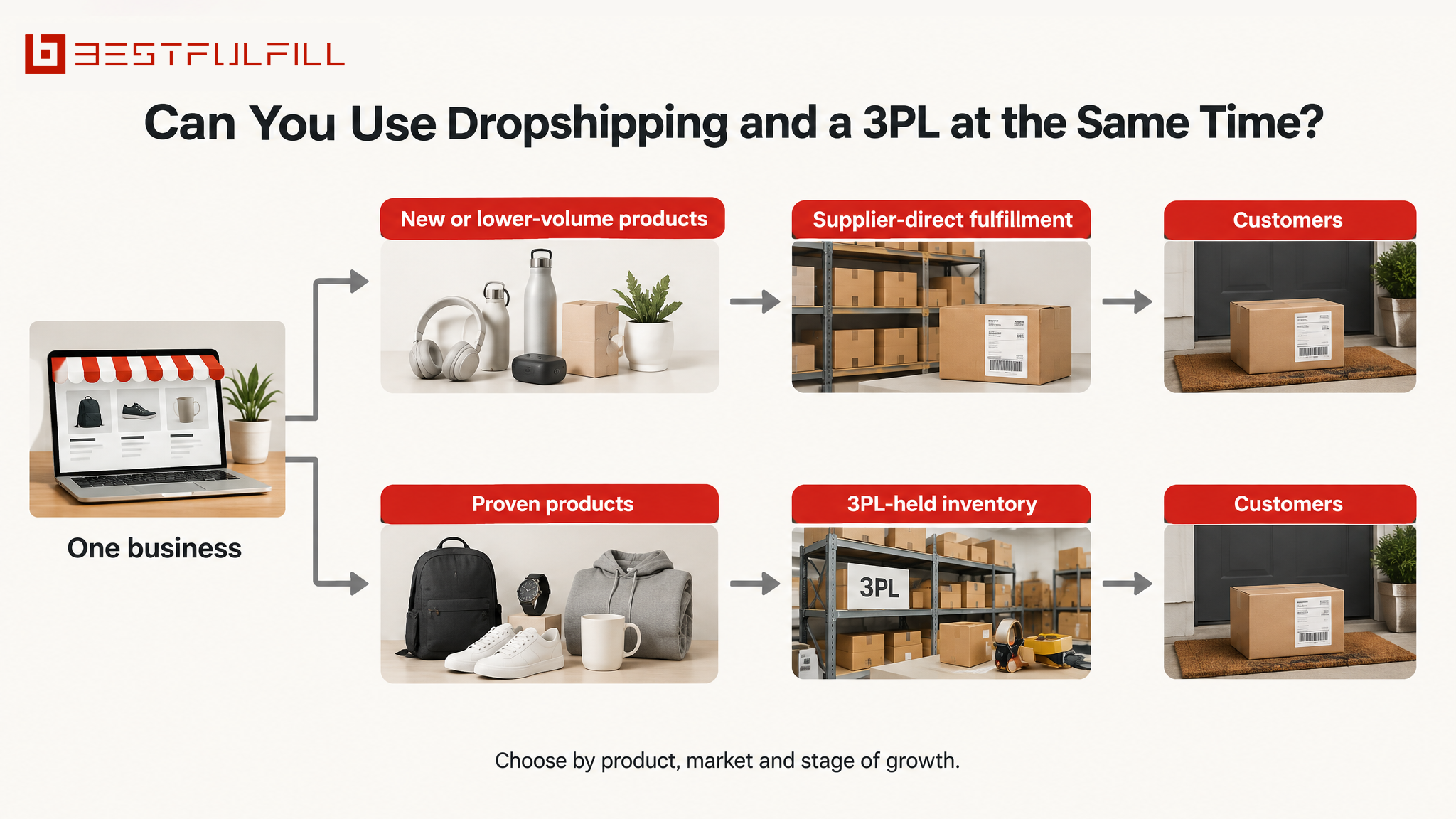
Yes. Dropshipping and 3PL fulfillment do not have to be mutually exclusive.
Some brands continue dropshipping new or lower-volume products while moving proven products into a 3PL warehouse.
This keeps the flexibility of dropshipping while giving the brand more control over established SKUs.
The same approach can work across markets. A business may use local or overseas warehousing for its largest markets while continuing to dropship into smaller ones.
For many growing ecommerce businesses, the real question is not simply dropshipping or 3PL.
It is:
Which fulfillment model makes the most sense for each product, market, and stage of growth?
Where Bestfulfill Fits
For ecommerce brands sourcing from China, fulfillment complexity often comes from managing sourcing, suppliers, quality control, warehousing, and international shipping as separate processes.
Bestfulfill connects these stages into a more structured fulfillment workflow:
Sourcing → Supplier Coordination → QC → Warehousing → Fulfillment → Global Shipping
This can help growing brands reduce fragmented supplier communication and build a more manageable operation across products and markets.
Bestfulfill supports this with 10+ years of industry experience, 60,000+ sqm of fulfillment center space, 10+ overseas warehouses, and millions of orders fulfilled annually.
The goal is not to move away from dropshipping simply because the business has grown. It is to build a fulfillment structure that can keep up as operational complexity increases.
Final Takeaway
The right time to switch from dropshipping to a 3PL is not when you reach a specific number of orders. It is when fulfillment becomes an operational bottleneck.
If supplier coordination, manual processes, customer experience, or multi-market expansion are becoming harder to manage, a more structured fulfillment model may be the next step.
For some brands, that means moving more fulfillment to a 3PL. For others, a hybrid approach may make more sense.
The goal is not simply to change fulfillment models.
It is to build a fulfillment operation that can keep up with your business.
Frequently Asked Questions (FAQ)
What is the difference between dropshipping and a 3PL?
With dropshipping, the supplier usually holds the inventory and ships products directly to customers. With a 3PL, the brand typically owns the inventory and stores it with the logistics provider, which then picks, packs, and ships orders on the brand’s behalf.
The main difference is not only inventory location, but also the level of control over fulfillment.
When should I switch from dropshipping to a 3PL?
Consider switching when fulfillment becomes difficult to manage efficiently. Common signs include growing supplier coordination, rising internal workload, too many manual processes, inconsistent fulfillment standards, and expansion across multiple channels or markets.
There is no universal order-volume threshold.
Is a 3PL cheaper than dropshipping?
Not necessarily. Dropshipping usually requires less upfront inventory investment, while 3PL fulfillment adds costs such as receiving, storage, pick-and-pack, and inventory management.
However, a 3PL may reduce other costs related to manual coordination, fulfillment errors, customer-service workload, and inefficient operations.
The better comparison is total fulfillment cost, not shipping price alone.
How does 3PL fulfillment work?
In a typical 3PL model, inventory is sent from the supplier or manufacturer to the 3PL warehouse. The 3PL receives and stores the products, connects with the brand’s sales channels, and picks, packs, and ships orders as customers place them.
Depending on the provider, additional services may include quality control, branded packaging, returns, and international shipping.
Do I need to buy inventory before using a 3PL?
Usually, yes. In a traditional 3PL model, the brand normally purchases or owns inventory before it is stored in the fulfillment warehouse.
This creates more inventory commitment than dropshipping, so demand forecasting and inventory planning become more important.
Can I use dropshipping and a 3PL at the same time?
Yes. A brand can use a hybrid fulfillment model—for example, dropshipping new products while storing proven, higher-volume products with a 3PL.
This keeps the flexibility of dropshipping while adding more control where it matters most.
How many orders do I need before using a 3PL?
There is no single order number that applies to every ecommerce business.
Some 3PLs have minimum order requirements, but operational complexity can matter more than volume. A business with several suppliers, markets, or channels may benefit from a 3PL before reaching very high order volume.
Is 3PL better than dropshipping?
Neither model is universally better.
Dropshipping can work well for product testing and limiting inventory risk. A 3PL is often better suited to businesses that need more control over inventory, packaging, fulfillment processes, and customer experience.
The right choice depends on the product, business stage, market, and operational requirements.
What are the disadvantages of using a 3PL?
Potential disadvantages include storage fees, inventory investment, receiving and fulfillment fees, less direct control over warehouse operations, and the risk of holding unsold stock.
These costs should be weighed against the operational workload and limitations of the current fulfillment model.
How do I choose a 3PL for my ecommerce business?
Look beyond shipping rates.
Evaluate warehouse locations, order-processing capabilities, integrations, inventory visibility, shipping options, service standards, support, pricing structure, and whether the provider can handle the products and markets you plan to serve.
For brands sourcing internationally, supplier coordination, QC, and cross-border logistics capabilities may also matter.