



Key Takeaways
- Shopify Is Still Growing: Q2 2026 revenue, gross profit, and GMV all increased strongly year over year.
- Ecommerce Is Easier to Enter: Shopify and AI tools are reducing the barriers to launching and operating online stores.
- Competition Is Increasing: As more brands can launch and test products quickly, execution becomes more important.
- Winning SKUs Create New Challenges: Once a product gains traction, sourcing, QC, inventory, and delivery can become growth constraints.
- Fulfillment Should Follow the SKU Lifecycle: Testing, validation, scaling, and mature products require different fulfillment priorities.
- AI Cannot Solve Physical Constraints: AI can accelerate digital operations, but inventory, quality, warehousing, and delivery still depend on physical execution.
Quick Answer: What Does Shopify's Growth Mean for DTC Brands?
Shopify's continued growth shows that ecommerce infrastructure is becoming easier to access.
For DTC brands, the challenge is gradually shifting from launching products to scaling them reliably.
As products move from testing to growth, fulfillment should evolve with the SKU lifecycle—from flexible origin fulfillment to quality control, regional inventory, and standardized operations.
What Happened: Shopify Continues to Grow
Shopify's Q2 2026 results highlight continued strength in ecommerce infrastructure.
In Q2 2026, Shopify reported:
- Revenue of $3.583 billion, up 34% year over year
- Gross profit of $1.708 billion, up 31%
- GMV of $115.56 billion, up 32%
- Adjusted EPS of $0.42, above analyst expectations
Shopify also provided stronger-than-expected Q3 guidance, expecting revenue growth in the low-30% range year over year.
The company is also expanding its AI capabilities through Sidekick, its AI commerce assistant, which is designed to help merchants with tasks such as store setup, content, promotions, and other workflows.
The bigger implication for DTC brands goes beyond Shopify's financial performance.
When launching becomes easier, execution becomes the differentiator.
More merchants can launch stores, test products, and reach customers with fewer resources. That creates opportunities—but also raises the level of competition.
Why Does Shopify's Growth Matter?
Ecommerce Is Becoming Easier to Enter
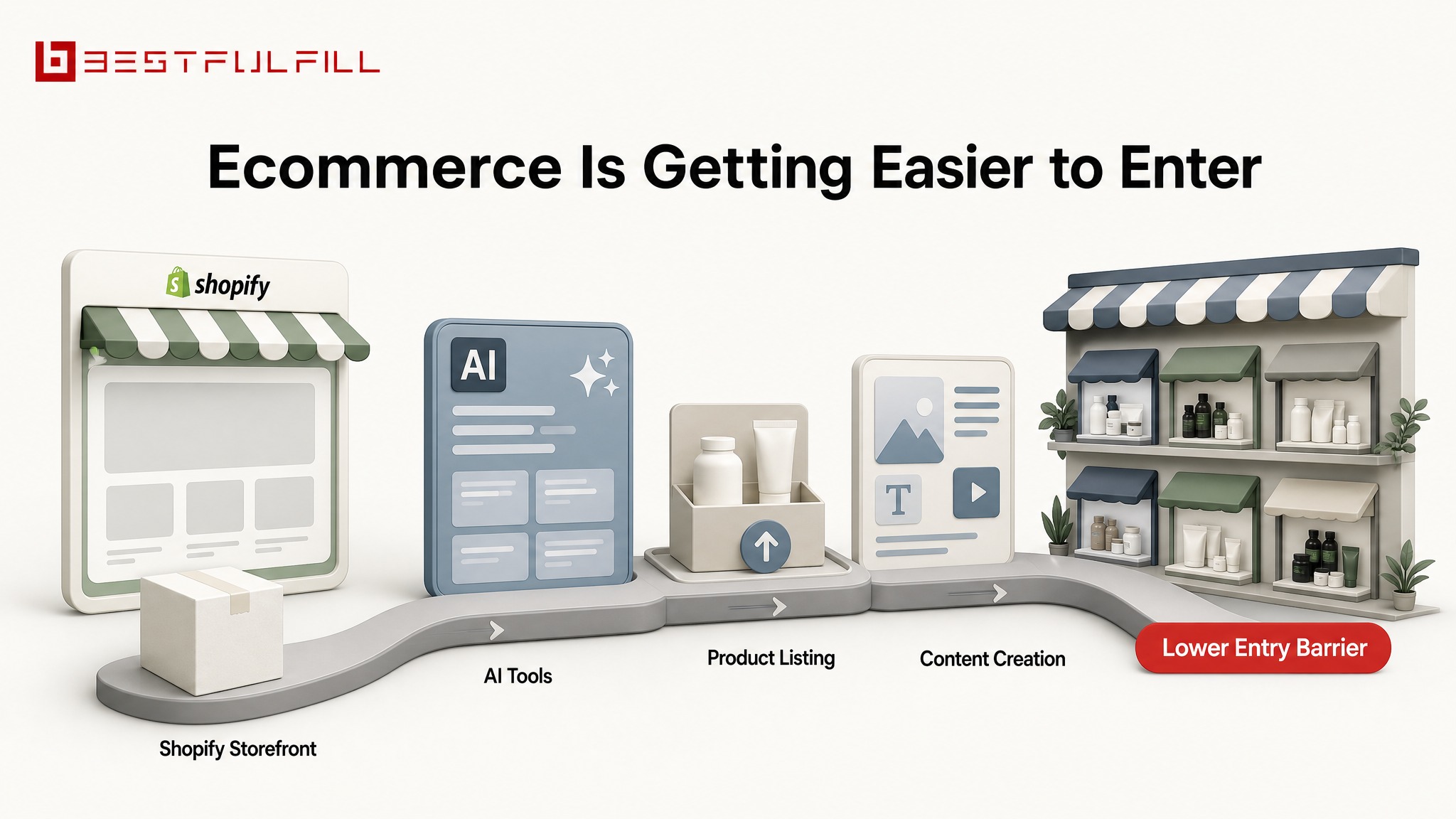
Shopify has reduced many of the technical barriers involved in launching an ecommerce business.
Merchants can now build stores, connect payments, manage orders, create content, and automate routine operations through increasingly integrated tools.
AI is pushing this trend further.
Product research, content creation, customer service, marketing, and other digital tasks can increasingly be accelerated with AI tools.
The result is straightforward:
More brands can launch and test products faster.
But easier entry also means more competition. If competitors can access similar platforms, suppliers, AI tools, and marketing technologies, simply launching quickly becomes less of an advantage.
The question then changes:
What happens after a product starts selling?
When Does Supply Chain Become a Growth Bottleneck?
Early-stage brands often prioritize flexibility.
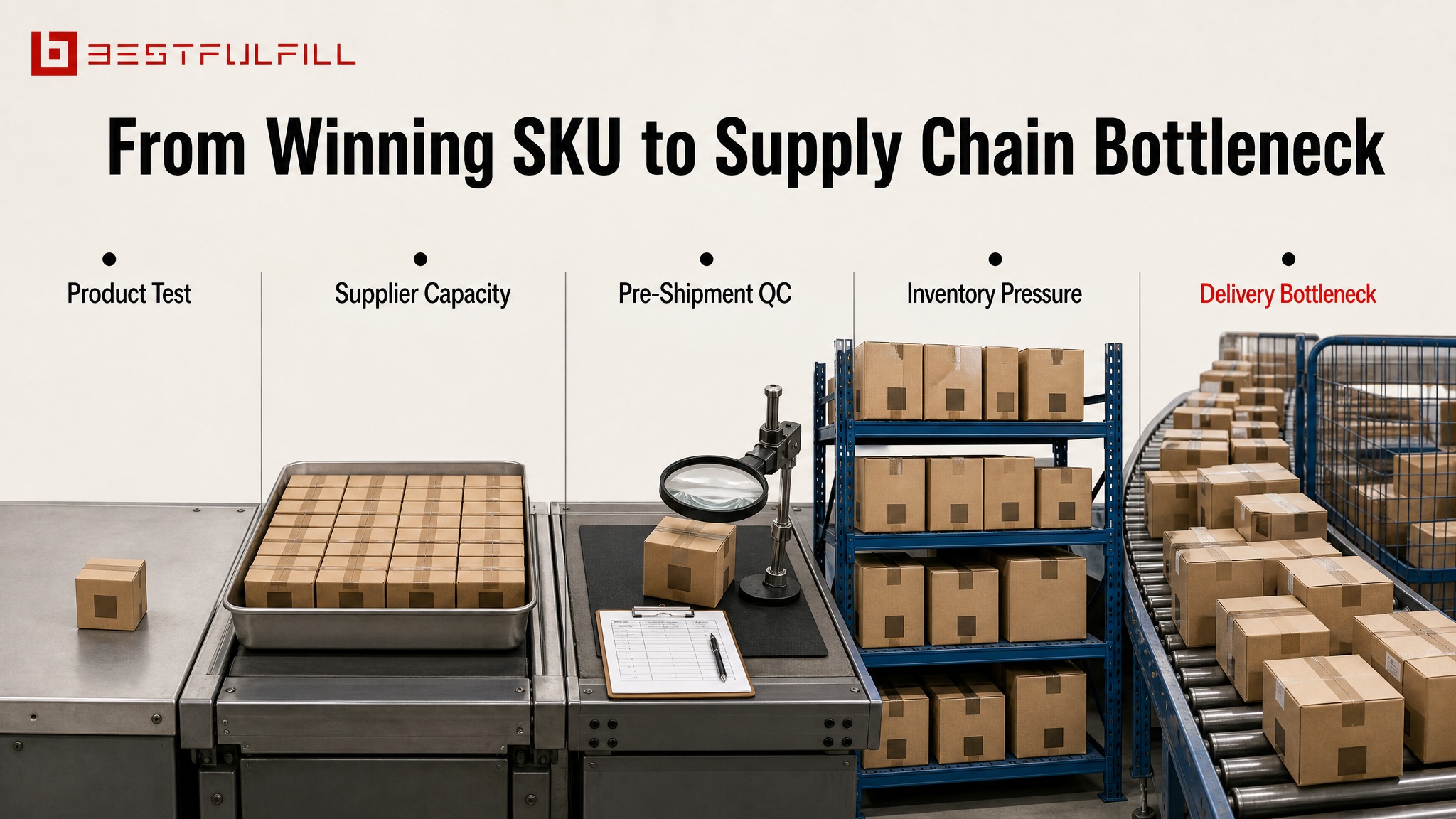
A typical product-testing model looks like:
Product discovery → Small-volume testing → Direct shipping → Validate demand
This can work well when demand is uncertain.
But once a SKU becomes a proven winner, its operational requirements change.
The brand may suddenly need:
- More consistent supplier production
- Pre-shipment quality inspection
- Better inventory forecasting
- Reliable shipping
- Regional inventory
- Custom packaging
- Returns management
At this point, the challenge is no longer simply finding a supplier.
It becomes a supply chain management problem.
A product can generate strong demand and still lose momentum if inventory arrives late, quality becomes inconsistent, or delivery performance fails to keep pace with customer expectations.
Fulfillment Should Follow the SKU Lifecycle
There is no single fulfillment model that works equally well for every product.
The right approach depends on where the SKU is in its lifecycle.
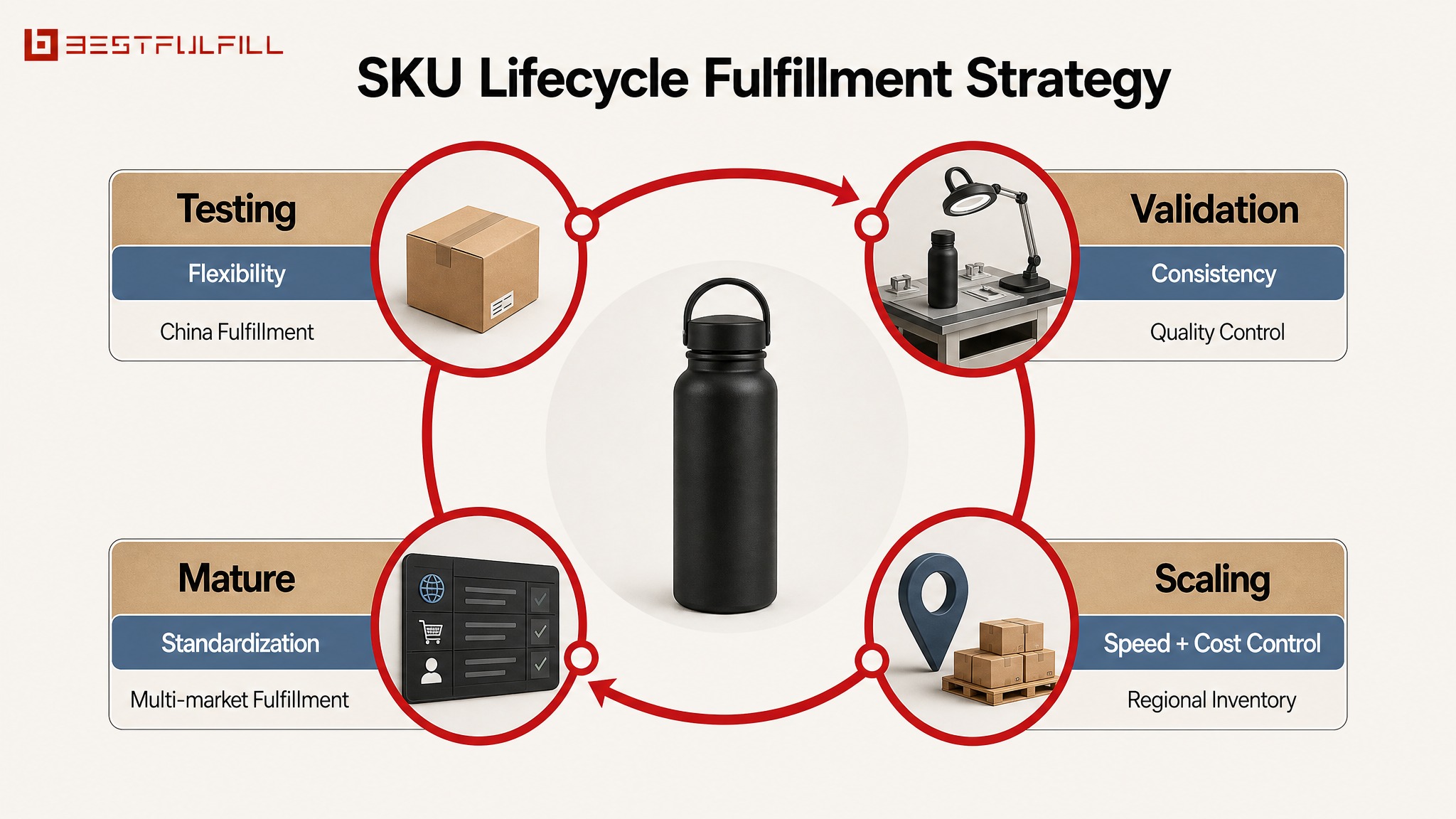
| SKU Stage | Main Goal | Recommended Fulfillment |
|---|---|---|
| Testing | Validate demand | Flexible China fulfillment |
| Validation | Improve reliability | QC + sourcing optimization |
| Scaling | Balance speed and cost | Regional inventory |
| Mature | Standardize operations | Multi-market fulfillment + SOPs |
Testing
Priority: Flexibility
When demand is unproven, brands typically benefit from low inventory commitment and flexible sourcing. Direct China fulfillment can help reduce inventory risk while the product is being tested.
Validation
Priority: Consistency
Once a product shows traction, quality control, supplier management, and inventory planning become more important. Pre-shipment inspection can help identify product issues before they reach customers.
Scaling
Priority: Speed + Cost Control
As order volume becomes more predictable, regional inventory may make economic sense. Positioning inventory closer to customers can improve delivery speed and reduce some operational complexity.
Mature
Priority: Standardization
Mature SKUs often require more structured SOPs, multi-market inventory management, packaging processes, and returns workflows.
The key is not choosing one fulfillment model for every SKU. It matches fulfillment to product maturity.
Why Fulfillment Is Becoming Growth Infrastructure
Fulfillment is often treated as an operational cost.
For scaling DTC brands, it is increasingly part of the growth system.
Consider the cycle:
More sales → More orders → More inventory → More fulfillment complexity → Higher customer expectations
At low volume, a small operational issue may be manageable.
At scale, the same issue can become expensive:
- Quality problems can create additional returns.
- Delayed shipments can increase customer support requests.
- Poor inventory planning can create stockouts.
- Unreliable delivery can weaken the customer experience.
As a result, fulfillment can affect both profitability and growth capacity.
The goal is not necessarily to use the fastest shipping method for every order.
The goal is to build a fulfillment model that supports the SKU's current stage—and can evolve as demand changes.
What Role Does AI Play?
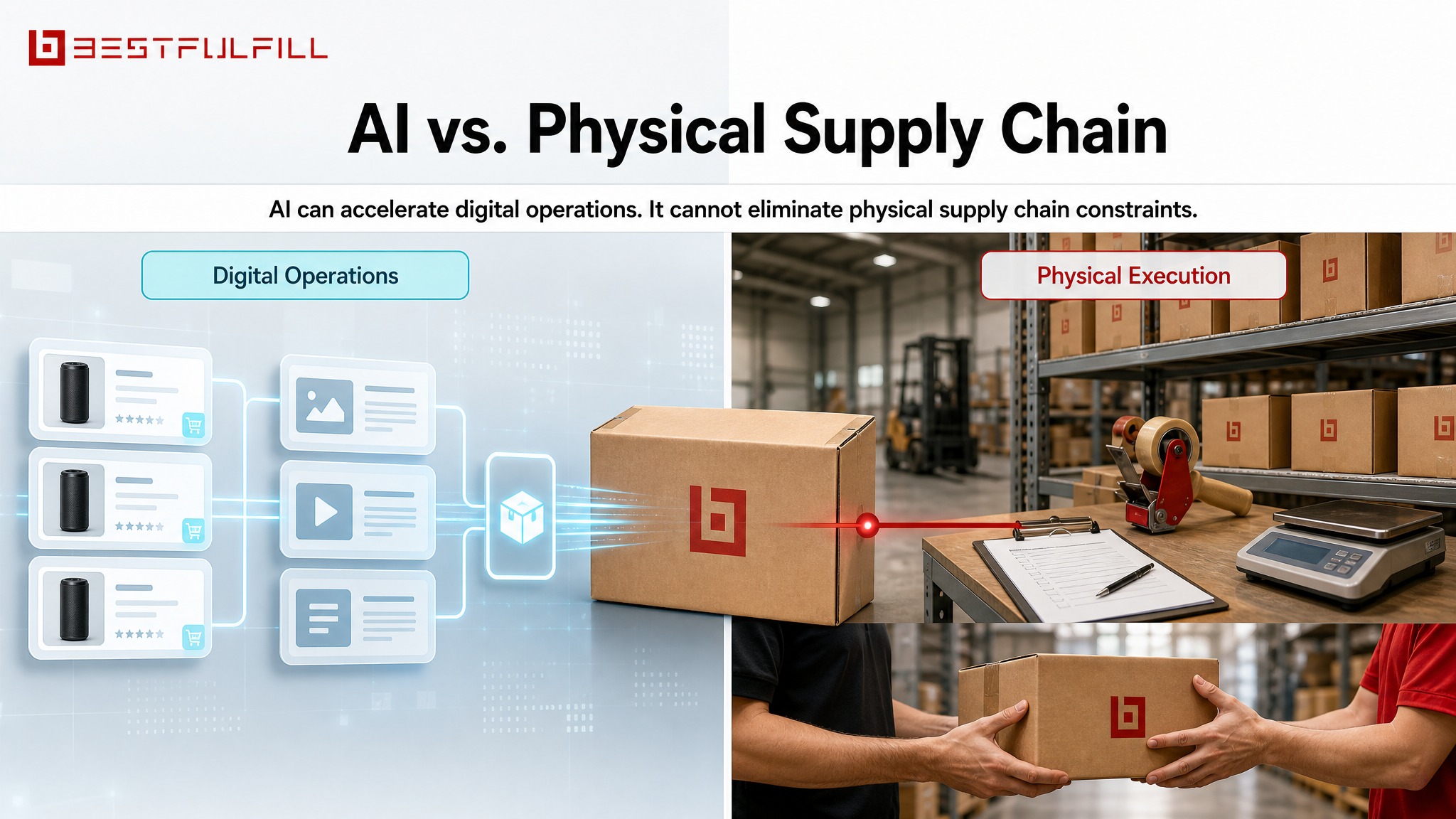
AI is accelerating ecommerce operations.
It can help brands with:
- Product research
- Content creation
- Marketing
- Customer service
- Store management
- Data analysis
But there is an important limitation:
AI can accelerate digital operations. It cannot eliminate physical supply chain constraints.
A better product description cannot solve a stockout.
AI-generated marketing cannot compensate for inconsistent product quality.
Automated order processing cannot replace reliable inventory and warehouse execution.
This creates an important distinction in modern ecommerce:
Digital operations are becoming more automated, while physical operations still depend on real-world execution.
For DTC brands, that makes supply chain reliability increasingly important.
When Should a Brand Upgrade Its Fulfillment?
There is no universal order-volume threshold.
Instead, brands can look for operational signals.
Your product has consistent demand
You are no longer testing whether customers want the product. Demand is becoming predictable enough to justify more structured operations.
Quality issues are increasing
Returns, refunds, or negative customer feedback are becoming more frequent.
Shipping affects customer experience
Delivery times, tracking, or carrier performance are becoming recurring concerns.
Inventory is becoming harder to manage
Stockouts, excess inventory, or increasing SKU complexity are consuming more operational resources.
Logistics is taking too much management time
Manual supplier communication, order tracking, and customer support are becoming difficult to manage internally.
When several of these signals appear together, fulfillment is no longer simply a back-office function. It has become part of the brand's growth infrastructure.
How Bestfulfill Supports the SKU Lifecycle
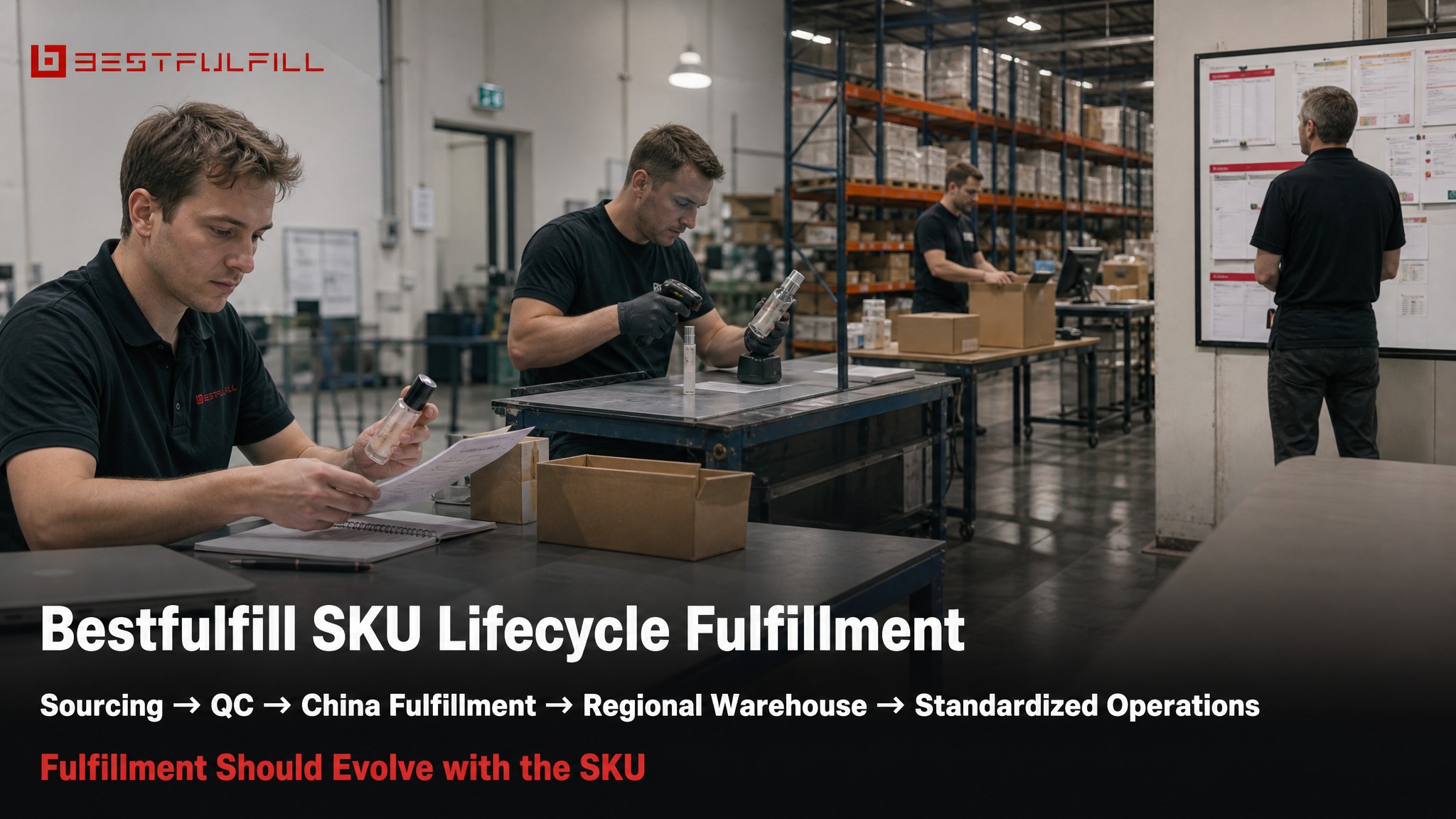
For brands moving beyond basic product testing, Bestfulfill combines China sourcing, quality control, and fulfillment within a lifecycle-based approach.
Instead of applying the same fulfillment model to every product, the strategy can evolve as SKUs mature.
Testing: Flexible China Fulfillment
For new or lower-volume products, China-based fulfillment can provide sourcing flexibility and lower inventory commitment.
Suitable for:
- Product testing
- New market launches
- Long-tail SKUs
- Uncertain demand
Validation: Sourcing + Quality Control
Once a SKU gains traction, the focus shifts toward product consistency and repeatable operations.
This can include:
- Supplier management
- Pre-shipment QC
- Packaging optimization
- Inventory planning
Scaling: Regional Fulfillment
For products with more predictable demand, inventory can be positioned closer to customers through regional fulfillment.
Potential benefits include:
- Faster regional delivery
- Better inventory visibility
- More predictable fulfillment
- Improved customer experience
Mature: Standardized Operation
Established products may require more structured SOPs across sourcing, fulfillment, packaging, inventory, and returns.
The broader principle is simple:
Fulfillment should evolve with the SKU—not remain fixed while the business scales.
Final Takeaway
Ecommerce Is Getting Easier. Scaling Is Not.
Shopify's Q2 2026 performance reflects continued growth in ecommerce infrastructure, while AI is making many digital operations faster and more accessible.
For DTC brands, this creates a more competitive environment where launching quickly is no longer enough.
The next advantage may come from execution:
Product → Brand → Customer Experience → Supply Chain → Fulfillment
For products still being tested, flexibility may matter most.
For proven winners, quality control, inventory planning, and fulfillment infrastructure become increasingly important.
The goal is not simply to find a fulfillment provider. It is to build a fulfillment strategy that grows with the product.
Frequently Asked Questions (FAQ)
Is Shopify's growth good for DTC brands?
Shopify's growth can create more accessible ecommerce infrastructure for merchants. At the same time, easier access to ecommerce tools can increase competition, making execution and customer experience more important.
When does fulfillment become a strategic priority?
Fulfillment typically becomes more important when a product develops consistent demand, quality issues increase, shipping affects customer experience, or inventory becomes difficult to manage.
Should new DTC brands use regional warehouses?
Not necessarily. For unproven products, flexible origin fulfillment can reduce inventory risk. Regional warehousing may become more relevant once demand becomes predictable.
Why is quality control important for scaling SKUs?
As order volume increases, even a small quality issue can result in more returns, refunds, and customer-service requests. Pre-shipment QC can help identify issues before products reach customers.
Can AI replace fulfillment operations?
No. AI can automate and accelerate many digital tasks, but physical activities such as inventory management, quality inspection, warehousing, and delivery still require operational execution.
What is SKU lifecycle fulfillment?
SKU lifecycle fulfillment means adapting the fulfillment model to the product's stage—from flexible fulfillment during testing to QC and sourcing optimization during validation, regional inventory during scaling, and standardized multi-market operations for mature products.