


Key Takeaways
- The best private label manufacturer depends on your product category, MOQ, customization needs, and growth stage.
- Apliiq and Trendsi are strong options for apparel, while Alibaba offers broad OEM/ODM manufacturer access.
- Printful and Printify are better suited to print-on-demand and design-led products.
- CJdropshipping and Zendrop can help ecommerce sellers move from dropshipping toward branded products.
- Bestfulfill is a stronger fit for brands that need to connect sourcing, QC, warehousing, branding, and fulfillment.
- Compare total landed cost, samples, MOQ, QC, lead time, IP ownership, and fulfillment—not just the factory price.
Quick Answer: What Are the Best Private Label Manufacturers?
There is no single best private label manufacturer for every ecommerce brand.
For apparel, Apliiq and Trendsi are worth considering. For broad OEM/ODM manufacturer sourcing, Alibaba provides one of the largest supplier pools. For print-on-demand, Printful and Printify offer low-inventory options.
For ecommerce brands moving beyond product testing, CJdropshipping, Zendrop, and Bestfulfill can provide a bridge between dropshipping and more controlled branded sourcing.
The right model usually follows:
Test → Validate → Customize → Brand → Scale
If demand is still uncertain, prioritize low MOQ and flexibility. Once a product has proven demand, greater control over quality, packaging, materials, and fulfillment becomes more valuable.
Best Private Label Manufacturers at a Glance
| Provider | Best For | Customization | Fulfillment |
|---|---|---|---|
| Alibaba | Broad manufacturer sourcing | High | Depends on supplier |
| Apliiq | Private label apparel | High | Yes |
| Trendsi | Fashion & apparel | Medium | Yes |
| Printful | Design-led products | Medium | Yes |
| Printify | Flexible POD | Medium | Yes |
| CJdropshipping | Private label dropshipping | Medium–High | Yes |
| Zendrop | Beginner-friendly branding | Medium | Yes |
| Bestfulfill | Sourcing + QC + fulfillment | High | Yes |
What Is a Private Label Manufacturer?

A private label manufacturer produces an existing or customizable product that is sold under your brand.
Depending on the supplier, customization may include:
- Logos and labels
- Packaging
- Colors and materials
- Product specifications
- Product design
Private labeling sits between generic dropshipping and fully custom manufacturing.
With dropshipping, you typically sell an existing supplier product. With private label, you gain more control over how that product is presented—and, depending on the manufacturer, how it is made.
Private Label vs. White Label vs. OEM vs. ODM
| Model | How It Works | Best For |
|---|---|---|
| White Label | Existing product + your branding | Fast, low-risk launches |
| Private Label | Existing product with branding/customization | Ecommerce brands |
| ODM | Manufacturer provides a design that you can modify | More product differentiation |
| OEM | You provide specifications/design | Maximum product and IP control |
The more customization you require, the more important MOQ, development time, sampling, and IP ownership become.
8 Best Private Label Manufacturers and Suppliers in 2026
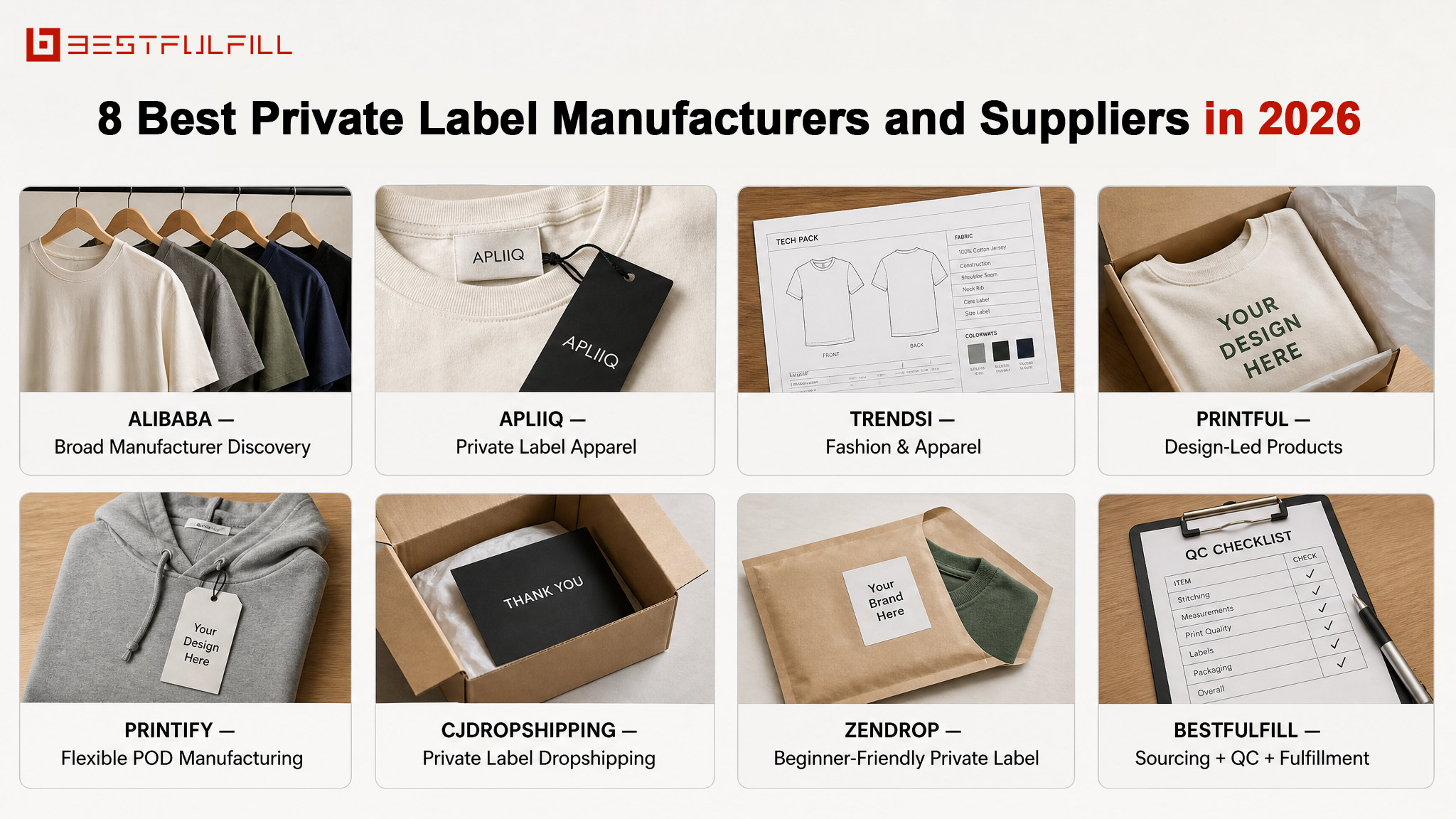
1. Alibaba — Best for Broad Manufacturer Discovery
Alibaba is a B2B sourcing marketplace rather than a single manufacturer. Its major advantage is the breadth of manufacturers available across product categories.
Best for: Brands looking for OEM, ODM, or private-label manufacturers.
Why consider it:
- Large manufacturer pool
- Broad product categories
- OEM/ODM capabilities
- Flexible MOQ options
- Extensive customization
The main challenge is supplier selection. Quality and manufacturing capabilities vary, so samples, certifications, production capacity, and QC procedures should be verified before placing an order.
2. Apliiq — Best for Private Label Apparel
Apliiq focuses on apparel and combines private labeling with print-on-demand, embroidery, custom packaging, and fulfillment.
Best for: Clothing brands that want branded apparel without large inventory commitments.
Its low-inventory model makes it useful for testing branded apparel. However, once volumes increase, traditional bulk manufacturing may offer better unit economics.
3. Trendsi — Best for Fashion and Apparel
Trendsi focuses on fashion products including apparel, shoes, and accessories, with private-label options for ecommerce sellers.
Best for: Fashion entrepreneurs moving from generic products toward branded apparel.
Its relatively low barrier to entry makes it useful for early-stage brands, although private-label MOQ and customization requirements can vary by product.
4. Printful — Best for Design-Led Products
Printful is primarily a print-on-demand provider, making it more suitable for brands whose differentiation comes from original designs rather than product engineering.
Best for: Creators and Shopify brands selling custom apparel and accessories.
The main advantage is avoiding traditional inventory commitments. The trade-off is less control over the underlying product compared with a dedicated OEM/ODM manufacturer.
5. Printify — Best for Flexible POD Manufacturing
Printify connects merchants with multiple production partners, giving brands more flexibility across products and production locations.
Best for: Brands that want to compare different POD production providers.
Because products come from different production partners, quality and fulfillment can vary. Sampling remains important before scaling a product.
6. CJdropshipping — Best for Private Label Dropshipping
CJdropshipping combines sourcing, warehousing, fulfillment, and branding support, making it useful for sellers moving beyond standard dropshipping.
Best for: Ecommerce sellers transitioning toward branded products.
Depending on the product, sellers can explore custom sourcing, packaging, labeling, and other branding options without immediately establishing a direct factory relationship.
Before committing, confirm the specific product's MOQ, customization requirements, sample costs, and production timeline.
7. Zendrop — Best for Beginner-Friendly Private Label
Zendrop combines product sourcing, Shopify integration, fulfillment, and branding features in a relatively simple ecommerce workflow.
Best for: Newer brands experimenting with branded products.
Its strength is convenience and automation. However, brands requiring deep product development, custom materials, or highly specialized manufacturing may eventually need a dedicated OEM/ODM partner.
8. Bestfulfill — Best for Sourcing + QC + Fulfillment
Bestfulfill is better understood as a sourcing and fulfillment partner rather than a traditional private-label factory.
Its value becomes more apparent when private labeling is part of a broader SKU lifecycle:
Source → Sample → QC → Customize → Stock → Fulfill → Scale
Instead of treating sourcing, quality control, warehousing, and fulfillment as separate operations, Bestfulfill can connect these stages around the same SKU.
Best for: Growing ecommerce brands that need greater supply-chain control after product validation.
Key capabilities include:
- Product sourcing
- Supplier coordination
- Quality inspection
- Private-label support
- Custom packaging
- Warehousing
- Cross-border fulfillment
- Multi-market fulfillment
This model is particularly useful when the goal is not simply to add a logo, but to build a repeatable supply chain around a winning product.
How to Choose a Private Label Manufacturer

Don't choose based on the lowest unit price alone. Compare these six areas.
1. MOQ and Total Landed Cost
MOQ determines how much inventory and cash you need upfront.
Compare:
Product Cost + Packaging + Shipping + Fulfillment + Returns
A lower factory price may not result in a lower total cost if quality, shipping, or rework costs are higher.
2. Customization
Clarify whether the supplier supports the level of customization you actually need:
- Logo and labels
- Packaging
- Materials
- Colors
- Dimensions
- Formulation
- Product design
Simple branding and true product development are very different manufacturing requirements.
3. Samples and QC
Always order samples before mass production.
Check:
Design → Materials → Function → Finish → Packaging
Also ask who performs QC, when inspections happen, what defects are checked, and what happens if a batch fails inspection.
4. Lead Time and Capacity
Look at the complete timeline:
Sampling → Production → QC → Packaging → Shipping
A manufacturer that can produce cheaply but repeatedly misses deadlines may create more problems than it solves.
5. IP and Certifications
For customized products, clarify who owns the product design, molds, specifications, and other intellectual property.
For regulated or market-specific products, confirm required certifications before production.
6. Fulfillment
If you sell through Shopify or other ecommerce channels, check whether the partner can support:
- Warehousing
- Inventory management
- Pick and pack
- Shipping
- Tracking
- Returns
- Multi-market fulfillment
Connecting manufacturing and fulfillment can reduce handoffs and operational complexity.
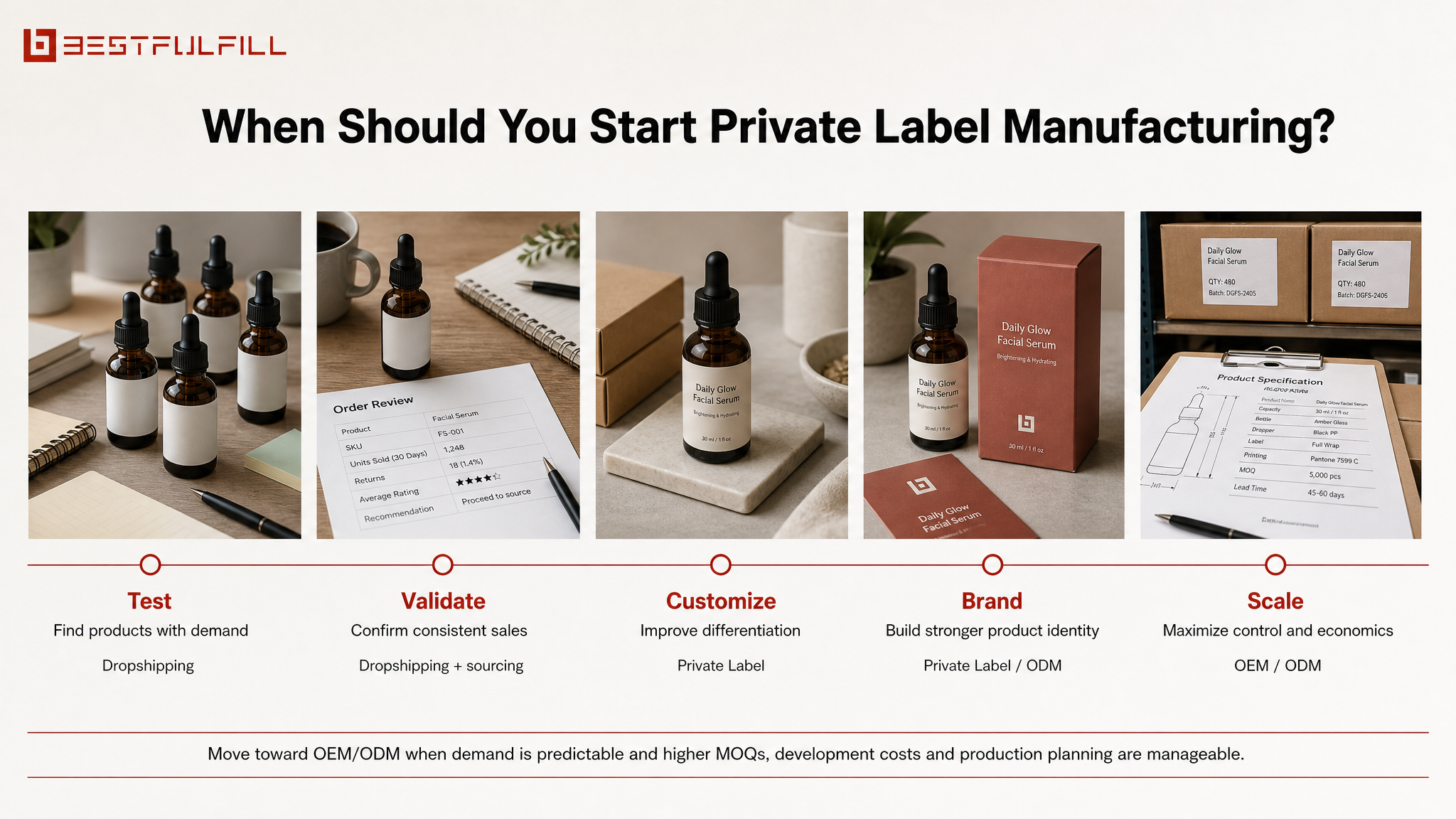
When Should You Start Private Label Manufacturing?
You don't need private labeling from day one.
A practical progression is:
| Stage | Main Goal | Suitable Model |
|---|---|---|
| Test | Find products with demand | Dropshipping |
| Validate | Confirm consistent sales | Dropshipping + sourcing |
| Customize | Improve differentiation | Private Label |
| Brand | Build stronger product identity | Private Label / ODM |
| Scale | Maximize control and economics | OEM / ODM |
Consider private labeling when a product has consistent demand, generic products are becoming harder to differentiate, and you want more control over packaging, quality, or customer experience.
Move toward OEM/ODM when demand is predictable and you can manage higher MOQs, development costs, and production planning.
Final Verdict
The best private label manufacturer depends on your business stage and product requirements.
- Alibaba: Best for broad manufacturer discovery
- Apliiq / Trendsi: Best for apparel
- Printful / Printify: Best for print-on-demand
- CJdropshipping: Best for flexible sourcing and private-label dropshipping
- Zendrop: Best for simpler branded ecommerce
- Bestfulfill: Best for brands connecting sourcing, QC, warehousing, branding, and fulfillment
Private labeling should not be treated as simply adding a logo to an existing product. The real advantage is greater control over the product, supply chain, and customer experience without taking on more operational complexity than your business can support.
Frequently Asked Questions (FAQ)
What are the best private label manufacturers in 2026?
The best option depends on the product and business stage. Alibaba is strong for broad manufacturer sourcing, Apliiq and Trendsi for apparel, Printful and Printify for POD, and Bestfulfill for sourcing and fulfillment support.
What is the best private label manufacturer for Shopify?
There is no single best option. Apliiq works well for apparel, Printful for design-led POD, Zendrop for simple branded products, and Bestfulfill for brands that need deeper sourcing and fulfillment support.
How do I find a reliable private label manufacturer?
Compare samples, MOQ, production capacity, QC procedures, certifications, lead times, communication, and references. Never choose a manufacturer based on price alone.
How much does private label manufacturing cost?
There is no fixed cost. It depends on the product, MOQ, customization, materials, packaging, tooling, sampling, and shipping. Calculate total landed cost before comparing suppliers.
What is a good MOQ for private label products?
A lower MOQ is generally safer for new products because it reduces inventory risk. Once demand is proven, larger production runs may improve unit economics.
Can I start private labeling with a low MOQ?
Yes. POD, dropshipping, and some low-MOQ suppliers allow brands to test branded products with limited inventory. Deeper customization usually requires higher production commitments.
What is the difference between private label, white label, OEM, and ODM?
White label generally uses an existing product with your branding. Private label allows more customization. ODM provides an existing manufacturer design that can be modified, while OEM produces according to your specifications or design.
When should I switch from dropshipping to private label?
Consider switching when a product has demonstrated consistent demand and you want greater control over branding, quality, differentiation, or customer experience.