

Key Takeaways
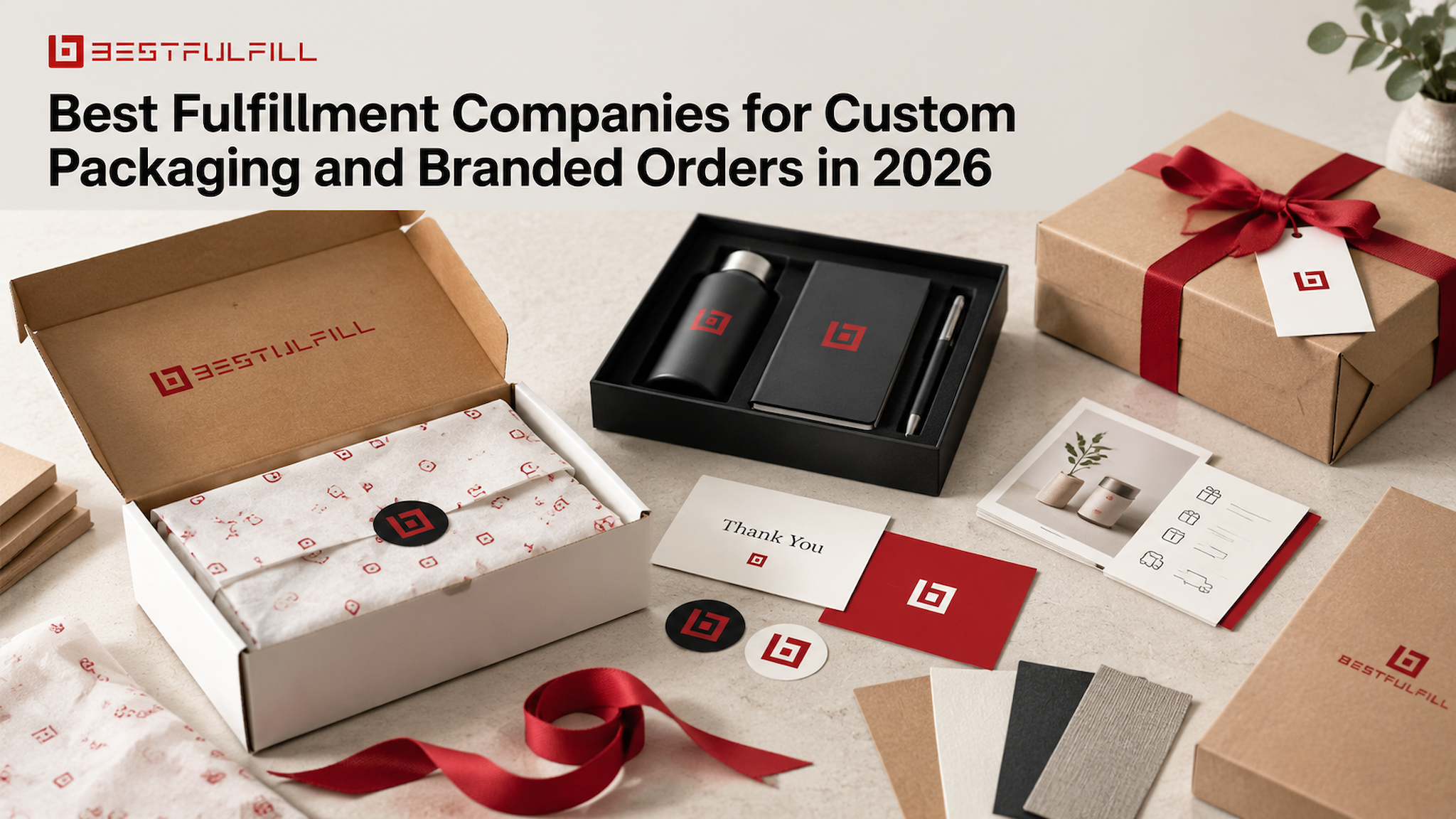
- Custom packaging and branded order fulfillment are not the same thing. Branded orders can also involve inserts, kitting, personalization, packaging inventory, and SKU- or order-specific rules.
- Responsibility varies significantly by provider. Some 3PLs execute merchant-supplied packaging, while others can source, stock, or manage packaging materials.
- Order complexity changes the fulfillment requirement. Subscription boxes, gift sets, promotional kits, and variable inserts require more operational control than standard branded packaging.
- The starting point matters. Warehouse-first 3PLs typically customize orders after inventory arrives, while sourcing-led models can coordinate products, QC, branding, and packaging further upstream.
- There is no single best provider for every brand. The right fit depends on sourcing model, order complexity, packaging ownership, volume, and required fulfillment coverage.
Quick Answer
The best fulfillment companies for custom packaging and branded orders in 2026 include ShipBob, ShipMonk, Ryder, Bestfulfill, Cart .com, and ShipNetwork.
ShipBob is well suited to scalable SKU-level customization; ShipMonk stands out for managed packaging procurement and inventory; Ryder provides extensive enterprise value-added services; Bestfulfill connects China sourcing and QC with product and packaging branding; Cart .com supports custom packaging and high-volume branded kits; and ShipNetwork is suited to complex branded workflows and subscription builds.
The key difference is not simply whether a provider offers custom boxes. It is how much of the customization workflow the provider manages and how consistently it can execute branded-order requirements.
Custom Packaging and Branded Fulfillment Comparison
Provider | Best For | Responsibility Starts At | Main Capability |
ShipBob | Scalable DTC customization | Fulfillment center | SKU-level packaging rules and repeatable customization |
ShipMonk | Managed custom packaging | Packaging procurement / fulfillment | Packaging sourcing, stocking, and management |
Ryder | Enterprise branded fulfillment | Fulfillment / VAS operations | Enterprise-scale customization and value-added services |
Bestfulfill | China-sourced branded orders | Sourcing / supplier stage | Sourcing, QC, product and packaging customization, and fulfillment |
Cart .com | High-volume branded kits | Packaging / fulfillment | Custom packaging, kitting, and high-volume branded assembly |
ShipNetwork | Complex branded workflows | Fulfillment center | Complex kitting and customized order workflows |
Best Fulfillment Companies for Custom Packaging and Branded Orders
ShipBob — Best for Scalable DTC Customization
Best for: Growing DTC brands that need repeatable customization across fulfillment operations.
ShipBob's Customization Suite brings branded packaging, kitting, gift notes, and marketing inserts into its fulfillment workflow. Brands can store custom boxes or mailers as SKUs and set SKU-level packaging preferences, so packaging rules can be applied by product rather than handled only through manual packing instructions.
This makes ShipBob particularly relevant when a brand has moved beyond using the same branded box for every order and needs customization to remain consistent as order volume and SKU count increase. Custom kitting and certain other customization services have separate workflows or fees, so brands should confirm setup and pricing for their specific program.
ShipMonk — Best for Managed Custom Packaging
Best for: Higher-volume brands that want their fulfillment partner to take more responsibility for packaging operations.
ShipMonk's customization offering includes branded packaging, inserts, kitting, bundling, and other custom packing workflows. Its PackSmart service extends that responsibility into packaging management, including sourcing, stocking, and managing packaging materials rather than requiring the merchant to coordinate every part of the packaging supply chain separately.
That distinction matters for brands whose challenge is no longer simply using custom packaging, but keeping the right packaging available as fulfillment volume grows. PackSmart is positioned for qualifying higher-volume merchants, so brands considering it should confirm eligibility and service scope before building their packaging strategy around the program.
Ryder — Best for Enterprise Branded Fulfillment
Best for: Established brands that require broader value-added services alongside ecommerce fulfillment.
Ryder's branded fulfillment capabilities sit within a broader value-added services operation. Its documented services include specialized packaging, gift wrapping, personalized notes, boxed sets, kitting, subassembly, repacking, labeling, quality inspection, RFID tagging, and light manufacturing.
That breadth makes Ryder more relevant when branded fulfillment involves assembly or personalization in addition to packaging. Ryder reports more than 10 million square feet of multi-client and dedicated warehouse space, while individual facilities can provide different value-added capabilities; Its Riverside facility, for example, lists gift wrapping, laser engraving, and personalized messaging. Brands should therefore verify that the required services are available at the specific facilities supporting their program.
Bestfulfill — Best for China-Sourced Branded Orders
Best for: Ecommerce brands sourcing from China that want sourcing, QC, branding, packaging, and fulfillment connected in one workflow.
Bestfulfill differs from warehouse-first providers primarily in where its responsibility can begin. Its service model includes product sourcing and supplier coordination, quality inspection, customized branding packages, inventory handling, and fulfillment, allowing branding requirements to be addressed before products enter downstream order fulfillment.
Available branding options include customized boxes, shipping bags or envelopes, logo stickers, and product-level branding. Bestfulfill For brands manufacturing or sourcing in China, the practical advantage is the ability to coordinate product, QC, and branding requirements earlier in the supply chain instead of treating packaging as a warehouse-only step.
This model is therefore most relevant when upstream coordination is part of the branded-order problem. Brands that already have finished inventory and mainly need domestic warehousing and downstream customization may place greater weight on a warehouse-first 3PL network.
Cart .com— Best for High-Volume Branded Kits
Best for: Brands running subscription, gifting, promotional, or other assembly-heavy programs.
Cart .com combines custom packaging with kitting and bundling inside its fulfillment network. Its documented programs include subscription boxes, gift sets, promotional bundles, and retail-ready kits, with individual components tracked within its warehouse management system.
The distinction here is assembly complexity. Cart .comstates that its subscription-box operations can handle programs ranging from 500 to 500,000 boxes, while gift-set programs can incorporate custom tissue, ribbon, inserts, and branded packaging. Because these figures are company-reported operating ranges rather than an industry benchmark, brands should still confirm the capacity, minimums, facility availability, and pricing applicable to their own program.
For brands whose branded experience depends on assembling multiple components correctly—not simply selecting a branded mailer—this combination of packaging and kitting is the more relevant capability.
ShipNetwork — Best for Complex Branded Order Workflows
Best for: Brands with complex kits, subscription boxes, variable inserts, or detailed fulfillment requirements.
ShipNetwork's customization services extend beyond branded packaging into workflow-specific execution. Its documented capabilities include multi-SKU kits, seasonal sets, pre-builds, subscription boxes, variable inserts, gift notes, literature versioning, and QA checkpoints.
More importantly for complex programs, ShipNetwork says its solution-design process can define SOPs, packaging specifications, routing logic, and integrations, then test custom workflows against defined success criteria before rollout.
That makes it particularly relevant when different orders require different assembly or presentation rules. For a brand that only needs the same branded box and insert on every shipment, however, this degree of workflow customization may be more than the operation requires.
How to Choose a Fulfillment Company for Custom Packaging
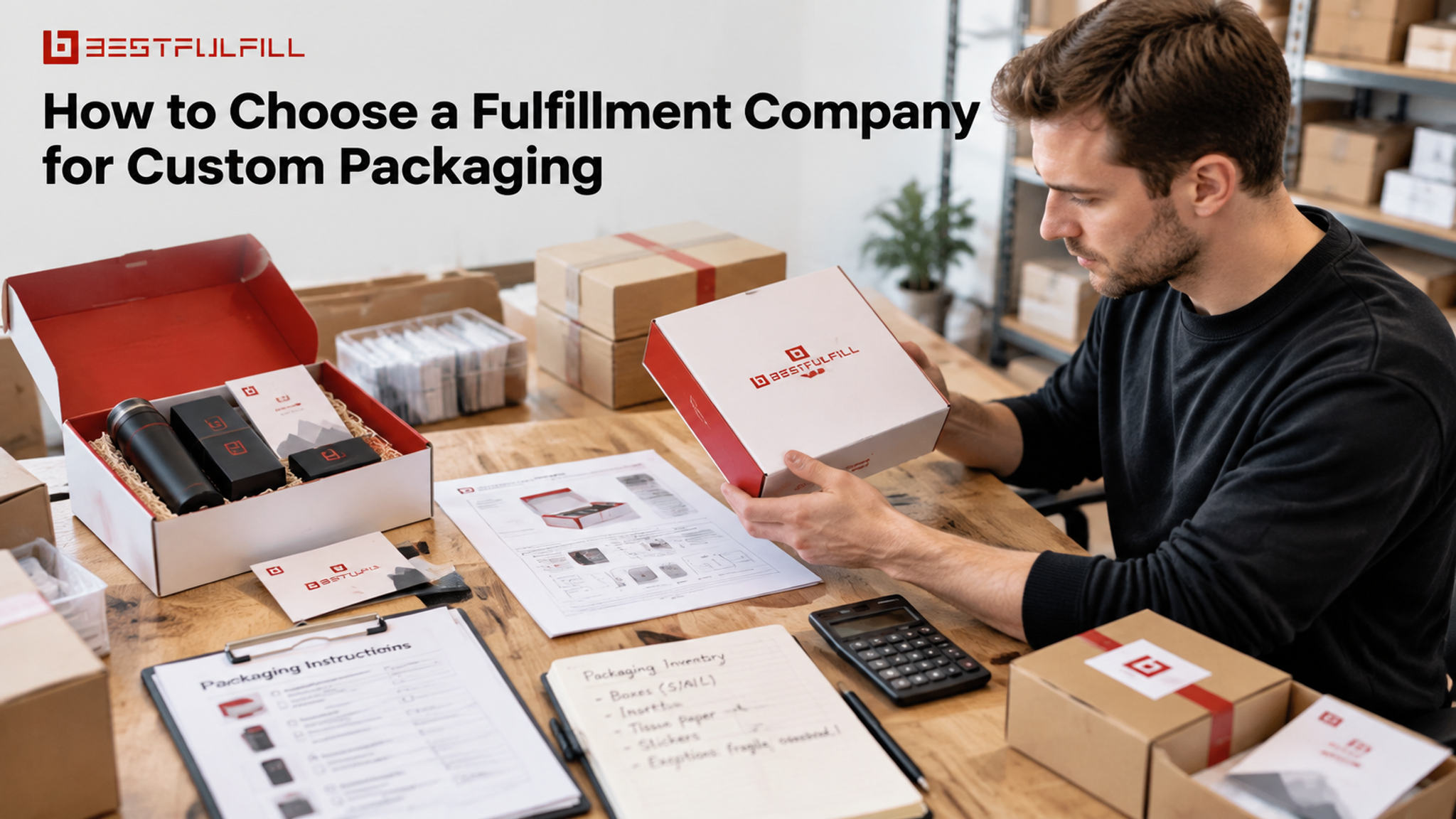
Once you have shortlisted providers with the right customization capabilities, verify how those capabilities will work for your actual orders before committing.
Check Customization Rules
Confirm how the warehouse determines which packaging, insert, kit, or personalization rule applies to each order. If requirements vary by SKU, campaign, or order type, look for system-based rules or documented SOPs rather than relying on manual instructions.
Plan Packaging Inventory
Confirm how custom packaging and inserts are tracked and replenished, and what happens when a required material runs out. Decide in advance whether affected orders should be held, use approved substitutes, or follow another predefined workflow.
Calculate Total Costs
Look beyond standard pick-and-pack rates. Custom fulfillment may involve packaging production, MOQs, setup fees, storage, kitting or assembly charges, and additional lead times. Compare providers using your actual order mix and packaging requirements.
Test Before Scaling
Run representative SKUs and order types through the proposed workflow before moving significant volume. Check packaging accuracy, inserts, assembly, labeling, shipping protection, and exception handling. If you plan to use multiple fulfillment centers, verify that the required customization can be executed consistently at each location.
Match Fulfillment Providers to Your Branded Order Complexity
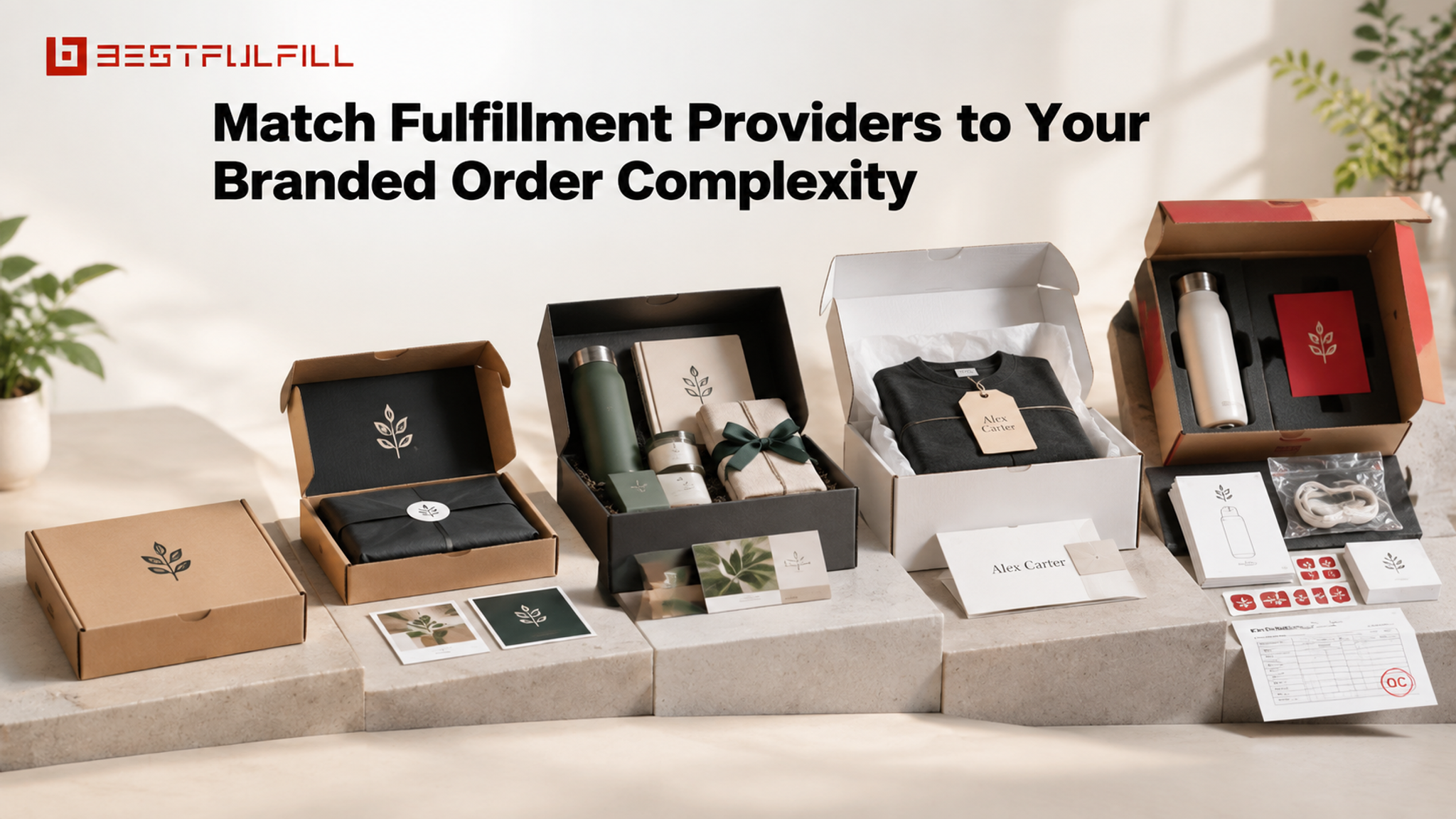
Different branded-order models require different levels of operational control. Use the order structure—not packaging appearance alone — to narrow the shortlist.
Branded Order Type | What the Workflow Requires | Best-Fit Providers |
Standard Branded Orders | Consistent branded packaging and inserts with limited variation | ShipBob, ShipMonk — structured warehouse-level customization |
SKU- or Campaign-Specific Orders | Packaging or inserts that vary by product, promotion, or order | ShipBob, ShipNetwork — rule-based or customized workflows |
Kits, Gift Sets & Subscriptions | Multi-item assembly, component control, recurring or seasonal changes | Cart .com, ShipNetwork — kitting, subscription builds, complex assembly |
Personalized / Enterprise Programs | Specialized packaging, personalization, assembly, and broader VAS | Ryder — enterprise-scale value-added fulfillment |
China-Sourced Branded Products | Supplier coordination, product or packaging customization, QC, and fulfillment | Bestfulfill — integrated China sourcing, QC, branding, and fulfillment |
The right fit depends on how your branded orders are actually built and fulfilled—the more complex the workflow, the more important clear ownership, repeatable execution, and scalability become.
Frequently Asked Questions (FAQ)
Do custom packaging programs usually have minimum order requirements?
Often, but the requirement depends on how the packaging is sourced and produced. Custom-printed boxes, mailers, tissue, and other materials may have supplier MOQs even when the fulfillment provider itself does not impose a specific order minimum.
Before launch, confirm both the packaging production MOQ and the fulfillment provider's volume requirements. These are separate constraints and can affect the amount of packaging inventory a brand must hold.
What happens if custom packaging runs out before product inventory?
The outcome depends on the fulfillment provider and the rules agreed with the brand. Orders may be held until packaging is replenished, shipped in approved standard packaging, or handled through another predefined exception workflow.
Brands should set this rule before launch rather than leave the decision to the warehouse after a stockout occurs. Packaging inventory should therefore be monitored separately from product inventory.
Can different SKUs use different branded packaging?
Yes, when the provider's fulfillment system and warehouse process support SKU- or order-specific packaging rules. ShipBob, for example, documents SKU-level packaging preferences within its Customization Suite.
For brands with several packaging variations, confirm how the rule is triggered, whether packaging materials are tracked as separate inventory, and what happens when one required component is unavailable.
Can the same custom packaging program run across multiple fulfillment centers?
Not automatically. A provider may operate multiple fulfillment centers without offering every customization service at every location.
Brands using distributed inventory should confirm which facilities support the required workflow, where branded materials must be stocked, and whether the same SOP can be reproduced consistently across locations before splitting inventory.
Who owns unused custom packaging if a brand changes 3PLs?
This should be clarified in the fulfillment agreement. Custom packaging may be purchased by the brand, procured on its behalf, or managed under a provider-specific packaging program.
Before signing, confirm who owns the materials, whether unused inventory can be returned or transferred, and what fees may apply if the relationship ends or the packaging design changes.
How should returns be handled when the original order used custom packaging?
Return workflows should be planned separately from outbound branded fulfillment. Original custom packaging may be damaged, discarded, or unavailable when an item returns, so it should not be assumed that returned inventory can automatically re-enter the same branded-order workflow.
Brands should define inspection, repacking, and restocking rules with the provider, particularly for products where presentation or packaging condition affects whether an item can be resold.