


Key Takeaways
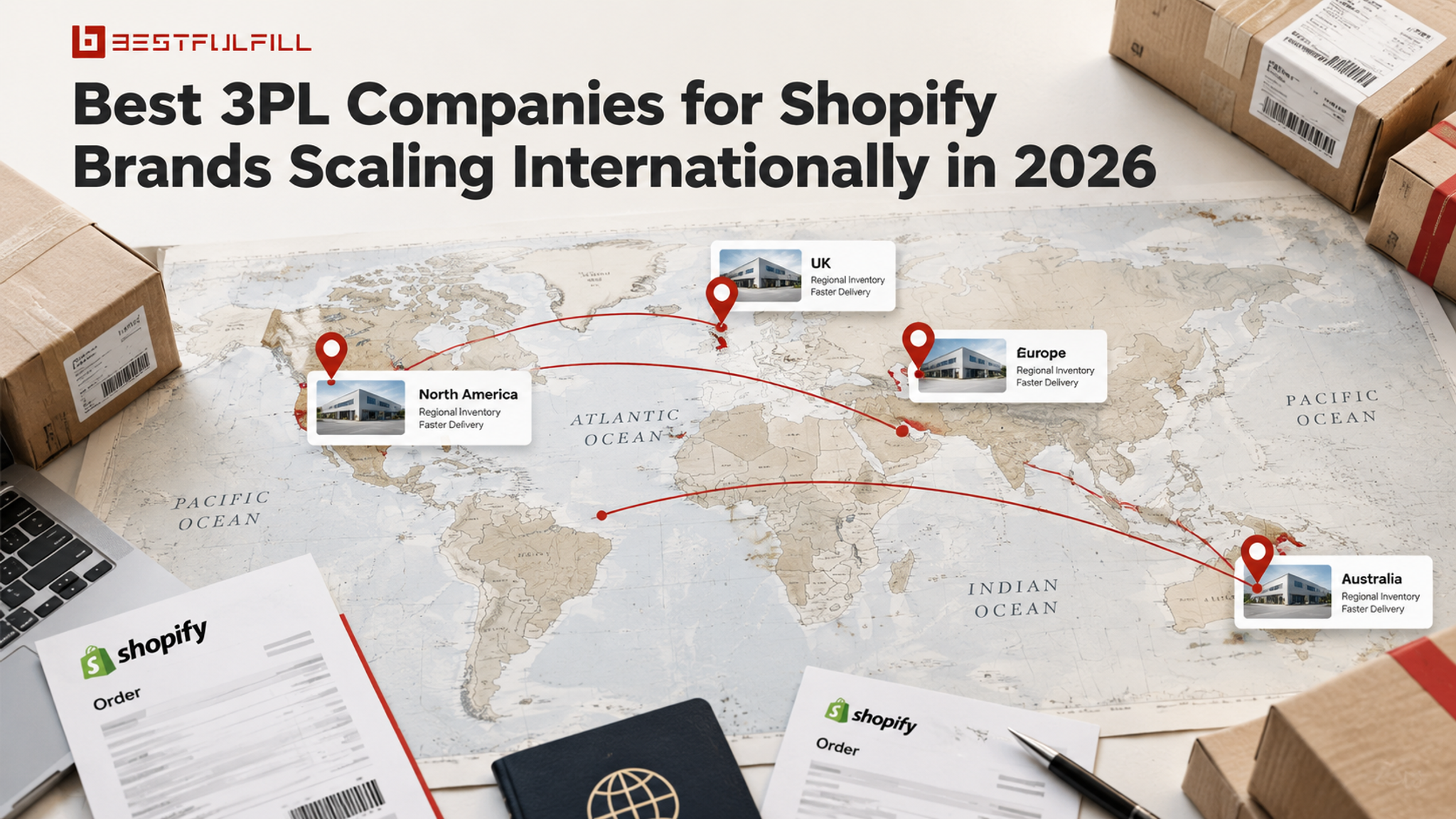
- International fulfillment is not the same as international shipping. Cross-border shipping can serve developing markets, while stable demand may justify regional inventory and local fulfillment.
- Shopify connectivity matters more with multiple warehouses. Inventory synchronization, order routing, tracking, and location mapping become more important as fulfillment becomes distributed.
- Inventory should follow stable demand. Brands do not need stock in every market; regional inventory makes more sense where demand can support it.
- Different 3PL models start at different points in the supply chain. Some begin with finished inventory at the warehouse, while others extend upstream into freight, sourcing, QC, or inventory preparation.
Quick Answer: What Are the Best 3PL Companies for Shopify Brands Scaling Internationally?
The best 3PL depends on how and where a Shopify brand is expanding.
ShipBob is suited to distributed inventory across major international markets. ShipMonk combines Shopify connectivity with fulfillment across North America, the UK, and Mainland Europe. Bestfulfill is relevant to brands sourcing from China that want sourcing, QC, inventory, and global fulfillment connected. Byrd focuses on European fulfillment, while fulfilmentcrowd supports multi-region fulfillment across the UK, Europe, the US, and Australia. Flexport takes a freight-led approach connecting international logistics with ecommerce fulfillment.
These providers are not presented as a universal 1–6 ranking. Each represents a different international expansion model and use case for Shopify brands.
Shopify 3PL Companies Compared
Provider | Best For | Geographic Strength | Main Limitation |
ShipBob | Distributed global fulfillment | US, Canada, UK, EU, Australia | Upstream sourcing and supplier coordination are not core |
ShipMonk | Complex DTC + cross-border fulfillment | US, Canada, UK, Mainland Europe | Physical network is concentrated in these regions |
Bestfulfill | China sourcing + global Shopify fulfillment | China origin + international markets | Less relevant if only one-market domestic warehousing is needed |
byrd | European Shopify expansion | EU + UK | Primarily Europe-focused |
fulfilmentcrowd | Multi-region Shopify fulfillment | UK, Europe, US, Australia | Brands should verify network fit for their specific markets |
Flexport | Freight + international Shopify fulfillment | International logistics + US fulfillment | International shipping reach does not equal local warehouse coverage in every market |
Capabilities, warehouse availability, shipping options, and onboarding requirements can vary by market, product, and order volume. Brands should confirm the current setup directly with each provider.
ShipBob — Best for Distributed Global Shopify Fulfillment
Best for: Scaling Shopify brands that want to position inventory closer to customers across multiple major markets.
ShipBob is an inventory-based ecommerce 3PL with a native Shopify integration. Its fulfillment network includes locations across the US, Canada, the UK, the EU, and Australia, allowing brands to distribute inventory across regions as demand grows.
Its Shopify integration is also adding Shopify Markets support designed to align market-specific configurations with appropriate regional warehouses when local inventory is available.
Watch for: ShipBob's core model begins with inventory entering its fulfillment network. Brands that also need sourcing, supplier coordination, or upstream QC may require additional support.
ShipMonk — Best for Complex DTC + Cross-Border Fulfillment
Best for: Growing Shopify brands with more complex fulfillment requirements expanding across North America, the UK, and Europe.
ShipMonk's Shopify integration supports capabilities including location mapping, automated order actions, and international tax ID mapping. ShipMonk also identifies itself as a certified Shopify Fulfillment Network partner.
Its owned and operated fulfillment centers span the US, Canada, the UK, and Mainland Europe, while its cross-border services include regional fulfillment and DDP options.
Watch for: Brands expanding beyond these core regions should confirm where inventory will be held and which routes will remain cross-border.
Bestfulfill — Best for China Sourcing + Global Shopify Fulfillment
Best for: Established and scaling Shopify brands sourcing from China that need upstream product control connected with international fulfillment.
Bestfulfill differs from warehouse-first 3PLs because its workflow can begin before products reach the warehouse. It connects China sourcing and supplier coordination with QC, warehousing, order fulfillment, and global shipping.
According to Bestfulfill's official website, its current infrastructure includes 60,000+ m² of domestic warehouse capacity and 10+ overseas warehouses. Its Shopify fulfillment guidance identifies North America, Europe, Australia, and Southeast Asia among its core business markets.
Watch for: Brands with finished inventory that only need domestic fulfillment in a single market may find a warehouse-first 3PL model more directly aligned with their needs.
byrd— Best for European Shopify Expansion
Best for: Shopify brands building a regional fulfillment setup across the EU and UK.
byrd's Shopify integration synchronizes orders and inventory and supports fulfillment through multiple European warehouses. Its current network includes 12 fulfillment centers across the EU and UK and 20+ carrier integrations, according to byrd.
This makes byrd particularly relevant when international expansion is concentrated in Europe and the goal is to move from cross-border shipping toward regional inventory and local carriers.
Watch for: Its main infrastructure advantage is European coverage, rather than an equally distributed physical network across all major global regions.
fulfilmentcrowd— Best for Multi-Region Shopify Fulfillment
Best for: Shopify brands that want to manage inventory across several international regions through one fulfillment platform.
fulfilmentcrowd's Shopify integration synchronizes orders, inventory, fulfillment status, and tracking information. Its international network currently spans the UK, Europe, the US, Ireland, and Australia; the company lists 17 warehouse locations across its network.
Its international model allows brands to position inventory in different regions while managing fulfillment through the same platform.
Watch for: Brands should evaluate the actual warehouse locations against their customer distribution rather than choosing a network based on location count alone.
Flexport — Best for Freight + International Shopify Fulfillment
Best for: Shopify brands whose international expansion involves both inbound freight and downstream ecommerce fulfillment.
Flexport's ecommerce offering connects freight, distribution, and DTC fulfillment. Shopify merchants can connect through the Shopify Fulfillment Network App, while Flexport also supports international shipping to more than 200 countries and territories with DDP and DDU options.
Its main distinction is therefore where logistics responsibility begins: international inventory movement can be connected with downstream distribution and ecommerce fulfillment rather than managed as separate processes.
Watch for: International shipping coverage should not be interpreted as equivalent local fulfillment-center coverage in every destination market.
How to Choose a 3PL for International Shopify Expansion
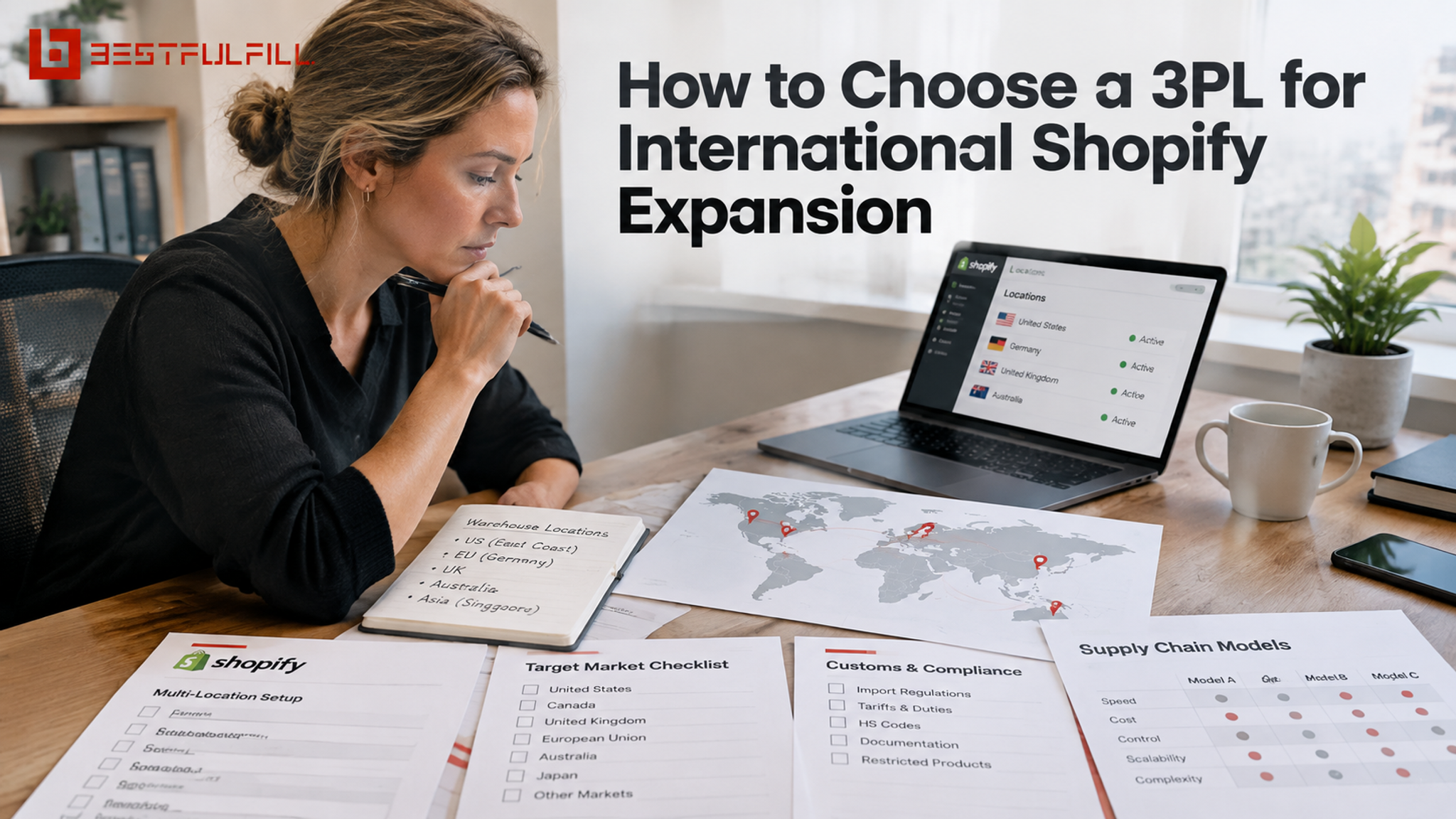
When comparing 3PLs, focus on whether the provider’s actual fulfillment setup matches your target markets, Shopify operations, and inventory requirements.
Check the provider’s actual fulfillment locations
Do not compare providers by total warehouse count alone. Check which locations can actually store and fulfill your inventory in the markets you plan to serve.
Confirm how Shopify works across multiple locations
Check how orders, inventory, tracking, and fulfillment locations are synchronized. If inventory is split across warehouses, confirm how orders are routed and how inventory is reflected in Shopify.
Compare requirements in each target market
Review receiving requirements, storage costs, minimum volumes, carrier options, returns, customs and duties processes, and product restrictions for the markets you plan to enter.
Match the operating model to your supply chain
Consider what support is needed before fulfillment begins. Finished inventory may fit a warehouse-based model, while brands that also need international freight, China sourcing, QC, or inventory preparation should compare providers that support those earlier stages.
Questions to Ask Before Choosing
- Can the same SKU be split across multiple fulfillment locations without creating inventory or routing issues?
- Which costs and minimum requirements apply when adding a new market or warehouse?
- How are cross-border returns, duties, and customs exceptions handled?
- Can the provider support upstream needs such as freight, sourcing, QC, or inventory preparation if required?
Which International 3PL Model Fits Your Shopify Brand?
| 3PL Model | How It Works | Shopify Connection | International Fulfillment Model | Representative Providers |
| Distributed Global Fulfillment | Inventory is placed across fulfillment centers in multiple major markets to fulfill orders closer to customers. | Native Shopify integration | Regional inventory across fulfillment centers | ShipBob |
| Regional Multi-Warehouse Fulfillment | Inventory is distributed across warehouses within a specific region or selected international markets. | Direct Shopify integrations; connection details vary by provider | Regional and multi-region inventory fulfillment, with cross-border options depending on provider | ShipMonk, byrd, fulfilmentcrowd |
| Sourcing-to-Fulfillment Model | Operations begin upstream, connecting sourcing and QC with inventory preparation, warehousing, and international order fulfillment. | Ecommerce/store integration | China sourcing + QC + global fulfillment | Bestfulfill |
| Freight-to-Fulfillment Model | International freight and inventory movement are connected with downstream distribution and ecommerce fulfillment. | Shopify Fulfillment Network App | Freight + distribution + DTC fulfillment | Flexport |
The main difference is where international fulfillment begins and how inventory is distributed. Some models focus on placing finished inventory closer to customers, while others begin earlier with sourcing or international freight before inventory reaches the fulfillment network.
Frequently Asked Questions (FAQ)
Can a Shopify store connect to multiple 3PL warehouses?
Yes, depending on the 3PL and its Shopify integration. Some providers support multiple fulfillment locations, inventory synchronization, and order routing across warehouses. Brands should confirm how locations are mapped in Shopify and how orders are assigned when the same SKU is stored in more than one region.
When should a Shopify brand move inventory to an overseas warehouse?
Local inventory becomes more relevant when a market has consistent enough demand to justify storing products closer to customers. Brands should compare current cross-border shipping with the receiving, storage, inventory, and fulfillment requirements of holding stock in that market before making the move.
Can a 3PL support both cross-border shipping and local fulfillment?
Yes, some 3PLs support both models. A Shopify brand may fulfill lower-volume markets cross-border while holding inventory locally in regions with more established demand. The available setup depends on the provider's warehouse locations, carrier network, and target countries.
What should Shopify brands check before adding a new international fulfillment location?
Brands should confirm warehouse location, receiving requirements, storage costs, inventory or volume requirements, carrier options, returns, customs and duties processes, and product restrictions. They should also verify how the new location will connect with Shopify and existing inventory.
Do Shopify brands sourcing from China need an overseas 3PL?
Not necessarily. The right setup depends on where customers are located and whether demand justifies holding inventory overseas. Brands sourcing from China can use direct cross-border fulfillment, overseas inventory, or a combination of both; if sourcing, QC, inventory preparation, and fulfillment also need to be coordinated, an integrated provider such as Bestfulfill represents another operating model.
Need a Shopify fulfillment setup that connects China sourcing, QC, inventory, and global delivery?
Explore how Bestfulfill supports growing Shopify brands from China-side sourcing and product control through international fulfillment and global shipping.