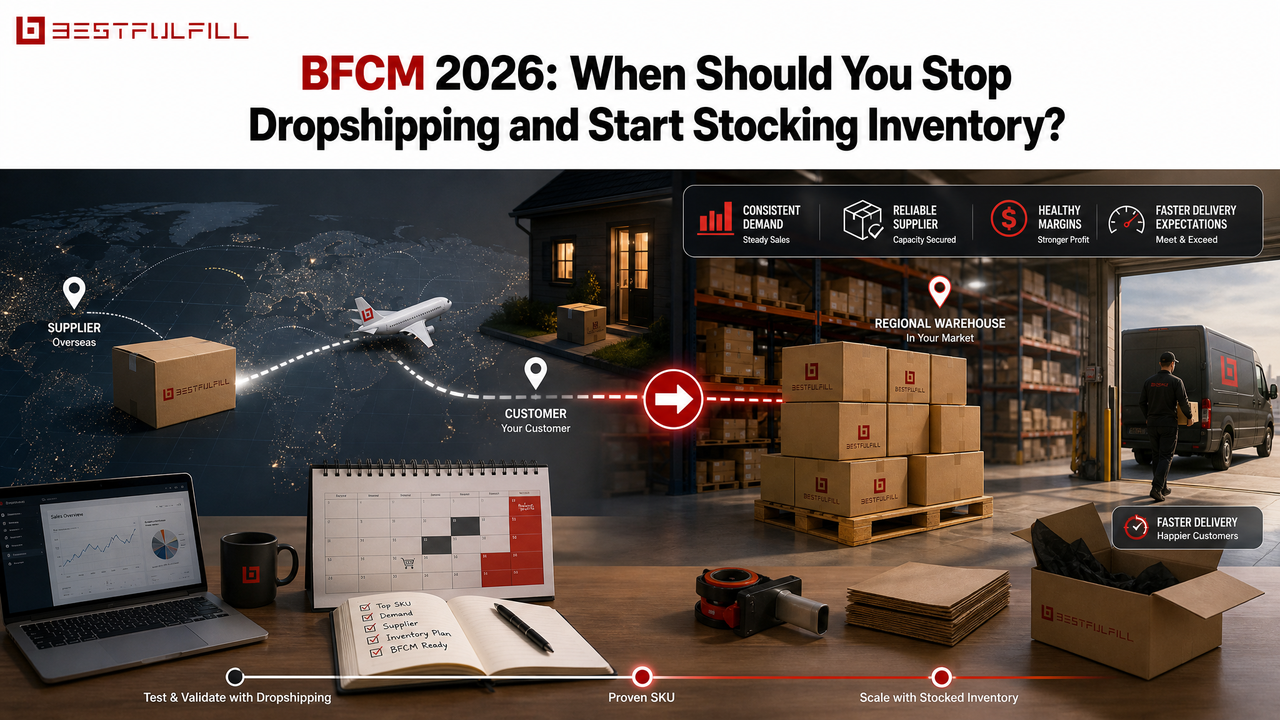
A product may work perfectly well with cross-border fulfillment during testing.
Once order volume grows, however, customers may expect faster and more predictable delivery.
If a large share of your orders comes from one market, regional inventory can become worthwhile because it shortens the distance between the product and the customer.
-
How to Transition from Dropshipping to Stocked Inventory Before BFCM
Moving to inventory does not mean buying several months of stock at once.
A gradual approach reduces both stockout and overstock risk.
Step 1: Identify Your Priority SKUs
Start with products that already show:
Do not spread inventory investment equally across every SKU.
Step 2: Forecast Demand
Use historical sales and expected BFCM uplift to establish a realistic range.
Rather than relying on a single forecast, consider:
Base case → High-demand case → Conservative case
This gives you a better view of potential inventory exposure.
Step 3: Confirm Production and Replenishment
Before placing an order, check:
From our fulfillment operations, we often find that inventory planning fails not because the purchase quantity was wrong, but because the full replenishment timeline was underestimated.
Production, inspection, transportation, receiving, and final fulfillment all take time.
Bestfulfill’s First-Hand Insight: QC and Warehouse Capacity Matter Too
From our fulfillment operations, we often see brands focus heavily on securing enough inventory while overlooking what happens after production. During peak season, QC inspection and warehouse receiving can become bottlenecks themselves. A large shipment that arrives without sufficient inspection or receiving capacity can delay inventory availability even when the products have already been produced and shipped.
That is why BFCM inventory planning should account for the full operational timeline—not just production and transportation, but also QC, warehouse receiving, and final fulfillment capacity.
Step 4: Decide Where to Position Inventory
For new or uncertain products, China fulfillment can remain the more flexible option.
For proven SKUs with strong demand in a specific market, regional inventory can provide faster delivery and reduce dependence on cross-border shipping during peak periods.
Step 5: Keep a Replenishment Plan
Inventory planning should not end when stock arrives.
Monitor:
The goal is to identify a potential stockout early enough to act.
Match Fulfillment to the SKU Lifecycle
A product's fulfillment requirements change as it matures.
This is why Bestfulfill approaches fulfillment through the SKU lifecycle, rather than applying one model to every product.
| SKU Stage |
Main Goal |
Recommended Fulfillment |
| Testing |
Validate demand |
Flexible China fulfillment |
| Validation |
Improve reliability |
QC + sourcing optimization |
| Scaling |
Balance speed and cost |
Regional inventory |
| Mature |
Standardize operations |
Multi-market fulfillment + SOPs |
Testing
The priority is flexibility.
Keep inventory exposure low while testing product-market fit, pricing, creatives, and geographic demand.
Validation
Once sales become more consistent, strengthen the foundations:
-
Supplier management
-
Product specifications
-
QC standards
-
Packaging
-
Replenishment procedures
Scaling
When demand becomes predictable, regional inventory may improve delivery performance and reduce pressure on cross-border networks.
Mature
For established SKUs, fulfillment becomes a repeatable operating system.
Standardized SOPs, multi-market inventory, returns management, and replenishment processes become more important.
The fulfillment model should evolve as the SKU evolves.
How Bestfulfill Supports BFCM-Ready SKUs
At Bestfulfill, we see BFCM preparation from several operational points: sourcing, QC, warehousing, and cross-border fulfillment.
One common pattern is that brands treat inventory as a purchasing decision alone. In practice, the process involves much more:
Supplier capacity → Production → QC → Shipping → Warehouse receiving → Fulfillment → Final delivery
A delay at any one of these stages can affect the customer's delivery date.
That is why our SKU Lifecycle Fulfillment Strategy is designed to match operational support to the stage of the product.
For early-stage products, flexible China fulfillment helps brands test demand without committing heavily to inventory.
For validated SKUs, sourcing optimization and QC help improve consistency.
For growing products, regional inventory can support faster delivery in markets where demand is sufficiently predictable.
For mature products, standardized fulfillment workflows and multi-market operations can make the supply chain more repeatable.
The objective is not to move every SKU into a warehouse.
It is to give each SKU the level of sourcing, inventory, and fulfillment control its growth actually requires.
Final Takeaway
BFCM does not mean every DTC brand should abandon dropshipping and buy inventory in bulk.
The better strategy is to match the fulfillment model to the SKU's lifecycle.
Use flexible fulfillment when demand is uncertain. Strengthen sourcing and QC when a product begins to prove itself. Move proven winners into stocked or regional inventory when volume, margins, and delivery expectations justify the investment.
The goal is not to stop dropshipping.
The goal is to know when a SKU has outgrown it.
For BFCM 2026, brands that make this transition early enough can enter peak season with better inventory visibility, stronger supplier control, and a fulfillment model designed around the products that actually drive growth.
Planning Your BFCM Inventory Strategy?
From sourcing and QC to inventory positioning and fulfillment, Bestfulfill helps DTC brands build the right fulfillment model for each SKU stage.
Plan Your BFCM Fulfillment Strategy with Bestfulfill
When should I stop dropshipping and start stocking inventory?
Consider stocking a SKU when it has consistent sales, predictable demand, reliable supplier capacity, and enough margin to support inventory and fulfillment costs. You don't need to move your entire catalog—focus on proven, high-volume products first.
Is dropshipping still a good strategy for BFCM?
Yes. Dropshipping remains useful for testing new products and managing long-tail SKUs. However, proven BFCM winners may benefit from stocked inventory to reduce stockout risk and improve fulfillment speed.
How early should I prepare inventory for BFCM?
For products with international sourcing and longer production or shipping lead times, inventory planning should begin several weeks before BFCM. The exact timing depends on supplier lead time, QC requirements, shipping method, and warehouse processing time.
How much inventory should I stock for BFCM?
There is no universal inventory quantity or multiplier. Brands should consider historical sales, current sales velocity, expected BFCM demand, supplier lead time, replenishment speed, and safety stock when forecasting inventory.
How can I avoid running out of inventory during BFCM?
Identify your hero SKUs early, confirm supplier capacity, build appropriate safety stock, and make sure inventory is received and QC-checked before the campaign starts. Real-time inventory monitoring and clear replenishment thresholds can also help reduce stockout risk.
Should I stock inventory in the US or fulfill BFCM orders from China?
The right choice depends on sales volume, customer location, delivery expectations, and total fulfillment costs. China fulfillment offers greater flexibility for unproven products, while regional inventory can be more suitable for proven, high-volume SKUs where faster delivery matters.
What is the best fulfillment strategy for BFCM?
There is no single fulfillment model for every product. A practical approach is to use flexible fulfillment for testing, strengthen sourcing and QC during validation, move proven winners into stocked or regional inventory during scaling, and standardize fulfillment operations for mature SKUs.