



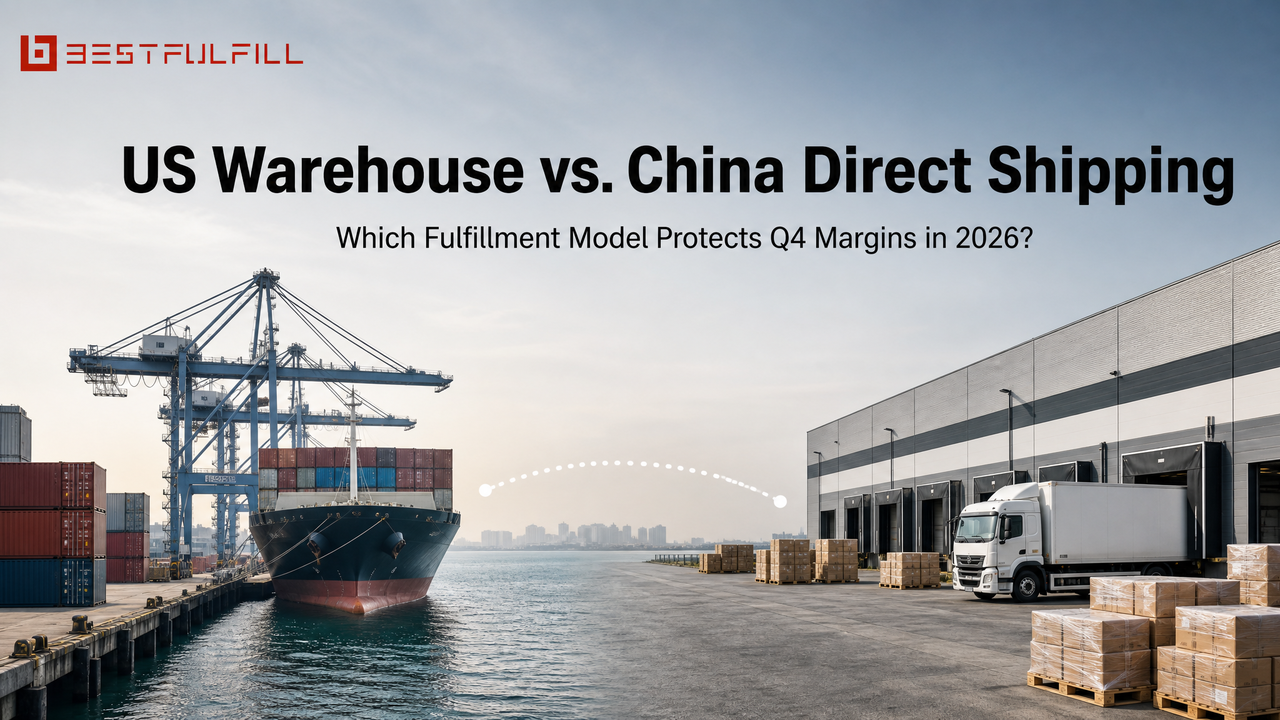
China Direct Shipping vs. US Warehousing: How to Choose the Right Q4 2026 Fulfillment Model
With the suspension of duty-free de minimis treatment for most low-value commercial shipments entering the United States, the traditional playbook—“Ship direct from China forever, move to US warehousing later”—is officially getting an update.
But does moving everything to a US warehouse automatically boost your profit margins?
Short answer: Not necessarily.
The ideal Q4 fulfillment strategy isn't just about raw shipping speed. Customs valuation, storage costs, dimensional weight, inventory turnover, and delivery expectations all decide whether direct shipping or domestic fulfillment delivers better unit economics.
For DTC brands prepping for Q4 2026, the question isn't just:
"Which fulfillment model is cheaper?"
It’s actually:
"Which fulfillment model gives this specific SKU the best balance of margin, cash efficiency, and customer experience?"
Let’s break down the math.
The Fulfillment Playbook Has Changed
For years, the DTC playbook was simple:
- Launch products using China direct shipping.
- Validate demand with zero inventory risk.
- Move proven winners into a US warehouse.
That strategy still works for early-stage brands—but the underlying economics have shifted.
The US customs environment now requires merchants to evaluate direct imports differently. Duty-free de minimis treatment is no longer broadly available for most low-value commercial shipments entering the United States.
Today, direct parcels must be evaluated based on HTS classification, country of origin, customs value, and applicable carrier processing fees.
Add in typical Q4 peak pressures—tight carrier capacity, peak surcharges, and impatient holiday shoppers—and domestic warehousing becomes less about “faster shipping” and more about operational predictability for your top-performing products.
Q4 2026 Fulfillment Factors Changing Your Unit Economics
Before diving into the numbers, let’s look at the three major forces shaping your fulfillment strategy this year:
De Minimis Changes = SKU-Level Scrutiny
In the past, low-value parcels entered the US with minimal customs friction. Today, that assumption is no longer reliable. Each direct parcel now requires precise evaluation based on declared value, duty rates, and import requirements.
Does this mean direct shipping is dead? No. But it does mean you need accurate SKU-level landed cost calculations before setting your ad budgets.
Bulk Importing Reduces Logistics Friction (Not Tariffs)
⚠️ Common Myth: "If I import in bulk to a US warehouse, I can avoid tariffs." Reality Check: Both direct shipping and bulk imports are subject to applicable duties based on HTS classification, origin, and declared value.
Bulk importing doesn't erase tariffs—it optimizes logistics expenses. It slashes international freight costs per unit, cuts per-parcel brokerage fees, and simplifies fragmented shipping overhead. Think of US warehousing as a cost-optimization strategy, not a tariff-avoidance loophole.
Holiday Delivery Expectations Create Real Pressure
Let's face it: holiday buyers have zero patience for delayed tracking numbers.
While faster domestic shipping helps reduce customer service inquiries ("Where is my order?" or "Will this arrive before Christmas?"), delivery speed alone won't magically fix a weak product offer. The true impact depends on your category, brand positioning, and customer expectations.

Comparing Q4 2026 Fulfillment Economics
Here is a side-by-side look at how the two models compare for a typical $50 selling price, 2 lb product operating at 2,000 monthly US orders:
| Feature / Metric | ✈️ China Direct Shipping Model | 🏢 US Warehousing Model |
|---|---|---|
| Upfront Capital Commitment | Minimal (Pay-as-you-go per order) | Moderate to High (Bulk inventory investment) |
| Inventory & Dead Stock Risk | Very Low (Ideal for testing) | Moderate (Requires accurate forecasting) |
| Storage & Holding Costs | None (No domestic storage fees) | Applicable (Monthly pallet/bin storage) |
| International Freight Cost / Unit | Higher per-parcel air expense | Lower bulk freight cost per unit |
| Last-Mile Delivery Window | 7–12 Business Days | 2–5 Business Days |
| Returns & Exchanges | Complex international return route | Streamlined local inspection & restock |
| Best Suited For… | New launches, low-volume SKUs, seasonal experiments | High-velocity SKUs, proven winners, steady demand |
(Note: Actual landed costs vary by HTS classification, declared value, carrier rates, and storage turnover. AOV is not the same as customs value.Illustrative estimates based on current rates and historical peak-season patterns. Actual Q4 carrier surcharges may vary.)
The Break-Even Point: It’s About the SKU, Not the Brand
There’s no magic order threshold where a brand should suddenly move 100% of its catalog to a US warehouse.
- A store doing 2,000 orders/month might still prefer direct shipping if they have a wide catalog with unpredictable individual SKU demand.
- A smaller store doing 300 orders/month might heavily benefit from US warehousing if 80% of those sales come from one single hero SKU.
💡 Practical Benchmark: A consistently selling SKU reaching approximately 50 orders per week is usually worth evaluating for domestic stocking.
Which Model Fits Your Current Business Stage?
[ New Brands / Testing ] ⟶ China Direct Shipping (Protect Cash Flow)
[ Scaling DTC Brands ]  ⟶ Hybrid Model (Stock Winners + Direct Test Items)
[ Established Brands ]  ⟶ US Warehouse Primary (Optimize Margins & Speed)
New Brands \& Product Testing
- Scenario: Launching new products, limited historical data, unpredictable demand.
- Recommended Focus: China Direct Shipping
- Why: Preserve cash flow, avoid over-ordering, and validate demand before locking up working capital.
Scaling DTC Brands
- Scenario: A few consistent bestsellers, accelerating growth, expanding catalog.
- Recommended Focus: Hybrid Fulfillment
- Why: Store your top 20% high-velocity winners in a US warehouse for maximum speed and margin, while keeping experimental SKUs on direct shipping lines.
Established Brands
- Scenario: Stable hero products, predictable demand curves, heavy Q4 volumes.
- Recommended Focus: US Warehouse Primary
- Why: Bulk ocean importing lowers unit freight expenses, while fast domestic delivery builds brand trust during peak holiday shopping windows.
The Q4 2026 Hybrid Fulfillment Playbook
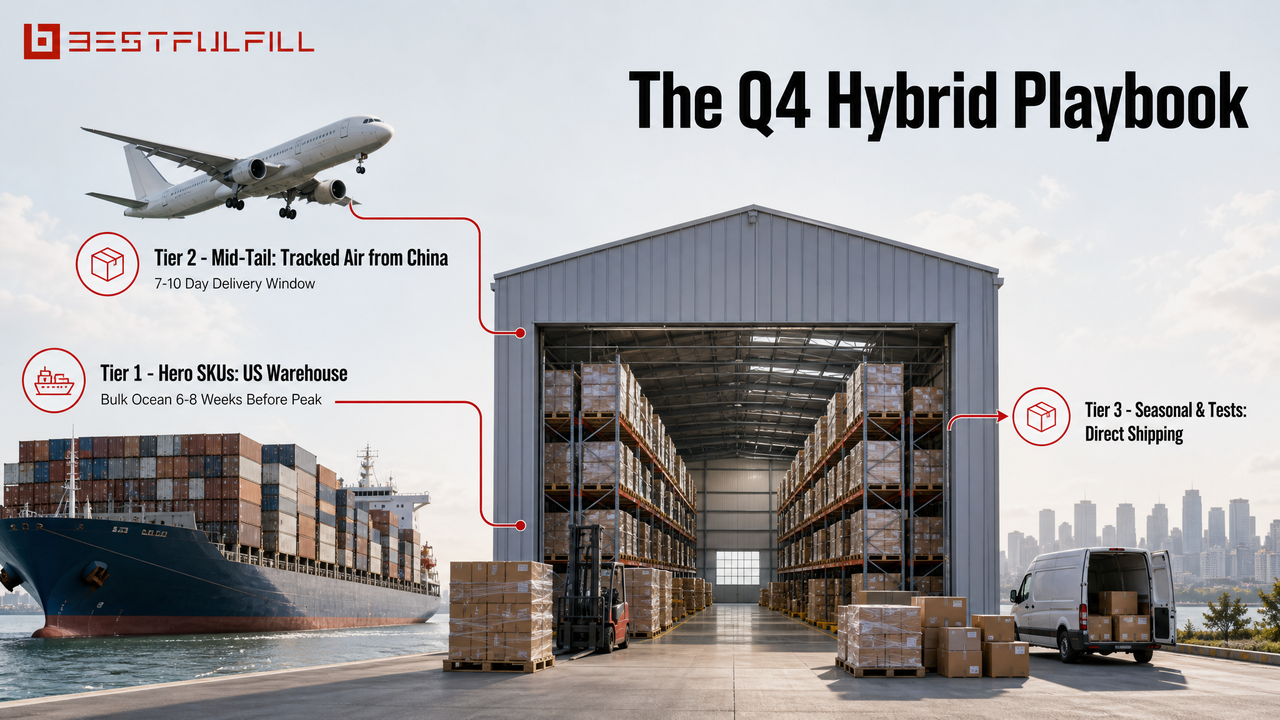
The highest-performing DTC brands rarely pick just one model. Instead, they organize their catalog into a tiered fulfillment strategy:
- Tier 1: Hero SKUs (US Warehouse)
Forecast Q4 demand early, import inventory before peak port congestion, and hold safety stock near your main customer base.
- Tier 2: Stable Mid-Tail Products (Flexible International Lines)
Maintain reliable tracked air shipping channels to balance transit speed with minimal inventory holding risk.
- Tier 3: Seasonal Products \& Experiments (China Direct Shipping)
Run lean campaigns, validate market response, and promote winners to Tier 1 in future quarters.
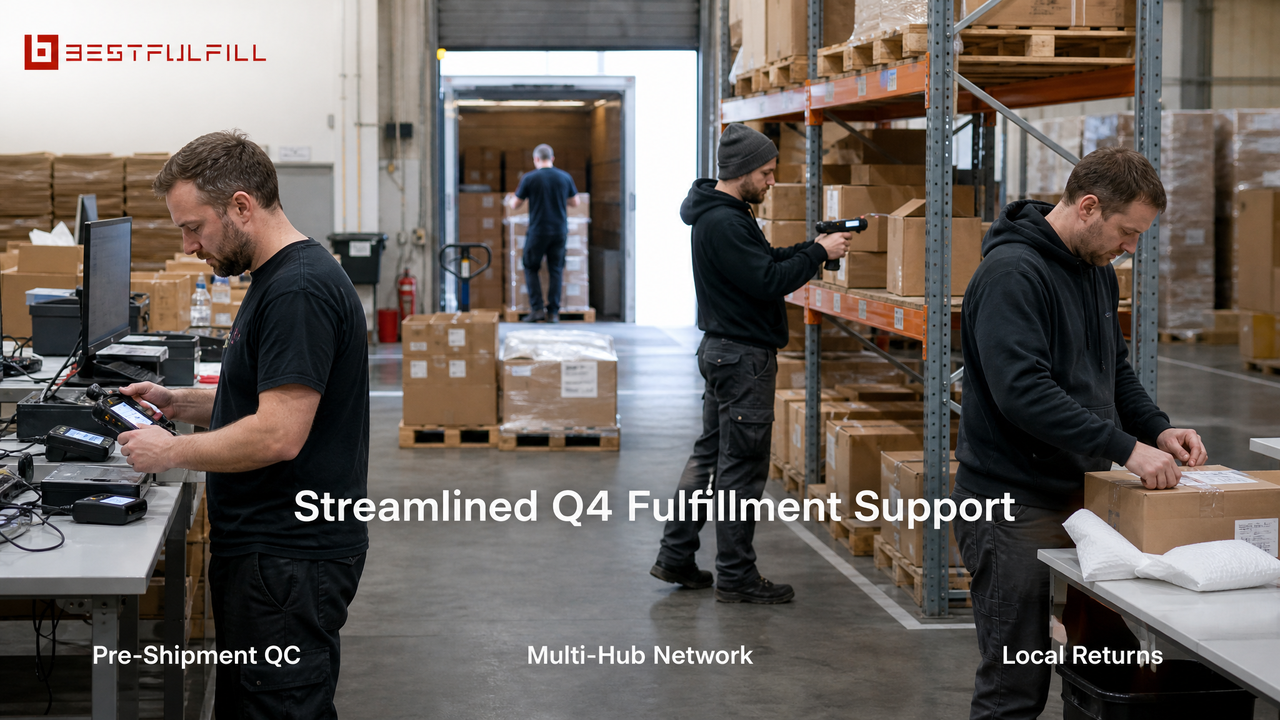
How Bestfulfill Powers Your Q4 Strategy
Whether you're shipping direct from origin, stocking US facilities, or balancing a hybrid stack, Bestfulfill helps align your supply chain with actual product demand:
For China Direct Shipping Operations:
- 🔍 Pre-Shipment Quality Control: Catch cosmetic or functional defects at our origin hub before parcels ship out, cutting unnecessary return rates.
- ✈️ Flexible Shipping Management: Access multiple postal and express routing lines to navigate carrier availability, customs clearance, and peak-season capacity surges.
For US Warehouse Fulfillment:
- 🏬 Domestic Warehouse Operations: Shorten last-mile delivery times and improve customer satisfaction during key holiday windows.
- ⚡ Efficient Inventory Intake: Standardized receiving workflows ensure your inbound stock gets shelved and ready for sale without long delays.
- 🔄 Local Return Processing: Manage returns, inspections, and restocking locally in the US, avoiding costly international reverse logistics.
Final Thoughts: Strategy is SKU-Based, Not Brand-Based
The choice between China direct shipping and US warehousing isn't an "either/or" battle.
Direct shipping remains your best tool for testing ideas and preserving capital. US warehousing is your engine for scaling proven winners and protecting margins.
The most resilient DTC brands in 2026 use a hybrid strategy: keep your highest-volume SKUs close to your customers, and keep the rest of your supply chain agile.
📊 Ready to Optimize Your Q4 Fulfillment Strategy?
Before peak season congestion kicks in, take a closer look at your SKU mix, landed costs, and delivery expectations.
- Let’s map your SKU mix and calculate whether direct shipping, US warehousing, or a hybrid model will maximize your Q4 margins.
Frequently Asked Questions (FAQ)
Q1: What’s a good rule of thumb for moving a SKU to a US warehouse?
When a SKU consistently reaches around 50+ orders per week, the savings on bulk shipping and domestic postage usually start offsetting US storage and handling overhead.
Q2: How far in advance should I plan US warehouse stock for the holidays?
Aiming to have bulk shipments land at domestic hubs by late September or early October gives you a comfortable runway before peak shipping volumes hit full stride.
Q3: How does a hybrid model handle unexpected sales spikes?
If your domestic warehouse stock sells out faster than planned, your direct China shipping line can act as an immediate backup fulfillment channel, ensuring you never have to pause your ads.