



Top 6 3PL Companies for Ecommerce Brands in 2026: Which One Fits Your Business?
Choosing a 3PL in 2026 is about more than warehousing and shipping.
For growing ecommerce brands, the right partner can affect delivery speed, inventory control, customer experience, and international expansion. But different 3PLs are built for very different business models.
This guide compares six 3PL companies for ecommerce brands in 2026: ShipBob, ShipMonk, Bestfulfill, Red Stag Fulfillment, eFulfillment Service, and SHIPHYPE.
Key Takeaways
- ShipBob is a strong choice for scaling brands that need distributed fulfillment.
- ShipMonk is well suited to complex fulfillment, kitting, and branded packaging.
- Bestfulfill fits cross-border brands that need China sourcing, QC, warehousing, and global fulfillment.
- Red Stag Fulfillment specializes in heavy and oversized products.
- eFulfillment Service is accessible for startups and lower-volume sellers.
- SHIPHYPE focuses on growing Shopify and DTC brands.
The best 3PL is not simply the largest provider. It is the one that best matches your product, sourcing model, customer markets, and growth stage.
Quick Answer: What Are the Best 3PL Companies in 2026?
| 3PL Provider | Best For | Main Strength |
|---|---|---|
| ShipBob | Scaling ecommerce brands | Distributed fulfillment |
| ShipMonk | Complex DTC operations | Kitting and customization |
| Bestfulfill | Cross-border brands | China sourcing + fulfillment |
| Red Stag Fulfillment | Heavy products | Specialized handling |
| eFulfillment Service | Startups | Low entry barrier |
| SHIPHYPE | Shopify & DTC brands | Ecommerce-focused fulfillment |
1. ShipBob — Best for Scaling Ecommerce Brands
Best for: Established ecommerce brands that need distributed inventory across multiple markets.
ShipBob combines fulfillment technology with a large warehouse network. Its platform supports ecommerce integrations, inventory management, distributed inventory, order fulfillment, and international expansion. (ShipBob)
Its main advantage is the ability to position inventory closer to customers as a brand scales.
Distinctive edge: A large distributed fulfillment network that helps established brands move inventory closer to customers as they scale.
Key strengths: Distributed fulfillment · Inventory technology · Ecommerce integrations · International expansion
Consideration: Using multiple fulfillment centers requires stronger inventory forecasting and stock allocation.
2. ShipMonk — Best for Complex and Branded Fulfillment
Best for: Brands with bundles, subscriptions, custom packaging, or more complex fulfillment workflows.
ShipMonk is built around ecommerce fulfillment with strong support for operational customization. Brands can use it for inventory management, kitting, bundling, branded packaging, returns, and multichannel fulfillment.
This makes it particularly relevant when fulfillment involves more than standard pick-and-pack.
Distinctive edge: Strong support for operational complexity, particularly when orders involve kits, subscriptions, bundles, or customized packaging.
Key strengths: Kitting · Bundles · Subscription fulfillment · Custom packaging · Multichannel operations
Consideration: Brands with very simple fulfillment requirements may not need the same level of customization.
3. Bestfulfill — Best for China Sourcing + Global Fulfillment
Best for: Cross-border ecommerce brands sourcing products from China.
Bestfulfill combines upstream supply-chain services with fulfillment. Its 3PL workflow can include product sourcing, quality and quantity checks, warehousing, labeling, pick and pack, and international shipping. (Bestfulfill)
That makes it relevant for brands that want fewer handoffs between factories, QC, inventory, and fulfillment.
Distinctive edge: Connects upstream China sourcing and QC with downstream warehousing and fulfillment within one operational workflow.
Key strengths: China sourcing · QC · Warehousing · Product customization · Global fulfillment
Consideration: Brands that only need domestic US fulfillment may prefer a provider with a denser US warehouse network.
4. Red Stag Fulfillment — Best for Heavy and Oversized Products
Best for: Brands selling bulky, heavy, or difficult-to-handle products.
Red Stag specializes in products that standard parcel-focused 3PLs may struggle with. Its facilities and processes are designed for larger and heavier SKUs, with support for parcel, pallet, retail, Amazon, returns, and kitting. (Red Stag Fulfillment)
Distinctive edge: Fulfillment operations designed specifically around heavy, oversized, fragile, or expensive-to-fulfill products.
Key strengths: Heavy products · Oversized fulfillment · High-value inventory · Parcel and freight
Consideration: Its specialization is less important for brands selling lightweight standard parcels.
5. eFulfillment Service — Best for Startups
Best for: Smaller ecommerce businesses outsourcing fulfillment for the first time.
eFulfillment Service stands out for its low barrier to entry. It currently states that it has no minimum order-volume requirements, setup fees, or long-term contracts. (eFulfillment Service, Inc.)
That makes it easier for smaller sellers to adopt outsourced fulfillment before reaching larger volumes.
Distinctive edge: A startup-friendly fulfillment model without the same volume commitments often associated with larger providers.
Key strengths: No order minimums · Startup-friendly · Ecommerce integrations · Returns
Consideration: Its single primary US fulfillment location may be less suitable for brands needing a highly distributed warehouse network. (eFulfillment Service, Inc.)
6. SHIPHYPE — Best for Shopify and DTC Brands
Best for: Growing Shopify brands needing straightforward North American fulfillment.
SHIPHYPE focuses on DTC ecommerce fulfillment, including receiving, storage, pick and pack, inventory management, returns, and store integrations. It supports fulfillment from US and Canadian locations and connects directly with Shopify. (SHIPHYPE Fullfillment)
Distinctive edge: A focused option for Shopify and DTC brands that want straightforward North American fulfillment.
Key strengths: Shopify fulfillment · DTC operations · Pick and pack · US and Canada fulfillment
Consideration: Brands requiring sourcing or factory-level QC may need additional upstream supply-chain support.
Best 3PL by Business Type
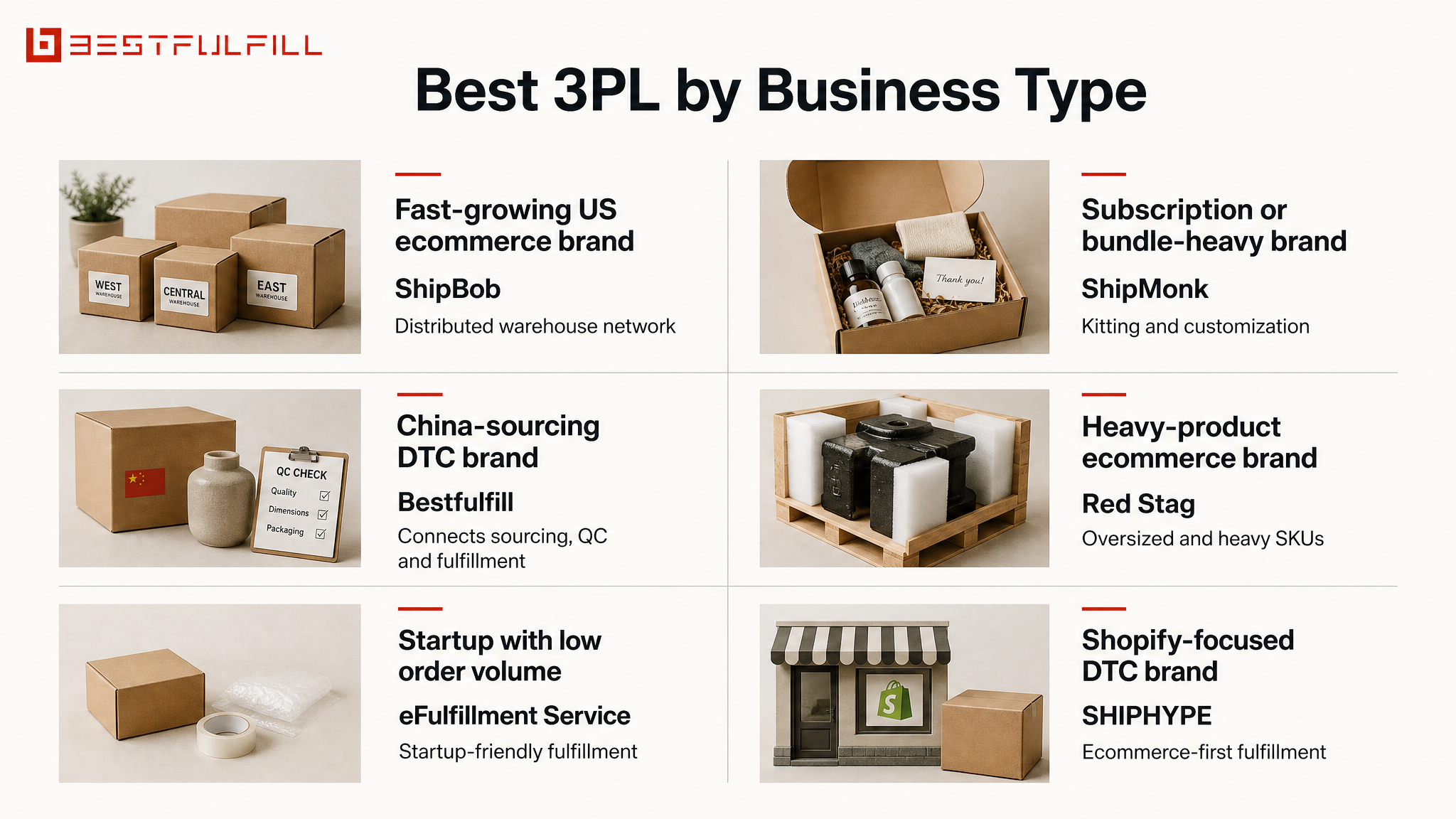
A provider that works well for one ecommerce brand may be a poor fit for another.
| Business Type | Best Match | Why |
|---|---|---|
| Fast-growing US ecommerce brand | ShipBob | Distributed warehouse network |
| Subscription or bundle-heavy brand | ShipMonk | Strong kitting and customization |
| China-sourcing DTC brand | Bestfulfill | Connects sourcing, QC and fulfillment |
| Heavy-product ecommerce brand | Red Stag | Built for oversized and heavy SKUs |
| Startup with low order volume | eFulfillment Service | No minimum order requirement |
| Shopify-focused DTC brand | SHIPHYPE | Ecommerce-first fulfillment |
This is often more useful than asking which company is “best overall.”
How to Choose the Right 3PL
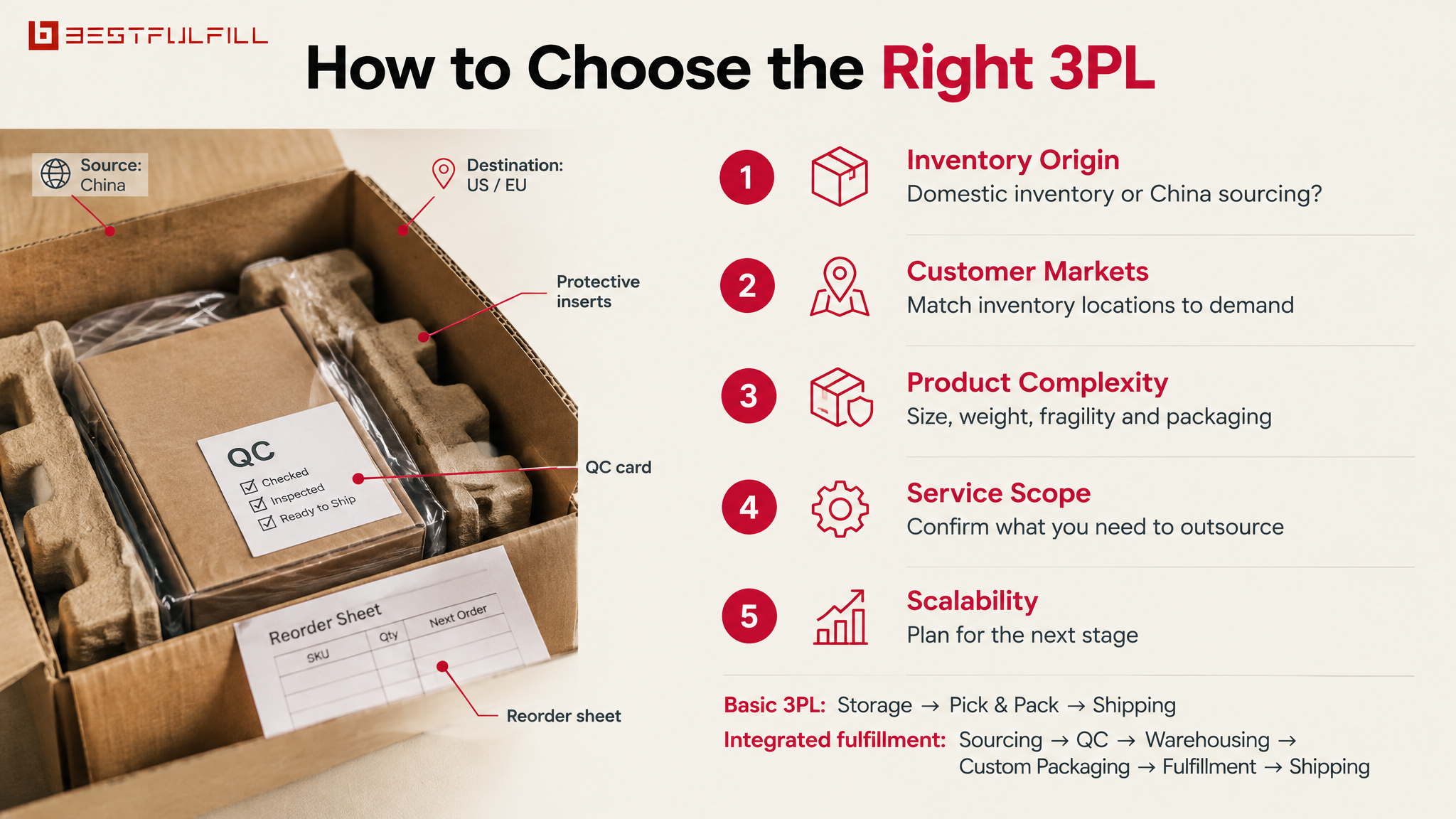
Compare 3PLs across five core dimensions:
1. Inventory Origin
If inventory is already stored domestically, prioritize warehouse coverage and delivery speed.
If products are sourced from China, also evaluate:
Supplier coordination · QC · Consolidation · Cross-border fulfillment
The further upstream your 3PL can support, the fewer operational handoffs you need to manage.
2. Customer Markets
Match warehouse locations to actual demand.
- Primarily, US customers: prioritize domestic fulfillment coverage.
- Global customer base: consider cross-border shipping, overseas warehouses, or a hybrid model.
More warehouses are not always better. The goal is better cost, inventory efficiency, and delivery performance.
3. Product Complexity
Your products should shape your 3PL shortlist.
Evaluate:
Size & weight · Fragility · SKU count · Bundling · Packaging · QC · Returns
Standard lightweight products can use general ecommerce 3PLs, while oversized, fragile, or highly customized products may require specialized operations.
4. Service Scope
Define exactly what you want to outsource.
Basic 3PL: Storage → Pick & Pack → Shipping
Integrated fulfillment: Sourcing → QC → Warehousing → Custom Packaging → Fulfillment → Shipping
Do not compare providers on price until you confirm they are offering the same service scope.
5. Scalability
Choose for the next stage, not only today's volume.
Check whether the provider can support:
More SKUs · Peak seasons · New markets · New sales channels · Private label · Branded packaging · Overseas inventory
A good 3PL should reduce the need for another operational migration as the business grows.
What Should You Compare Before Choosing a 3PL?
| Criteria | What to Check |
|---|---|
| Warehouse network | Are locations close to your customers? |
| Fulfillment SLA | How quickly are orders processed? |
| Inventory visibility | Can you track stock accurately? |
| Integrations | Does it connect with your sales channels? |
| Product handling | Can it manage your product type? |
| Customization | Does it support kitting, packaging, or labeling? |
| Returns | How are returns inspected and processed? |
| Pricing | What is the total cost beyond shipping rates? |
| Scalability | Can it support new markets and higher volume? |
Do not choose a 3PL based only on the lowest shipping or pick-and-pack rate.
The more useful comparison is total operational cost and operational fit.
What We See When Ecommerce Brands Choose a 3PL
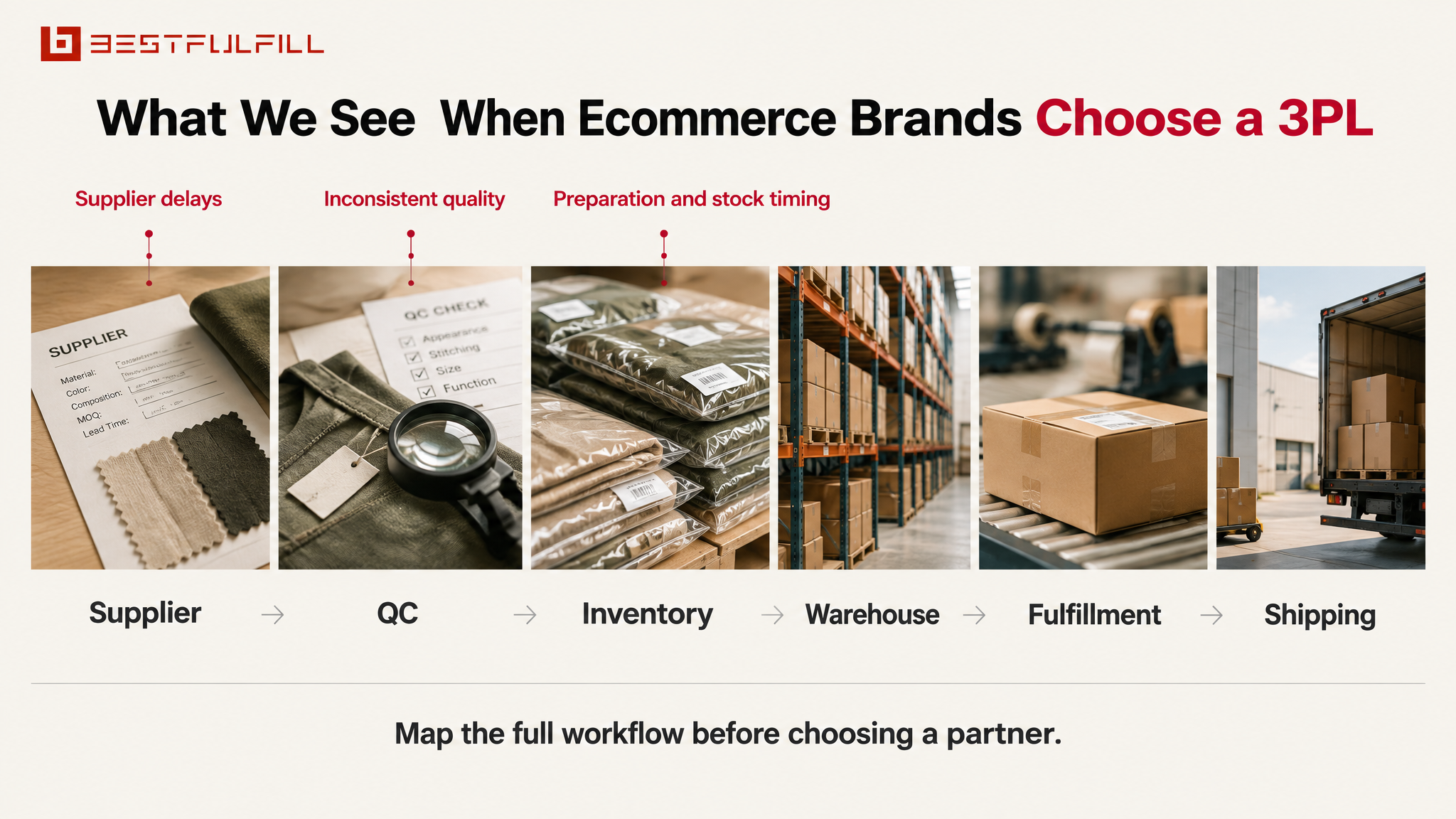
From our work with cross-border ecommerce brands, one pattern appears repeatedly: many fulfillment problems begin before inventory reaches the warehouse.
Supplier delays, inconsistent QC, packaging preparation, inventory timing, and stock movement can create just as much operational friction as pick-and-pack itself.
We also see brands compare 3PLs mainly on warehouse location or shipping rates, while overlooking where their biggest bottleneck actually sits.
If the main issue is delivery speed, a wider warehouse network may be the right answer.
But if problems start with suppliers, product quality, or inventory coordination, adding another warehouse may not solve the underlying issue.
The better approach is to map the full workflow:
Supplier → QC → Inventory → Warehouse → Fulfillment → Shipping
Then choose the partner that removes the most friction from that chain.
Final Verdict
There is no single best 3PL for every ecommerce brand.
Choose ShipBob if distributed fulfillment and network scale are the priority.
Choose ShipMonk when kitting, subscriptions, or branded fulfillment add operational complexity.
Consider Bestfulfill if products are sourced from China and you want sourcing, QC, inventory, and global fulfillment connected through a more integrated workflow.
Red Stag Fulfillment stands out for heavy and oversized products, while eFulfillment Service provides an accessible option for smaller sellers. SHIPHYPE is a strong fit for Shopify-focused DTC fulfillment.
The key question is simple:
Which 3PL solves the biggest bottleneck in your current supply chain?
Frequently Asked Questions (FAQ)
What is the best 3PL for ecommerce?
There is no universal best provider. The right choice depends on product type, warehouse requirements, sourcing location, customer markets, and fulfillment complexity.
What is the best 3PL for Shopify?
ShipBob, ShipMonk, and SHIPHYPE are ecommerce-focused options with Shopify support. Brands sourcing from China may also consider Bestfulfill when sourcing and QC need to be connected with fulfillment.
What is the best 3PL for small businesses?
eFulfillment Service is worth considering for smaller sellers because it currently has no minimum order-volume requirement, setup fee, or long-term contract. (eFulfillment Service, Inc.)
What is the best 3PL for brands sourcing from China?
Look for capabilities beyond warehousing, including supplier coordination, QC, product preparation, and cross-border shipping. Bestfulfill is one provider that combines these functions with fulfillment. (Bestfulfill)
How much does a 3PL cost?
3PL costs can include receiving, storage, pick and pack, shipping, packaging, returns, and additional services. Compare total fulfillment cost rather than one headline rate.
When should an ecommerce brand use a 3PL?
Consider a 3PL when warehousing, inventory, shipping, returns, or supplier coordination begin consuming too many internal resources or limiting growth.