



Key Takeaways: EU €3 Import Duty 2026
New EU Customs Rules Start July 1, 2026
The EU will introduce a temporary €3 customs duty on eligible low-value imports from outside the EU.
The €3 Duty Applies Per Item Category
The charge is based on different item categories identified by tariff sub-headings, not simply the number of parcels.
Low-AOV Products May Face More Cost Pressure
A fixed €3 customs duty can represent a larger share of the value of lower-priced products.
DDP Can Improve Cost Predictability
DDP can incorporate applicable import costs into the landed-cost structure before delivery.
EU Warehousing Supports Scaling
Local inventory can help brands improve delivery speed and reduce cross-border fulfillment complexity.
Quick Answer: How Will the EU €3 Duty Affect DTC Brands?
From July 1, 2026, eligible low-value consignments entering the EU from outside the EU will be subject to a temporary €3 customs duty for each different item category contained in the parcel.
The actual impact on a DTC brand depends on:
- Product value
- Product category
- Shipping method
- Order structure
- Inventory location
Brands can adapt by:
- Reviewing product-level landed costs
- Using DDP shipping for product testing
- Considering EU warehousing for proven products
The €3 customs duty does not make cross-border ecommerce unviable, but it makes fulfillment and landed-cost planning more important.
What Is the EU €3 Import Duty Rule?
Starting July 1, 2026, the EU will remove the existing customs duty exemption for low-value consignments with an intrinsic value of €150 or less.
As an interim measure, a €3 customs duty will apply to eligible low-value consignments entering the EU from outside the EU.
The temporary measure is currently scheduled to apply from July 1, 2026, until July 1, 2028. Once the EU Customs Data Hub becomes operational, the interim duty is expected to be replaced by the normal customs tariff system. The temporary measure may also be extended if the relevant infrastructure is not ready.
Before July 2026
Low-value consignments up to €150 could enter the EU without customs duty, although applicable import VAT requirements still applied.
From July 1, 2026
Eligible low-value consignments will be subject to the new temporary €3 customs duty, in addition to applicable VAT and other import-related costs.
For DTC brands shipping directly from China or other non-EU markets, this changes the way landed costs need to be calculated.
Important Detail: The €3 Duty Is Not Simply Per Parcel
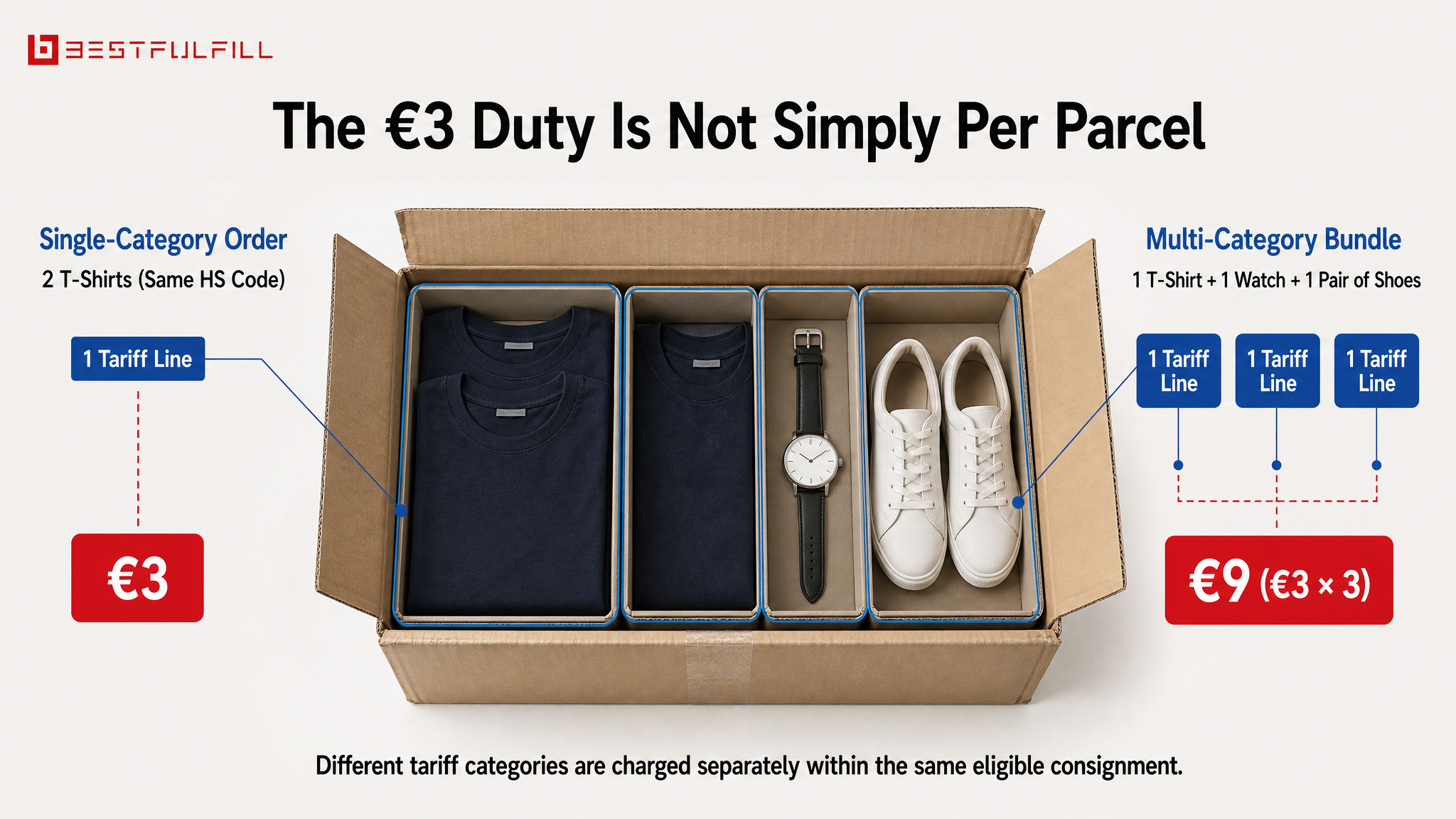
A common misunderstanding is that every package automatically receives only one €3 charge.
In practice, the duty calculation is connected to tariff classification.
A shipment containing multiple product categories may involve multiple tariff lines.
| Order Scenario | Items Included | HS Classifications Involved | Total Customs Duty Owed |
|---|---|---|---|
| Single Category Order | 2 T-shirts (Same HS Code) | 1 Tariff Line | €3 |
| Multi-Category Bundle | 1 T-shirt + 1 Watch + 1 Pair of Shoes | 3 Tariff Lines (3 HS Codes) | €9 (€3 × 3) |
€3 Customs Duty vs. EU Handling Fee
The new €3 customs duty should not be confused with the separate EU handling fee proposal.
They are different measures.
The €3 customs duty is the temporary customs measure introduced from July 1, 2026.
The handling fee is a separate measure being developed as part of the broader EU customs reform. The European Commission has also published separate guidance covering the VAT treatment of the €3 customs duty and the proposed Union handling fee.
For ecommerce brands, it is therefore important to keep the two costs separate when calculating future EU fulfillment expenses.
How Will the EU €3 Duty Affect DTC Brands?
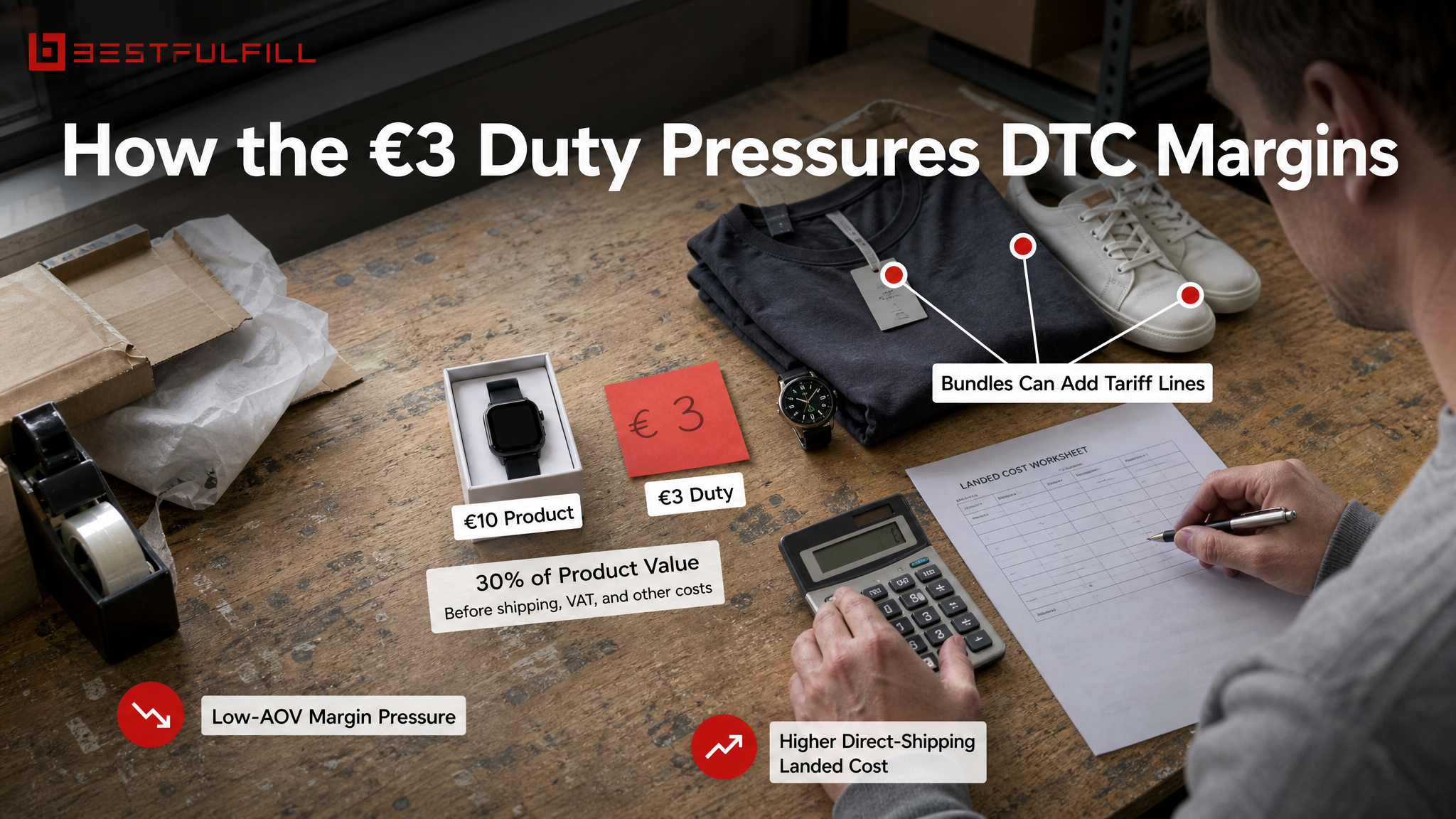
Low-AOV Products May Face Greater Margin Pressure
A fixed €3 customs duty represents a larger percentage of product value when selling lower-priced products.
For example, a €10 product would face a €3 customs charge equal to 30% of its product value, before considering other shipping and import-related costs.
This does not mean every €10 product will experience a 30% increase in total landed cost. The actual impact depends on shipping costs, VAT treatment, carrier charges, product margins, and other factors.
Products that may require closer margin analysis include:
- Fashion accessories
- Phone accessories
- Small consumer electronics
- Lifestyle products
- Other low-AOV SKUs
Brands should review:
- Product-level margins
- Shipping costs
- Return costs
- Average order value
- Fulfillment location
Direct Shipping Requires Better Landed-Cost Management
Direct shipping from China or other origin markets remains an option for many ecommerce brands.
However, brands may need to account for:
- Customs duties
- Shipping costs
- Carrier or clearance charges
- VAT treatment
- Delivery experience
DDP (Delivered Duty Paid) shipping can help brands incorporate applicable import costs into the landed-cost structure before delivery.
This can reduce the likelihood of unexpected charges being passed to customers.
However, DDP does not eliminate the new €3 customs duty.
Instead, it can provide a more predictable way to manage applicable duties and import costs within the fulfillment and pricing structure.
Product Bundling Requires Customs Planning
Increasing average order value through bundles is a common DTC strategy.
However, brands should consider customs classification when combining products from different categories.
For example, a parcel containing a skincare product and a separate accessory may involve different tariff sub-headings.
That can affect the total customs duty applied to the parcel.
Brands should therefore evaluate bundle structures together with their fulfillment or customs partner rather than assuming that one parcel automatically means one €3 charge.
How Can Brands Adapt to the New EU Import Environment?
There is no single fulfillment strategy for every ecommerce business.
The right approach depends on:
- Product stage
- Order volume
- Product margins
- Customer expectations
- Inventory requirements
Three strategies are particularly relevant.
| Adaptation Strategy | Operational Action | Primary Business Benefit |
|---|---|---|
| Strategy 1: Optimize Product Economics | Audit product margins and bundle structures (use items under the same HS Code). | Prevents selling low-margin multi-category bundles at a loss. |
| Strategy 2: DDP Shipping (Product Testing) | Pre-calculate and pay import duties and VAT before parcel dispatch. | Ensures transparent checkout with zero doorstep fees for buyers. |
| Strategy 3: Local EU Warehousing (Scaling) | Stock proven, high-velocity bestsellers inside the EU in bulk. | 100% exempt from €3 cross-border import duties; enables 2–7 day delivery. |
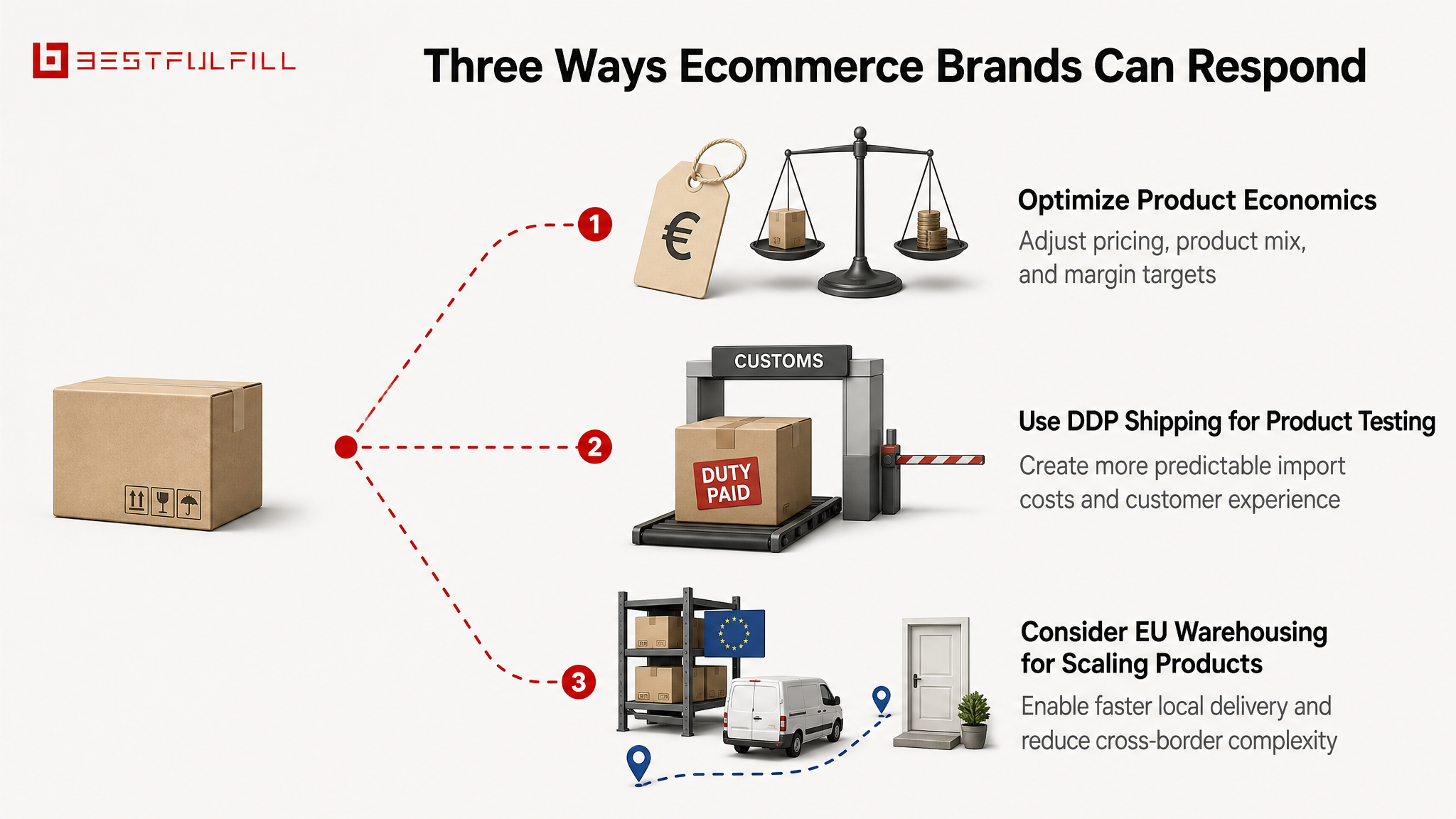
Strategy 1: Optimize Product Economics
Brands should review:
- Product margins
- Shipping costs
- Return rates
- Average order value
Lower-margin products may require pricing adjustments or alternative fulfillment models.
Strategy 2: Use DDP Shipping for Product Testing
For new products or low-volume SKUs, direct shipping can remain a flexible approach.
DDP shipping helps brands:
- Pre-calculate import costs
- Reduce customer payment friction
- Improve delivery experience
However, brands should compare total landed costs across different shipping solutions.
Strategy 3: Consider EU Warehousing for Scaling Products
For products with stable demand, moving inventory closer to European customers can improve fulfillment efficiency.
Potential benefits include:
- Faster local delivery
- More predictable customer experience
- Reduced cross-border shipment complexity
- Better regional inventory planning
Once goods have been properly imported and cleared into the EU, subsequent domestic EU shipments generally do not require another import customs clearance.
For brands with proven demand, EU warehousing can therefore provide an alternative to shipping every individual order across the EU border.
Fulfillment Model Comparison
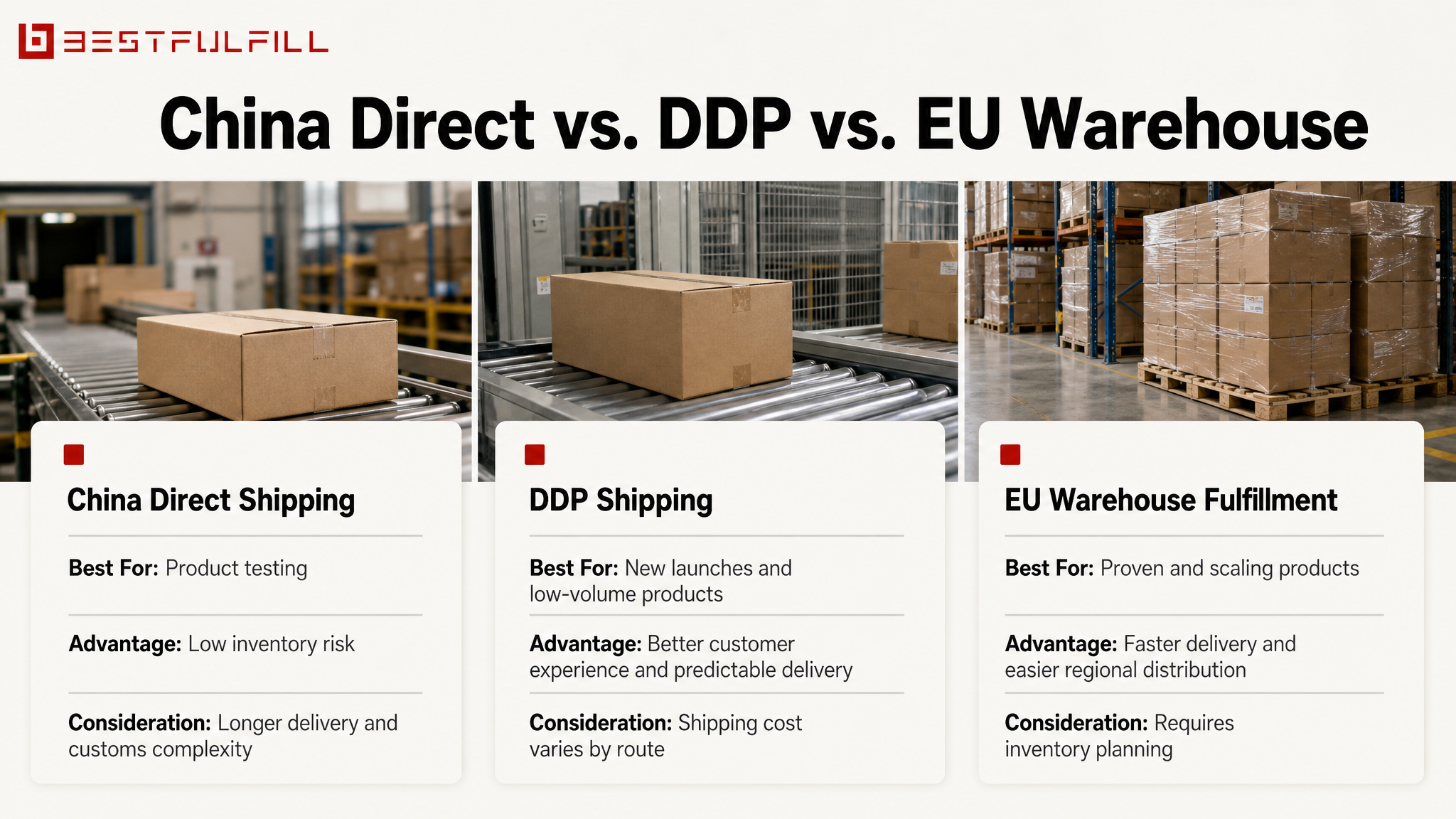
How Fulfillment Providers Can Help Brands Adapt
As EU customs requirements evolve, fulfillment decisions become increasingly connected to sourcing, inventory, shipping, and customer experience.
A fulfillment provider can help brands compare different models based on:
- Product category
- Order volume
- Destination market
- Inventory requirements
- Shipping costs
- Customer delivery expectations
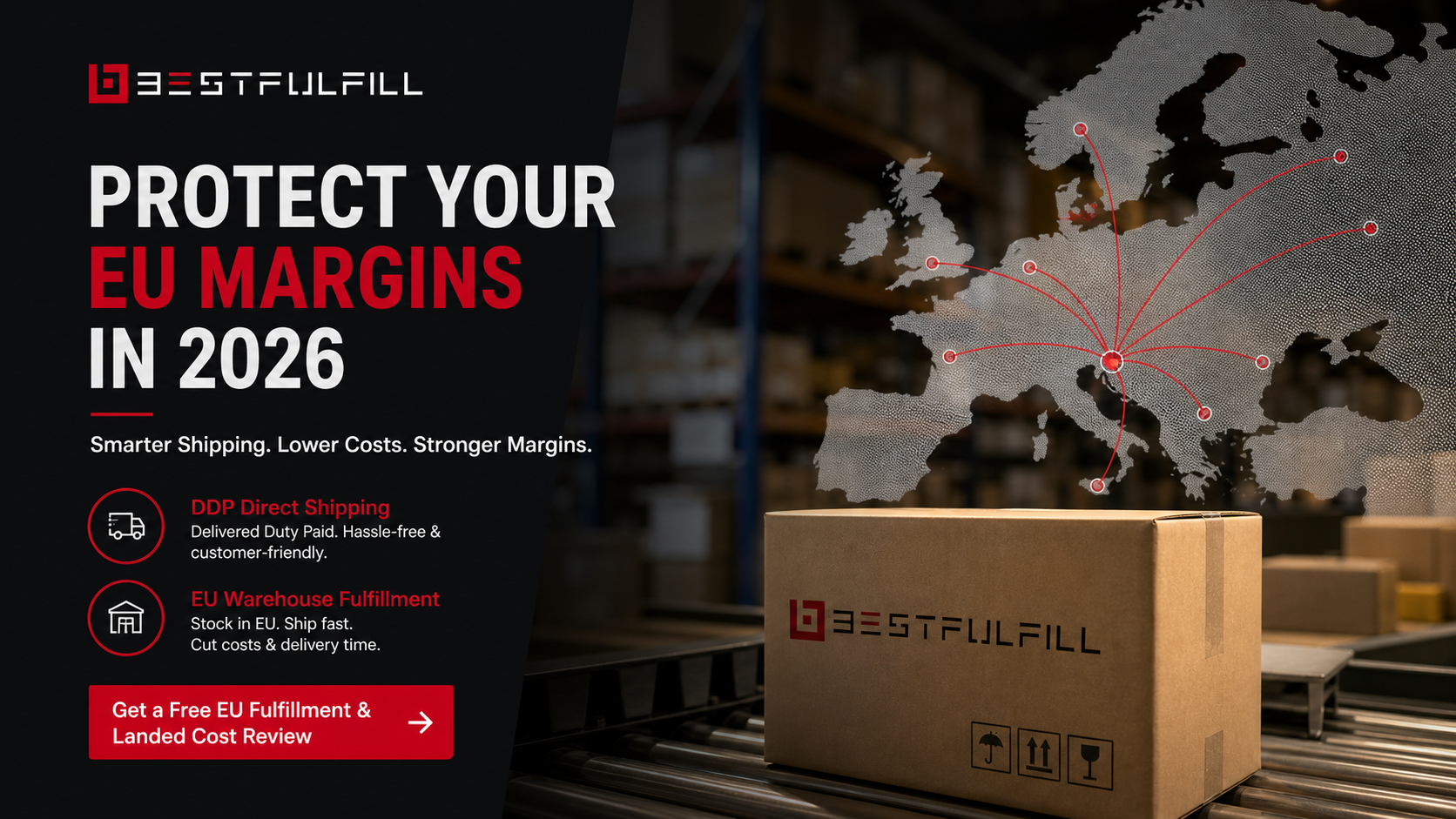
For example, Bestfulfill supports brands through two fulfillment approaches depending on product stage.
Bestfulfill Approach: Two Fulfillment Paths
Option 1: EU Warehouse Fulfillment
For Scaling Products
For proven products with consistent European demand, brands can move inventory closer to customers.
Potential benefits include:
- Faster regional delivery
- Reduced cross-border shipment complexity
- More predictable fulfillment operations
- Better inventory positioning for established markets
This approach may be suitable for:
- Hero products
- Stable sales volume
- Proven EU demand
Local EU fulfillment does not mean the goods were never subject to import procedures. Inventory must first be properly imported and cleared into the EU.
Option 2: Optimized DDP Direct Shipping
For Product Testing
For new products or long-tail SKUs, direct shipping from China can help brands limit upfront inventory exposure.
A managed DDP solution can help brands:
- Handle applicable import costs upfront
- Reduce customer payment friction
- Improve delivery predictability
- Maintain flexibility while testing products
This approach may be suitable for:
- New product launches
- Market testing
- Lower-volume SKUs
- Long-tail product catalogs
Again, DDP is a cost-management and delivery model, not a way to eliminate the applicable €3 customs duty.
Official EU Policy References
This article is based primarily on official EU customs and regulatory information.
The European Commission states that from July 1, 2026, a temporary €3 customs duty will apply to eligible low-value consignments up to €150 imported from outside the EU. The measure is currently intended to apply until July 1, 2028, after which normal customs duties are expected to apply under the broader customs reform framework.
The Council of the European Union explains that the €3 duty is levied on each different category of item in a parcel, identified by tariff sub-headings, rather than simply once per parcel.
The Council also explicitly distinguishes the €3 customs duty from the separate handling fee proposal being developed under the broader customs reform.
For product-specific customs classification or compliance questions, brands should consult the relevant EU customs guidance or a qualified customs professional.
Final Takeaway
The EU €3 customs duty does not eliminate cross-border ecommerce, but it makes fulfillment strategy more important.
DTC brands should evaluate:
- Product margins
- Customs exposure
- Shipping models
- Inventory location
- Customer experience
For product testing: DDP direct shipping can provide flexibility and help make import costs more predictable.
For scaling products: EU warehousing can support faster local delivery and more predictable regional fulfillment.
The most effective strategy will depend on each brand's product economics, sales volume, and customer distribution.
📊 Ready to Protect Your EU Margins in 2026?
Don't assume that one fulfillment model will work equally well for every SKU.
Get a Free EU Fulfillment & Landed Cost Review with Bestfulfill.
Bestfulfill can review your product mix, shipping model, and EU fulfillment strategy to help you compare direct DDP shipping with EU warehouse fulfillment under the new 2026 customs environment.
The goal is not simply to reduce one customs cost — it is to build a fulfillment model that balances landed cost, inventory risk, delivery speed, and customer experience.
Frequently Asked Questions (FAQ)
Does the EU €3 duty apply to all products under €150?
The rule applies to eligible low-value imports under the updated customs framework. The actual treatment depends on customs classification and shipment details.
Is the €3 duty charged per parcel?
The calculation is related to tariff classification rather than simply the number of parcels. Multiple tariff lines within one shipment may affect the total duty amount.
Can DDP shipping prevent customers from paying unexpected fees?
DDP shipping allows applicable import costs and clearance fees to be handled before delivery, helping reduce unexpected charges for customers.
Should DTC brands move inventory to EU warehouses?
Brands with proven products and stable demand may benefit from EU warehousing because it can improve delivery speed and operational predictability.
Is dropshipping still viable after the EU customs change?
Yes. The impact depends on product economics and fulfillment strategy.
Brands may continue using direct shipping for testing while adopting regional fulfillment for scaling products.