Key Takeaways
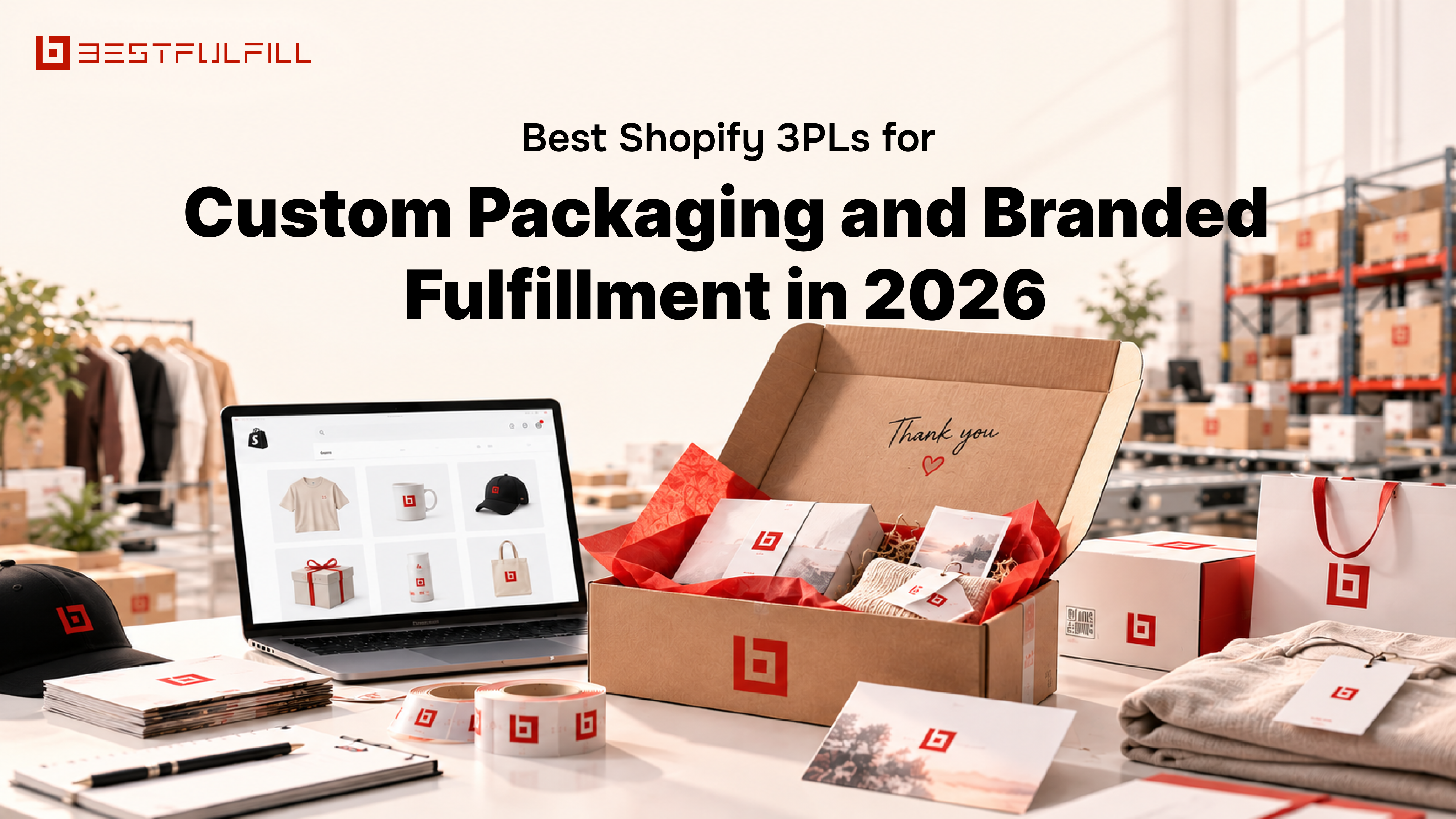
- Custom packaging can include boxes, inserts, kitting, SKU-level rules, and packaging inventory management.
- The real difference between 3PLs is not whether they offer branded packaging, but how reliably they can execute it at scale.
- Packaging materials should be treated as inventory, not decoration.
- Shopify brands should evaluate branding capability together with fulfillment accuracy, inventory visibility, kitting, and market coverage.
- The strongest provider is the one whose operating model matches the complexity of the brand experience.
Quick Answer: Which Shopify 3PLs Are Best for Custom Packaging and Branded Fulfillment?
- Bestfulfill — connected product preparation, QC, branded fulfillment, and global shipping
- ShipBob — distributed DTC fulfillment with standardized branding
- ShipMonk — subscriptions, bundles, kitting, and complex packaging workflows
- Cart.com— larger DTC, campaign, and omnichannel fulfillment programs
- Boutique Shopify 3PLs — highly customized unboxing experiences at smaller scale
- Vertical-specialist 3PLs — category-specific packaging and handling requirements
These are scenario-based recommendations rather than a universal ranking.
For a broader comparison beyond branded packaging, see Best Shopify 3PL Fulfillment Companies for Growing Ecommerce Brands in 2026.
Shopify 3PLs for Branded Fulfillment Compared
| Provider | Best Fit | Branding Capability | Fulfillment Strength | Key Consideration |
| Bestfulfill | Scaling Shopify brands needing connected product preparation and fulfillment | Custom packaging, inserts, kitting, SKU-specific workflows | Sourcing + QC + branded fulfillment + global shipping | Best when complexity starts before warehouse fulfillment |
| ShipBob | DTC brands with stable inventory | Custom packaging, inserts, gift notes | Distributed ecommerce fulfillment | Branding workflows may vary by setup |
| ShipMonk | Subscription and high-SKU brands | Kitting, bundles, inserts, packaging optimization | Flexible ecommerce fulfillment | Advanced workflows require more setup |
| Cart.com | Larger DTC and omnichannel brands | Complex kits, custom materials, campaign fulfillment | Scalable multi-channel operations | May be more infrastructure than smaller brands need |
| Boutique Shopify 3PLs | Emerging DTC brands | High-touch custom packaging | Flexible execution | Coverage and technology can be limited |
| Vertical Specialists | Beauty, supplements, apparel | Category-specific packaging and labeling | Specialized handling | Less flexible outside their core vertical |
What Makes Branded Fulfillment Different?
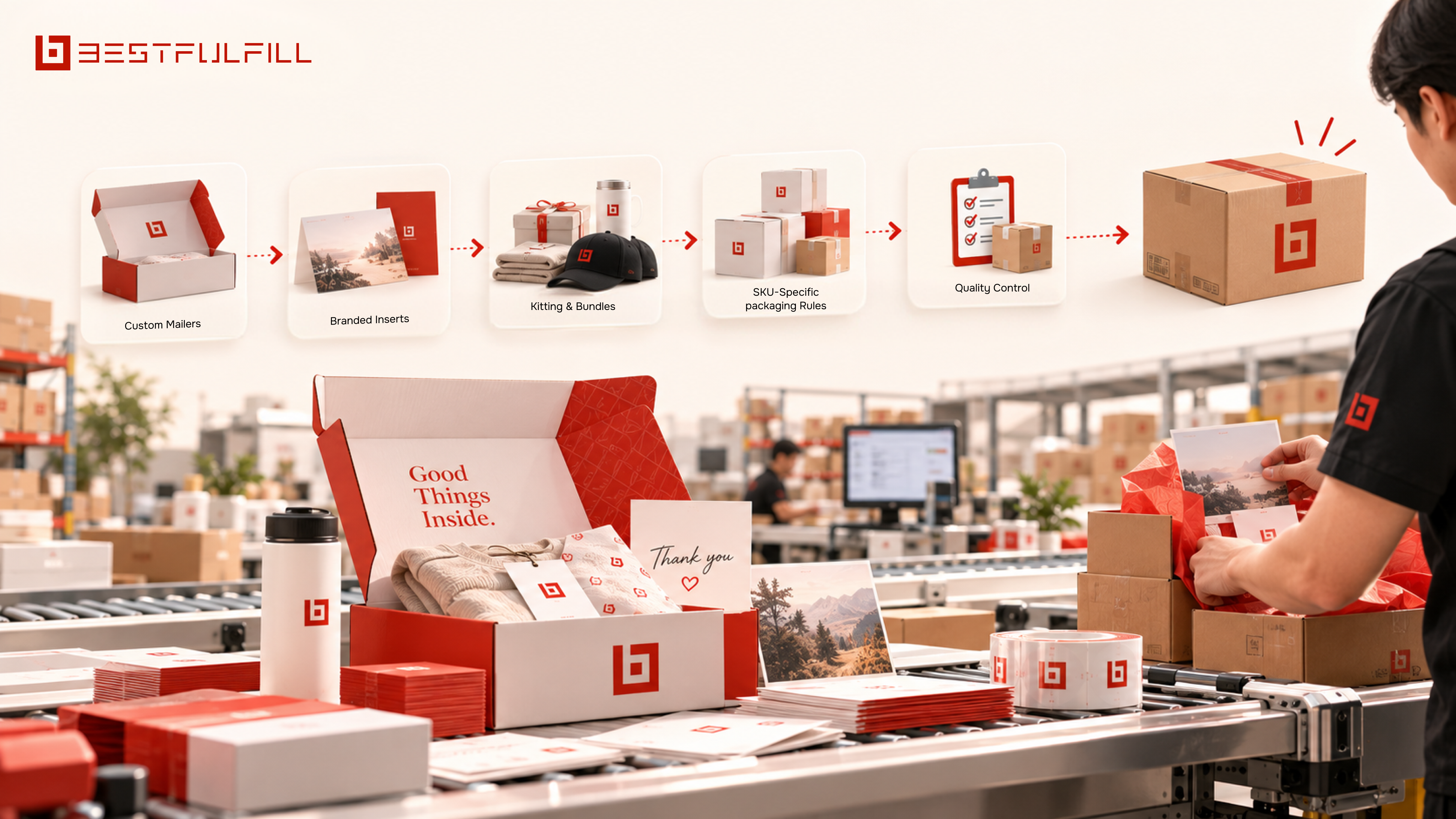
Custom packaging is already a common feature across the Shopify fulfillment ecosystem. The Shopify App Store's 3PL custom packaging category currently lists hundreds of 3PL apps with custom-packaging capabilities.
But offering the feature is not the same as managing it well.
A simple branded mailer is relatively easy. Different packaging by SKU, seasonal inserts, subscription kits, bundle components, and multiple packaging versions create a much more complex warehouse workflow.
Custom packaging is a design choice. Branded fulfillment is an operational system.
Once packaging varies by SKU, campaign, bundle, or market, the challenge is no longer the box itself — it is executing the right packaging rule consistently at scale.
The better question is not:
“Do you offer custom packaging?”
It is:
“How is branded fulfillment actually managed inside your operation?”
For brands making the transition from supplier-direct fulfillment to a more controlled brand experience, see How to Move from Dropshipping to Branded Fulfillment in 2026.
Bestfulfill — Best for Connected Branded Fulfillment
Bestfulfill is a full-service ecommerce 3PL for Shopify brands that can connect branded fulfillment with sourcing, supplier coordination, QC, and product preparation.
Its branding support can include custom boxes, mailers, inserts, labels, SKU-specific packaging rules, and kitting. Bestfulfill can currently handle 150,000+ parcels per day, giving scaling brands more operational capacity to standardize branded fulfillment as order volume grows.
Where it fits: Established and scaling Shopify brands that need product preparation, branding, inventory management, and global fulfillment connected.
Key consideration: Packaging specifications and SKU-level rules should be clearly defined before fulfillment begins.
ShipBob — Best for Distributed DTC Fulfillment
ShipBob is suited to Shopify brands that already have finished inventory and want to distribute products closer to customer demand.
Its network spans 50+ strategically positioned fulfillment centers, while its Customization Suite supports branded packaging, custom kitting, gift notes, and inserts.
Where it fits: DTC brands prioritizing regional delivery performance and relatively standardized branded fulfillment.
Key consideration: Brands with complex SKU-specific packaging should confirm how consistently those workflows can be executed across the fulfillment locations they plan to use.
ShipMonk — Best for Complex Packaging Workflows
ShipMonk is particularly relevant to brands with subscriptions, bundles, and more detailed kitting requirements.
Its PackSmart program goes beyond basic branded boxes into packaging sourcing, inventory management, right-sizing, inserts, dunnage, and packaging optimization. ShipMonk also notes that PackSmart is intended for qualifying high-volume merchants.
Where it fits: Shopify brands with subscriptions, high SKU counts, bundles, or recurring promotional kits.
Key consideration: More advanced packaging programs require additional setup and planning compared with standard pick-and-pack fulfillment.
Cart.com — Best for Larger DTC and Omnichannel Programs
Cart.com is better suited to brands where branded fulfillment involves complex kits, promotional campaigns, bundles, and component-level inventory.
Its custom packaging solution combines packaging sourcing and production with storage, kitting, fulfillment, and real-time packaging inventory visibility.
Where it fits: Larger DTC and omnichannel brands with more complex campaign-based fulfillment.
Trade-off: Smaller Shopify stores with simple branded fulfillment may not need the same level of infrastructure.
Boutique Shopify 3PLs — Best for High-Touch Branding
Smaller regional 3PLs can be a strong option when customization matters more than network size.
They may be more flexible with tissue paper, stickers, seasonal inserts, launch kits, handwritten-style notes, and smaller custom packaging runs.
Where they fit: Emerging DTC and lifestyle brands with highly customized unboxing experiences.
The trade-off: Technology, warehouse coverage, and scalability can vary significantly.
Vertical-Specialist 3PLs — Best for Category-Specific Requirements
Specialist providers can be useful for beauty, supplements, apparel, and other categories where packaging must work alongside labeling, batch tracking, fragile handling, or category-specific returns.
Where they fit: Shopify brands with specialized operational or compliance requirements.
Key consideration: They may be less flexible as a brand expands into additional product categories.
What Custom Packaging Fulfillment Actually Includes
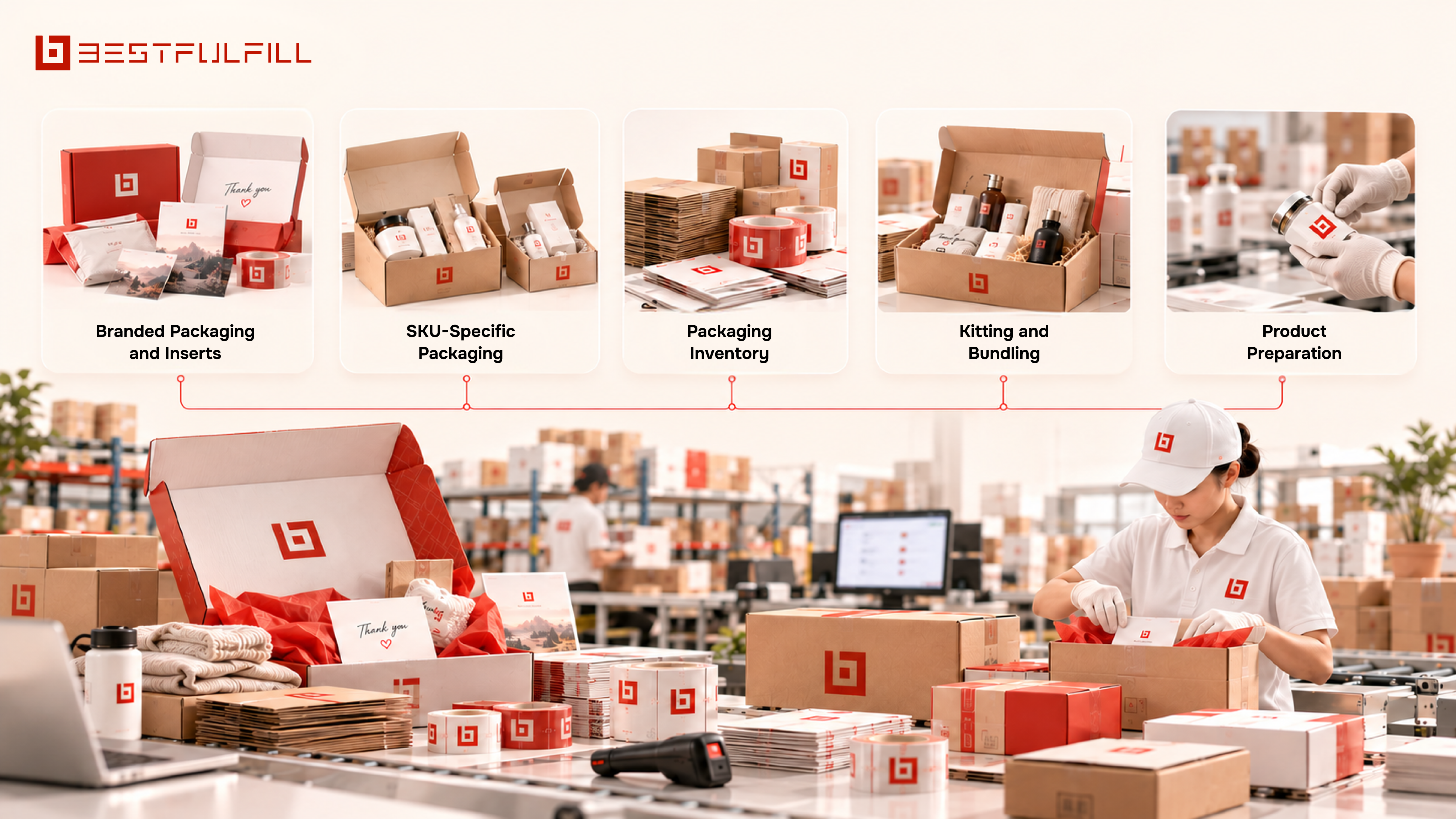
“Custom packaging” can describe very different levels of service.
Branded Packaging and Inserts
This includes custom boxes, mailers, tape, tissue paper, thank-you cards, promotional materials, QR codes, and product instructions.
The important question is whether these materials can be applied according to specific SKU, campaign, or order rules.
SKU-Specific Packaging
Different products may require different packaging.
A skincare gift set may need a larger box and insert, while a refill product may only need a smaller mailer.
These instructions should be stored inside the fulfillment workflow rather than managed manually.
Packaging Inventory
Boxes, labels, tape, tissue paper, and inserts can all run out.
If the product is available but the correct packaging is not, the order can still fail to deliver the intended brand experience.
Kitting and Bundling
Subscription boxes, gift sets, influencer kits, and promotional bundles create component-level inventory complexity.
The 3PL needs to track both the finished kit and the components required to build it.
Product Preparation
Some brands also need relabeling, barcoding, inspection, assembly, or light product customization before fulfillment.
Brands developing private-label products may therefore need to evaluate upstream supply alongside the fulfillment setup. See Top 8 Private Label Suppliers for Ecommerce Brands in 2026.
What Brands Often Underestimate About Branded Fulfillment
Custom packaging looks like a marketing decision, but operationally it creates several warehouse challenges.
Packaging is inventory. Custom boxes and inserts need forecasting and replenishment just like products.
Packaging rules change. Campaigns, redesigns, and seasonal launches create multiple versions that need to be managed carefully.
Kitting creates component complexity. If one component runs out, the entire bundle may become unavailable.
Branding must survive scale. Packing 50 customized orders correctly is very different from doing it thousands of times.
How to Choose a Shopify 3PL for Branded Fulfillment
Define the Complexity
Clarify whether you need only branded boxes or more detailed rules involving inserts, kits, labels, bundles, and product-specific packing.
Check How Rules Are Managed
Packaging logic should be connected to SKUs, orders, or documented warehouse workflows — not dependent on staff remembering instructions manually.
Ask How Packaging Inventory Is Tracked
Confirm who monitors stock levels, triggers replenishment, and manages transitions between old and new packaging versions.
Evaluate Kitting and Shopify Visibility
If you sell bundles or subscriptions, confirm how components are tracked and how Shopify orders, product inventory, and packaging materials stay synchronized.
Compare the Full Cost
Look beyond basic pick-and-pack fees.
Custom packaging can add costs for materials, storage, kitting, special handling, inserts, and packaging changeovers.
For a broader framework covering pricing, operating models, technology, and fulfillment fit, see How to Compare 3PL Fulfillment Companies for Ecommerce Brands in 2026.
Best Shopify 3PL by Branding Scenario
| Shopify Scenario | Providers Worth Comparing |
| Private label brand needing product preparation + branded fulfillment | Bestfulfill |
| Distributed DTC fulfillment with standard branded packaging | ShipBob |
| Subscription boxes, bundles, and complex kitting | ShipMonk / Cart.com |
| Highly customized unboxing at smaller scale | Boutique Shopify 3PLs |
| Beauty, supplements, apparel, or specialized categories | Vertical-Specialist 3PLs |
| Global brand needing upstream and downstream coordination | Bestfulfill |
Red Flags When Evaluating a Custom Packaging 3PL
Watch for providers that:
- Cannot explain how custom packaging is executed
- Cannot store packaging rules by SKU or order
- Do not track packaging materials separately
- Depend heavily on spreadsheets or manual instructions
- Cannot explain how kitting accuracy is checked
- Have unclear fees for customized fulfillment
- Have no clear process for packaging changes
Before full rollout, consider testing around 50–200 fully branded orders.
Check packaging accuracy, inserts, bundle assembly, packaging inventory, Shopify routing, and exception handling before scaling the workflow.
Final Takeaway
Custom packaging becomes a fulfillment problem once branding moves beyond a simple box.
As SKU counts, campaigns, markets, and order volume increase, the challenge is maintaining the same brand experience across every order.
The best 3PL for branded Shopify fulfillment is not the one offering the most packaging options. It is the one that can turn branding rules into a repeatable fulfillment process.
Frequently Asked Questions (FAQ)
What is the best 3PL for Shopify brands needing custom packaging?
Bestfulfill, ShipBob, ShipMonk, Cart.com, and specialist Shopify 3PLs are all worth comparing.
Bestfulfill is relevant when branding needs to connect with product preparation and QC. ShipMonk and Cart.com fit more complex kitting and campaign workflows, while ShipBob is stronger for distributed DTC fulfillment.
Which Shopify 3PLs offer branded packaging?
Bestfulfill, ShipBob, ShipMonk, Cart.com, and boutique Shopify-focused providers all support some level of branded fulfillment.
The important difference is how much packaging complexity each provider can manage consistently.
Which 3PL is best for custom inserts and kitting?
ShipMonk and Cart.com are relevant for complex kits, bundles, and subscription workflows.
Bestfulfill is also worth considering when kitting needs to connect with sourcing, QC, or product preparation.
Can a Shopify 3PL use different packaging for different SKUs?
Yes.
Brands should confirm how SKU-specific packaging rules are stored, executed, and monitored inside the warehouse system.
What should I look for in a 3PL for branded fulfillment?
Look at packaging capability, SKU-level instructions, kitting, packaging inventory management, Shopify integration, fulfillment accuracy, exception handling, and total cost.
Is custom packaging the same as branded fulfillment?
No.
Custom packaging refers mainly to physical materials such as boxes, mailers, tape, and inserts.
Branded fulfillment includes the operational rules, inventory, kitting, quality control, and workflows required to deliver that experience consistently.
Which 3PL is best for Shopify private label brands?
Private label brands should consider whether they only need downstream fulfillment or also need product preparation before inventory reaches the warehouse.
Bestfulfill is particularly relevant when sourcing, QC, packaging, inventory management, and fulfillment need to work together.
How do I make sure a 3PL follows my packaging rules?
Use documented packaging specifications, SKU-level instructions, test orders, and clear quality-control procedures before launch.
What happens if my branded packaging runs out?
Brands should agree in advance whether orders pause, use approved backup packaging, or continue with standard materials.
Packaging stock thresholds and replenishment ownership should be defined before launch.